

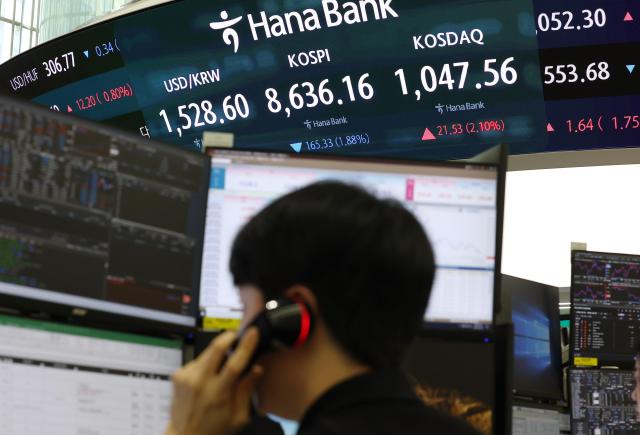
The won-dollar exchange rate has surpassed 1530 won for the first time in over two months. This increase is attributed to heightened military tensions between the U.S. and Iran, which have driven up international oil prices, along with the announcement of additional tariffs by the U.S. Concerns are growing that if the conflict in the Middle East continues, the upper limit of the exchange rate could rise further.
On June 4, the exchange rate closed at 1529.7 won, up 13.3 won from the previous trading day. It opened at 1530.0 won, marking the first time the rate has opened above 1530 since March 10, 2009, during the global financial crisis when it was at 1554.0 won. This is also the first time the rate has exceeded 1530 since March 31.
The exchange rate has remained in the 1500s for 13 consecutive trading days. Despite a strong warning from Bank of Korea Governor Rhee Hyun-sung during a press conference following a monetary policy meeting on May 28, stating, "We will respond firmly to any excessive fluctuations in the exchange rate," the upward trend has not abated.
Geopolitical instability in the Middle East continues to push the exchange rate higher. With U.S.-Iran ceasefire negotiations faltering, both sides have continued military actions, contributing to rising international oil prices.
Additionally, the U.S. Trade Representative announced on June 2 that a 12.5% additional tariff would be imposed on South Korea, leading to continued foreign selling in the domestic stock market and further weakening the won. As a result, foreign exchange reserves decreased by $8.8 billion to $426.99 billion at the end of last month.
Deputy Prime Minister and Minister of Economy and Finance Koo Yun-cheol held a market situation review meeting on the morning of June 4, stating, "In a situation of high external uncertainty, we are closely monitoring to prevent the spread of anxiety, and we will take immediate action if excessive fluctuations occur."
As the situation in the Middle East is expected to persist longer than anticipated, market analysts predict that the upper limit of the exchange rate may rise further. In particular, if the blockade of the Strait of Hormuz continues, there could be simultaneous increases in global oil inventory depletion and inflationary pressures. The upcoming U.S. Consumer Price Index (CPI) and Federal Open Market Committee (FOMC) results, scheduled for release next week, are also likely to exert upward pressure on the exchange rate.
Moon Da-woon, a researcher at Korea Investment & Securities, noted, "At the current level, it is difficult to gauge the next upper limit, as any level seems excessive. Given the high burden at this level, we expect to see government intervention concerns with dollar selling inflows, which will moderate the pace of increase."
Conversely, some analysts believe that if the Middle East risks subside, the exchange rate could stabilize. Park Sang-hyun, a researcher at iM Securities, stated, "With the easing of high oil price risks, improvements in domestic economic fundamentals, and an expanding current account surplus, the won is likely to strengthen in the second half of the year. If the Middle East risks are resolved, it could quickly drop below 1450 won."
* This article has been translated by AI.

Copyright ⓒ Aju Press All rights reserved.