

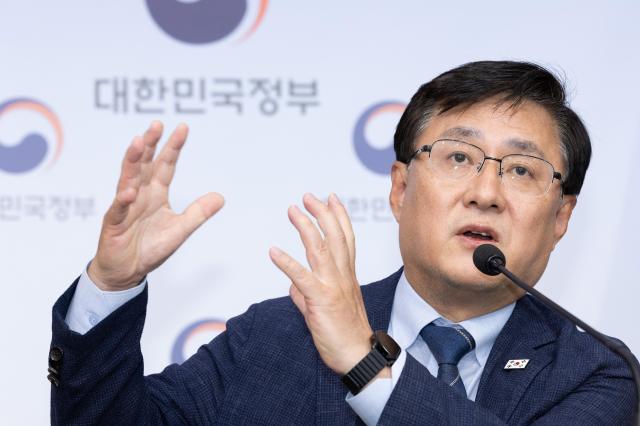
During a briefing with reporters at the Government Complex in Seoul, Kim explained that the threshold for Korea Electric Power Corporation (KEPCO) to turn to losses is an average wholesale electricity price (SMP) of 146 won, while the current SMP remains in the 120 won range.
He added, "KEPCO recorded a profit of 13 trillion won last year and a profit of 3 trillion won in the first quarter of this year, so there are currently no significant factors necessitating an increase in electricity rates."
However, he indicated that measures would be put in place to prepare for a prolonged surge in LNG prices. Kim emphasized the need to prevent a situation similar to the one during the Russia-Ukraine war, where some businesses profited excessively from rising gas prices, which ultimately burdened KEPCO with losses. He mentioned that various options, including price caps and settlement systems, are under internal review.
While ruling out an immediate rate increase, Kim noted that the restructuring of the electricity system would proceed swiftly. The ministry plans to initiate discussions on introducing regional electricity pricing in the second half of this year to promote balanced national development and decentralized power networks.
Kim pointed out that industrial electricity rates in South Korea are higher than those in countries like China and the United States, stating, "There is a need to stabilize industrial electricity rates in conjunction with national balanced development."
He also mentioned that the ministry is considering lowering rates for areas farther from the capital region through regional pricing. This plan will be shared with the public following consultations with relevant departments and a national forum.
Discussions on restructuring the five major power companies are also set to intensify. Kim noted that determining how to reorganize these companies in line with the goal of phasing out coal by 2040 is one of the key issues in the 12th Basic Plan for Electricity Supply and Demand. He revealed that a study on the potential integration of the five companies is underway, with preliminary results expected to be released this month.
He explained that the plan will include a roadmap for phasing out coal power plants, handling remaining facilities, transitioning to a bidirectional power grid, and expanding flexible power sources.
Regarding the direction of the energy mix, Kim stated, "We aim to phase out coal by 2040 while expanding renewable energy to 100 GW and maintaining nuclear power." He added that the adjustment of roles among renewable energy, nuclear, and gas will be a central topic in the 12th Basic Plan.
Kim expressed a commitment to establishing a new power system that utilizes both renewable energy and nuclear power while using gas as an emergency and flexible power source. He indicated that these issues would be discussed with the public in open forums.
Reflecting on the first anniversary of the ministry's establishment, Kim highlighted the synergy gained from the integration of departments. He noted that the consolidation of policy oversight and execution functions has accelerated the implementation of key policies, such as the expansion of renewable energy and the promotion of electric vehicles.
He acknowledged that while the public may not yet feel the impact, they will soon experience more tangible results from policies like community solar income starting in the second half of the year.
* This article has been translated by AI.

Copyright ⓒ Aju Press All rights reserved.