

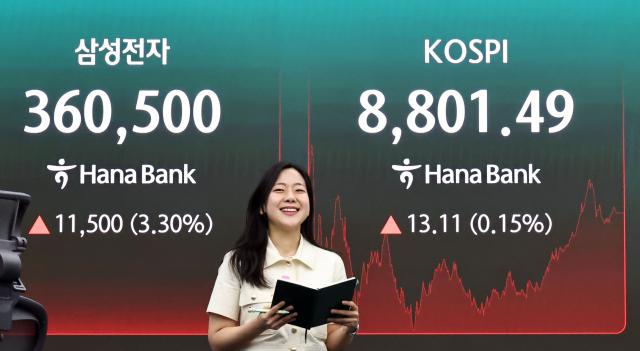
As the June 3 local elections conclude, financial markets are refocusing on interest rates, stock prices, and real estate fundamentals. With market variables that were overshadowed by political events now coming to the forefront, attention is turning to the direction of idle funds in circulation.
According to Hana Financial Research on June 4, funds flowing into asset management in the first quarter totaled 114.4 trillion won, significantly outpacing bank deposits, which saw an inflow of 21.1 trillion won—5.4 times less. The net inflow of funds surrounding the stock market, including investor deposits and comprehensive asset management accounts (CMA), also reached 31.8 trillion won, exceeding the net inflow of bank deposits. This surge in investment sentiment is attributed to the unprecedented rise in the KOSPI index.
If this trend continues throughout the year, the gap in net inflows between asset management and bank deposits could reach 360 trillion won. Typically, during election periods, investors tend to adopt a wait-and-see approach, favoring safe assets like deposits. However, with the stock market consistently reaching new highs in the first half of the year, there is potential for the increased liquidity in the market post-election to be absorbed by investment markets in the second half.
Experts believe that considering corporate earnings and fundamental strength, a KOSPI index of 10,000 is achievable. Korea Investment & Securities raised its forecast for the KOSPI's upper limit in the second half from 9,250 to 11,000, citing improved profit outlooks for semiconductor companies as a key factor.
The real estate market is also seen as another potential source of fund inflows in the second half. Signs of recovery in transactions, particularly in certain areas of Seoul, suggest that idle funds may flow into the real estate sector. There are expectations that investors looking to realize profits from the stock market or those with cash reserves may begin purchasing real estate.
However, the financial sector believes that the direction of fund flows in the second half will ultimately depend on interest rates. With the Bank of Korea expected to raise the benchmark interest rate at least twice in the second half, the attractiveness of deposits may increase again. Rising interest rates could weaken investors' appetite for riskier assets and keep market funds tied to safer investments.
As interest rates rise, the repayment burden for those engaged in leveraged investments will increase, and their capacity for new borrowing will inevitably diminish. The fixed-rate mortgage rates from the five major banks—KB Kookmin, Shinhan, Woori, Hana, and NH Nonghyup—have risen to between 4.34% and 7.32%, up from 4.26% to 7.10% at the end of last month. The market anticipates that loan rates could soon surpass 8%.
A financial sector official stated, "Typically, investor sentiment rebounds after elections, but in a rising interest rate environment, the pace of fund movement may be slower than expected. Ultimately, returns will determine the flow of liquidity."
* This article has been translated by AI.

Copyright ⓒ Aju Press All rights reserved.