

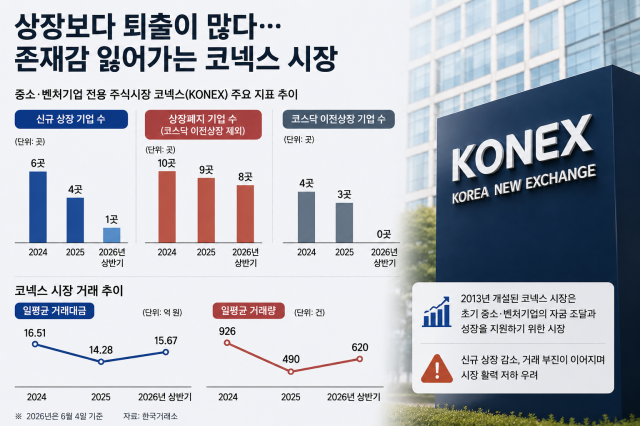
The KONEX market, dedicated to small and venture companies in South Korea, is entering its 14th year but has been losing vitality in recent years, with both new listings and trading activity declining. Notably, the number of companies delisted has surpassed new listings, raising concerns about its effectiveness as a growth platform for small businesses.
According to the Korea Exchange, only one company, S-Tech M, has gone public on KONEX this year, having listed in April. This follows six new listings in 2024 and four in 2025, highlighting a significant drop in activity as the first half of this year concludes.
In contrast, the number of delisted companies has increased, with 10 in 2024 and nine in 2025, excluding those that moved to KOSDAQ. This year, eight companies, including relatively recent listings like AMC and Pangs Sky, have exited the market. The ongoing trend of more companies leaving than entering has contributed to a decrease in the total number of listed firms. Additionally, there have been no transfers from KONEX to KOSDAQ this year, following four in 2024 and three in 2025.
Trading activity has also been sluggish. The average daily trading volume in the KONEX market has steadily declined over the past three years, dropping from 1.936 billion won to 1.651 billion won and then to 1.428 billion won. Although trading volume saw a slight recovery this year to around 620 transactions per day, it remains low compared to previous years, down from an average of 926 transactions in 2024 and 490 in 2025.
KONEX was established in 2013 to support funding and growth for early-stage small and venture companies, aiming to serve as a 'growth ladder' for firms transitioning to KOSDAQ. However, the expansion of direct pathways to KOSDAQ, such as technology-based and growth-based listings, has diminished the necessity for KONEX listings.
Concerns have also arisen regarding the government's recent proposal to restructure the KOSDAQ market into first and second tiers, which could further limit KONEX's relevance. An industry insider noted, "If the KOSDAQ tier system is implemented, the rationale for KONEX as an intermediate market may become even less clear."
In response, measures are being introduced to enhance liquidity in the KONEX market. The KONEX Association will support some listing costs, including external auditor fees and advisory fees, up to a total of 1 billion won, to incentivize new listings from this month until the end of the year.
The exchange is also working on regulatory improvements. On June 2, it announced plans to increase the stock distribution obligation for KONEX-listed companies from the current 5% to a maximum of 15%. Additionally, designated advisors will be granted priority negotiation rights for facilitating transfers to KOSDAQ, as part of the proposed amendments to the KONEX market listing regulations and implementation guidelines. The exchange aims to boost market liquidity and enhance incentives for KONEX listings.
* This article has been translated by AI.

Copyright ⓒ Aju Press All rights reserved.