

Labor representatives argue that the changing realities of the labor market necessitate broader protections, while business groups firmly oppose any changes, claiming they fall outside the commission's authority.
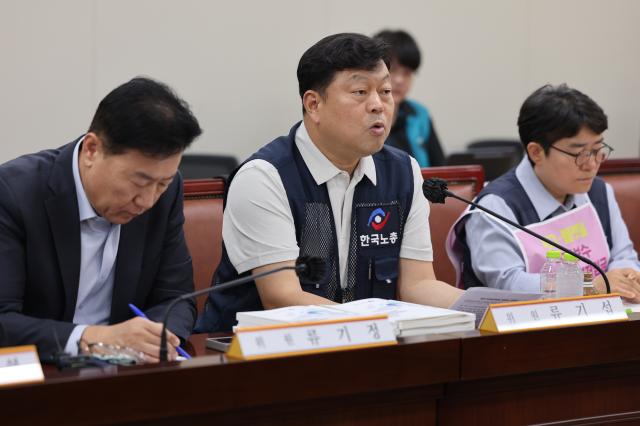
On June 4, the Minimum Wage Commission convened its third plenary meeting at the Government Sejong Center to discuss the application of minimum wage standards for contract workers.
This discussion was prompted by a request from Minister of Employment and Labor Kim Young-hoon, who asked the commission to consider whether it is appropriate to set a separate minimum wage for contract workers or those receiving wages in similar forms, acknowledging that traditional hourly, daily, weekly, or monthly wage structures may not apply.
Many delivery riders and drivers, often contracted as individual business owners, frequently find themselves excluded from the current minimum wage system. Labor advocates argue that the existing minimum wage framework, which primarily focuses on wage employees, fails to adequately protect low-wage workers in the evolving labor market.
Ryu Gi-seop, Secretary General of the Korean Confederation of Trade Unions, stated, "Currently, nearly 9 million contract workers play a crucial role in the labor market. Expanding minimum wage coverage for these workers is a necessary measure to protect them in low-wage sectors."
Lee Mi-sun, Deputy Chair of the Korean Confederation of Trade Unions, emphasized, "Ensuring minimum wage for 8.7 million special employment and platform workers is an urgent task. Even when recognized as workers by the courts, they often lack proper wage calculation standards, leading to repeated instances of inadequate protection."
Conversely, business representatives argue that expanding the minimum wage coverage could complicate the implementation of the system itself.
Ryu Gi-jeong, Executive Director of the Korea Employers Federation, remarked, "Minimum wage is a system aimed at workers defined under the Labor Standards Act. Determining worker status is not something the Minimum Wage Commission can decide."
He also highlighted the challenges in applying uniform standards to contract workers, given the variability in workload, travel distance, and contract methods.
Yang Ok-seok, Head of the Human Resources Policy Department at the Korea Federation of Small and Medium Enterprises, expressed concern, stating, "There is insufficient objective verification and data on the impact of applying different minimum wage standards to various types of contract work. Overzealous application could undermine the flexibility of contract work and lead to job losses."
The outcome of the Minimum Wage Commission's discussions will determine whether the minimum wage system will expand from its traditional focus on wage employees to encompass new forms of employment. However, significant differences in positions between labor and management regarding the scope of application, criteria for determining worker status, and industry-specific wage calculation methods suggest that the path to actual implementation may be fraught with challenges.
* This article has been translated by AI.

Copyright ⓒ Aju Press All rights reserved.