

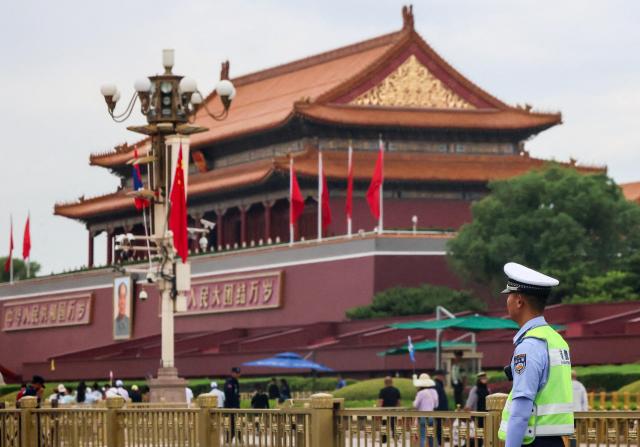
According to reports from Reuters on June 3, Rubio issued a statement titled "37th Anniversary of the Tiananmen Square Massacre," reminding the world that it has been 37 years since the Chinese Communist Party ordered the military to attack thousands of peaceful protesters in and around Tiananmen Square on June 4.
He stated, "The students, workers, and citizens who lost their lives gathered to exercise their inherent rights and demand democratic reforms and accountability for corruption. We remember their lives and honor their legacy." He emphasized that no amount of censorship can erase the past, asserting that the legitimacy of those who sacrificed to defend the inalienable rights of free expression and peaceful assembly will eventually be proven.
AFP noted that Rubio's statement came less than three weeks after President Donald Trump met with Chinese President Xi Jinping in Beijing, where they agreed on an unstable trade truce, amid a slight easing of tensions compared to the previous year.
China responded swiftly. Foreign Ministry spokesperson Mao Ning stated during a regular briefing on June 4 that, "The U.S. has distorted historical facts, slandered China's political system and development path, and interfered in China's internal affairs. China expresses strong dissatisfaction and resolute opposition."
Mao claimed that the Chinese government has long reached a clear conclusion regarding the political turmoil of the late 1980s, asserting that the path of socialism with Chinese characteristics is a choice made by history and the people, receiving heartfelt support from the entire Chinese populace and sufficient recognition from the international community. He urged the U.S. to fulfill its promise to respect China and its people through concrete actions and to stop promoting ideological confrontation, as well as to cease interfering in China's internal affairs under the pretext of so-called "democracy and human rights."
China Blocks Tiananmen Memorials
Memorials and controls surrounding the Tiananmen incident continue. According to ABC News, Chinese police informed the families of Tiananmen victims that they would not be allowed to visit a cemetery in Beijing on the anniversary. Amnesty International noted that families have been reading commemorative statements at the cemetery under police surveillance for over 30 years on this date.
In Hong Kong, memorial events have virtually disappeared. ABC News reported that on June 4, Hong Kong police heightened security in and around the park where large candlelight vigils were previously held, detaining performance artists attempting symbolic actions the day before the anniversary.
Since 2020, Hong Kong authorities have banned candlelight vigils citing COVID-19, and large memorial events have not occurred since the implementation of the national security law, which led to the prosecution of organizers.
In mainland China, any mention of the June 4 Tiananmen incident is strictly taboo. The largest memorial events, once held in Hong Kong, have been suppressed by authorities, leading to commemorations primarily taking place in cities abroad, including London, New York, Berlin, and Taipei.
Meanwhile, amid the 37th anniversary of the Tiananmen incident, tensions between China and the West have extended to security and Taiwan issues. The Five Eyes intelligence alliance warned that Chinese military intelligence is attempting to recruit current and former officials, military personnel, and journalists through online job platforms to extract confidential information. China dismissed this as "entirely fabricated malicious slander."
Conflicts also arose over Taiwan. China recently imposed a one-year ban on entry to mainland China, Hong Kong, and Macau for four New Zealand lawmakers who visited Taiwan, claiming they violated the "One China" principle and warning that crossing the red line on Taiwan issues would have consequences. In response, New Zealand and Taiwan asserted that parliamentary exchanges are a normal part of diplomatic relations.
* This article has been translated by AI.

Copyright ⓒ Aju Press All rights reserved.