

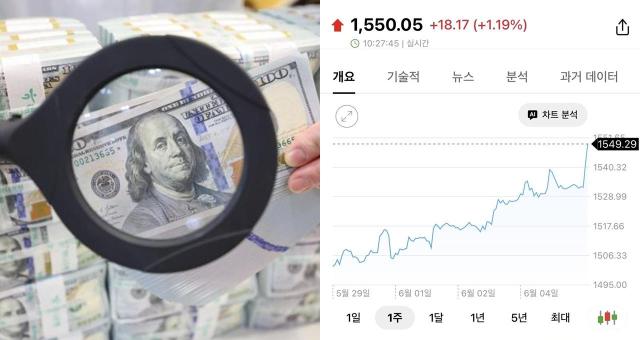
The exchange rate of the Korean won against the U.S. dollar has surpassed 1550 won, reaching its highest level since the global financial crisis. This surge has heightened market anxiety, with some online commentators suggesting that the government may have relaxed its currency management after the recent elections.
In the Seoul foreign exchange market, the won-dollar rate exceeded 1550 during trading, marking the highest level since 2009, during the global financial crisis. Analysts attribute the decline in investor sentiment towards the won to a combination of prolonged conflict, rising oil prices, and foreign capital outflows.
There are claims that the foreign exchange authorities suppressed the exchange rate through large-scale dollar sales throughout May. However, no official evidence has been presented to confirm that the government manipulated the exchange rate for electoral purposes. The foreign exchange authorities typically implement market stabilization measures during periods of rapid currency fluctuations and have recently stated that they will take necessary actions against excessive market imbalances.
Market experts suggest that the current surge in the exchange rate is more influenced by global dollar strength and escalating geopolitical risks than by domestic factors. Korea Investment & Securities noted in a recent report that factors contributing to the won's weakness, such as prolonged conflict, foreign selling, and tariff risks, continue to accumulate, making it difficult to predict the upper limit of the exchange rate.
Ultimately, it is challenging to attribute the current spike in the exchange rate solely to the conclusion of the elections. However, market participants are closely monitoring the potential for further intervention by foreign exchange authorities, developments in the Middle East, and changes in U.S. monetary policy as key variables that will determine the future direction of the won.
* This article has been translated by AI.

Copyright ⓒ Aju Press All rights reserved.