

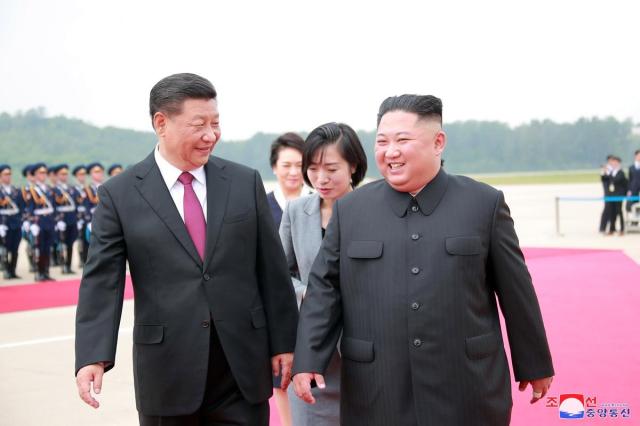
Chinese President Xi Jinping will make a state visit to North Korea on June 8-9, marking his first trip to the country in seven years and his second since Kim Jong Un took power.
This visit comes amid escalating U.S.-China strategic competition and closer ties between North Korea and Russia. Analysts view it as a reaffirmation of the traditional friendship between China and North Korea, while also showcasing China's role as a key player in addressing issues on the Korean Peninsula.
According to Yonhap News on June 5, the International Liaison Department of the Chinese Communist Party announced that Xi is visiting at the invitation of Kim. North Korea's state media, KCNA, reported the same. This meeting will occur about nine months after the two leaders last met during the 80th anniversary celebrations of China's victory in the war against Japan in Beijing last September.
The visit coincides with the 65th anniversary of the China-North Korea Mutual Aid and Cooperation Treaty. Historically, both nations have used significant anniversaries to highlight their relationship, and this summit is expected to serve as a platform to reinforce their traditional alliance and strategic cooperation.
Notably, this is Xi's first overseas trip of the year, which underscores the strategic importance of China-North Korea relations in his foreign policy. After refraining from international travel since attending the APEC summit in South Korea last year, Xi's choice of North Korea as his first destination signals the significance of this relationship in China's diplomatic agenda.
This year, Xi has held meetings with South Korean President Lee Jae-myung, U.S. President Donald Trump, and Russian President Vladimir Putin. By meeting with Kim, he will have engaged with all major stakeholders concerning the Korean Peninsula. This has led to interpretations that China is positioning itself as a mediator in the region, seeking to expand its diplomatic influence.
The situation on the Korean Peninsula has changed significantly since 2019. North Korea is now solidifying its status as a nuclear power, rejecting denuclearization. On June 4, KCNA reported that Kim inspected a new nuclear material production facility and held important discussions to strengthen the country's nuclear capabilities.
This activity, revealed just before Xi's visit, is seen as a reaffirmation of North Korea's commitment to maintaining its nuclear status.
While China officially upholds the principle of denuclearization on the Korean Peninsula, it has recently shifted its focus toward easing sanctions and expanding economic cooperation with North Korea. During last month's U.S.-China summit, denuclearization was mentioned as a common goal, but a joint statement from the China-Russia summit emphasized opposition to sanctions against North Korea instead.
Experts believe that economic cooperation will be a key agenda item during the upcoming summit, alongside nuclear issues. There is a strong possibility that discussions will include the expansion of trade between China and North Korea, as well as cooperation in tourism, railways, healthcare, and Chinese investment in North Korea.
Some analysts suggest that this visit could symbolize a strategic collaboration among North Korea, China, and Russia in opposition to a U.S.-centric international order. With military cooperation between North Korea and Russia strengthening, China may be looking to recalibrate its relationship with North Korea and actively reshape the Northeast Asian order.
Ultimately, Xi's visit to Pyongyang carries implications beyond a mere friendly gesture. It is expected to serve as a diplomatic stage where China seeks to assert its influence and secure a leading role in addressing the complex issues surrounding North Korea's nuclear ambitions, sanctions, and the broader geopolitical dynamics involving the U.S. and Russia.
* This article has been translated by AI.

Copyright ⓒ Aju Press All rights reserved.