

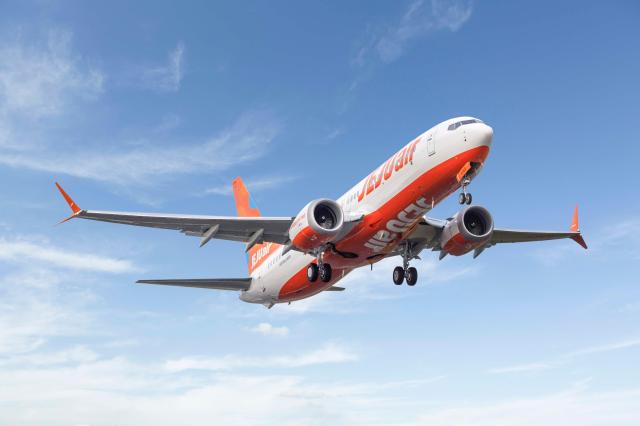
Jeju Air, South Korea's low-cost carrier (LCC), marked its 20th anniversary on June 5. The airline has been credited with popularizing air travel in the country by maintaining cost competitiveness and operational efficiency through its single aircraft type strategy.
Jeju Air began operations on June 5, 2006, with flights between Gimpo and Jeju. It quickly expanded to include routes from Gimpo to Busan and from Busan to Jeju, establishing itself in the domestic LCC market.
In 2009, the airline entered the international market by launching flights from Incheon to Osaka, subsequently expanding its routes to Japan, China, and Southeast Asia.
The airline's passenger transport numbers have steadily increased. From 2006 to 2025, Jeju Air recorded an average annual passenger growth rate of 22.7%. It has maintained the top position in annual passenger numbers among domestic LCCs for 20 consecutive years.
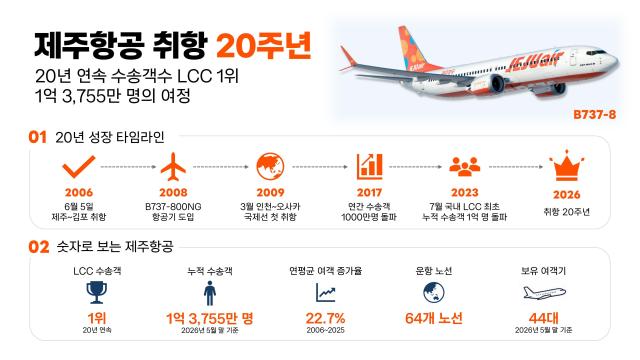
In its first year, Jeju Air transported 250,000 passengers, surpassing 10 million in 2017. By July 2023, it became the first domestic LCC to exceed a cumulative total of 100 million passengers, reaching 137.55 million by the end of last month.
The airline's growth is attributed to its single aircraft type strategy. Since introducing the Boeing 737-800NG in 2008, Jeju Air has maintained a uniform fleet.
Recently, it has accelerated the modernization of its fleet by expanding the introduction of the next-generation Boeing 737-8, aiming to enhance cost competitiveness through more fuel-efficient aircraft.
Currently, Jeju Air operates 44 passenger aircraft. From 2023 to May, it acquired 12 Boeing 737-8s while also retiring and selling older aircraft.
The airline is also focused on optimizing route operations, implementing a flexible route strategy that adapts to demand changes, particularly for medium- and short-haul flights to Japan, China, and Southeast Asia.
A Jeju Air official stated, "Over the past 20 years, we have grown by securing cost competitiveness and operational efficiency based on our single aircraft type operation."
Meanwhile, Jeju Air continues to perform well despite challenges in the aviation industry due to global oil prices. According to the Ministry of Land, Infrastructure and Transport's aviation information portal, Jeju Air transported 1,127,370 passengers in April, a 20.3% increase from 936,899 during the same period last year. The overall load factor was 91.9%, 2.4 percentage points higher than the average load factor of 89.5% for LCCs.
* This article has been translated by AI.

Copyright ⓒ Aju Press All rights reserved.