

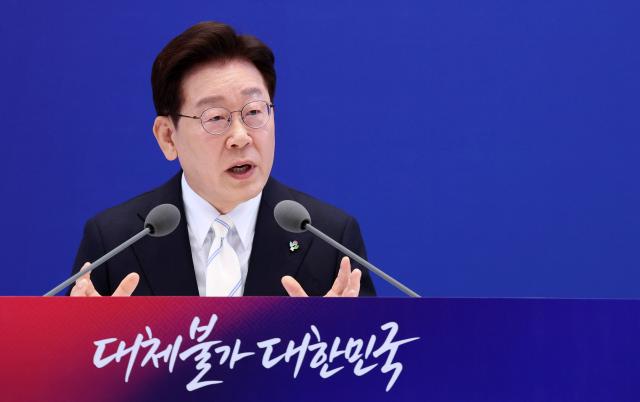
President Lee Jae-myung emphasized on June 8 that the goal of denuclearization must not be abandoned, stating that negotiations should aim to halt North Korea's production of nuclear materials and the development of intercontinental ballistic missile (ICBM) technology in the short term.
During a press conference at the Blue House to mark his first year in office, President Lee asserted that while long-term denuclearization is essential, it is crucial to set realistic short-, medium-, and long-term goals for dialogue.
He noted, "We are imposing sanctions to the fullest extent possible, but it is uncertain whether the door to China is firmly closed to North Korea's evasion of sanctions, while the door to Russia remains wide open. Therefore, despite our pressure, they find ways to escape. This is a regrettable reality."
President Lee pointed out that North Korea is currently capable of producing 10 to 20 nuclear weapons annually and is continuously improving its ICBM technology, nearing its final stages of development.
He warned that maintaining the status quo would only exacerbate the situation, stating, "Halting this situation would benefit both the Korean Peninsula and the international community."
Regarding security on the Korean Peninsula, he remarked, "We cannot pursue nuclear armament. If we do, will Japan and Taiwan remain passive? The entire region would become nuclear-armed, leading to severe international sanctions that South Korea, with its high dependence on foreign trade, cannot withstand. Calls for nuclear armament are truly irresponsible."
On international security, he analyzed that if North Korea's nuclear weapons or missile technology exceed what is necessary for regime preservation, they may be exported, posing a significant risk. "Preventing this alone would benefit the international community," he added.
President Lee reiterated that the immediate goals for negotiations should include halting the production of additional nuclear materials, preventing the export of nuclear materials, and stopping ICBM technology development. He stated, "If we are questioned about why we abandoned denuclearization, it would only lead to a worse situation by ignoring reality." He mentioned that he has communicated this to U.S. President Donald Trump on two occasions and continues to discuss it with other leaders.
In response to a question about the Korea-Japan Mutual Military Support Agreement (ACSA), President Lee described the military cooperation between South Korea, the U.S., and Japan as unique. He expressed that security issues in Northeast Asia should be approached through a complex multilateral security framework, but acknowledged the current confrontational atmosphere necessitates caution. ACSA refers to an agreement between nations to share military supplies such as ammunition, fuel, and food in times of crisis.
Regarding the recent incident involving the South Korean vessel Namuho being struck by an Iranian missile in the Strait of Hormuz, President Lee stated, "It is clear that this was not an intentional act. If it were, they would have claimed responsibility. While there are various factors, we assess it as an Iranian missile, and we have lodged a strong protest and demanded measures to prevent recurrence."
During a press conference at the Blue House to mark his first year in office, President Lee asserted that while long-term denuclearization is essential, it is crucial to set realistic short-, medium-, and long-term goals for dialogue.
He noted, "We are imposing sanctions to the fullest extent possible, but it is uncertain whether the door to China is firmly closed to North Korea's evasion of sanctions, while the door to Russia remains wide open. Therefore, despite our pressure, they find ways to escape. This is a regrettable reality."
President Lee pointed out that North Korea is currently capable of producing 10 to 20 nuclear weapons annually and is continuously improving its ICBM technology, nearing its final stages of development.
He warned that maintaining the status quo would only exacerbate the situation, stating, "Halting this situation would benefit both the Korean Peninsula and the international community."
Regarding security on the Korean Peninsula, he remarked, "We cannot pursue nuclear armament. If we do, will Japan and Taiwan remain passive? The entire region would become nuclear-armed, leading to severe international sanctions that South Korea, with its high dependence on foreign trade, cannot withstand. Calls for nuclear armament are truly irresponsible."
On international security, he analyzed that if North Korea's nuclear weapons or missile technology exceed what is necessary for regime preservation, they may be exported, posing a significant risk. "Preventing this alone would benefit the international community," he added.
President Lee reiterated that the immediate goals for negotiations should include halting the production of additional nuclear materials, preventing the export of nuclear materials, and stopping ICBM technology development. He stated, "If we are questioned about why we abandoned denuclearization, it would only lead to a worse situation by ignoring reality." He mentioned that he has communicated this to U.S. President Donald Trump on two occasions and continues to discuss it with other leaders.
In response to a question about the Korea-Japan Mutual Military Support Agreement (ACSA), President Lee described the military cooperation between South Korea, the U.S., and Japan as unique. He expressed that security issues in Northeast Asia should be approached through a complex multilateral security framework, but acknowledged the current confrontational atmosphere necessitates caution. ACSA refers to an agreement between nations to share military supplies such as ammunition, fuel, and food in times of crisis.
Regarding the recent incident involving the South Korean vessel Namuho being struck by an Iranian missile in the Strait of Hormuz, President Lee stated, "It is clear that this was not an intentional act. If it were, they would have claimed responsibility. While there are various factors, we assess it as an Iranian missile, and we have lodged a strong protest and demanded measures to prevent recurrence."
* This article has been translated by AI.

Copyright ⓒ Aju Press All rights reserved.