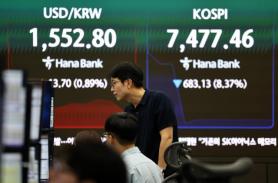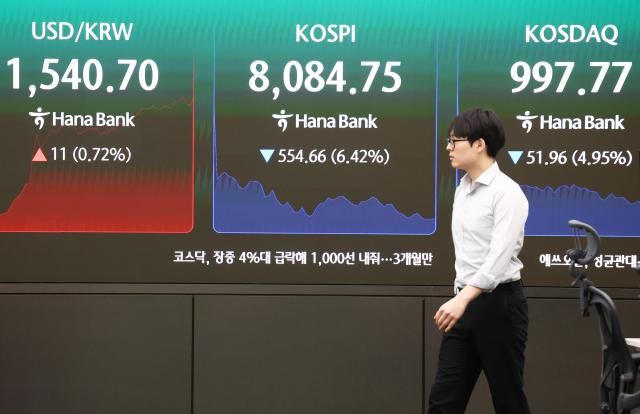
In Seoul, the won closed at 1,548.2 per dollar after opening at 1,555.2 and briefly rising to 1,560 before reversing sharply in morning trade.
The turnaround was largely attributed to policy intervention. Yun Kyung-soo, director general of the international department at the Bank of Korea (BOK), and Lee Hyung-ryul, director general of the international finance bureau at the Ministry of Economy and Finance, issued a joint statement, warning that authorities will "never tolerate excessive volatility and one-way herd behavior decoupled from economic fundamentals and will respond strongly."
The statement followed two emergency meetings held on last Thursday and Sunday by top economic and financial policymakers including Deputy Prime Minister and Minister of Economy and Finance Koo Yun-cheol and BOK governor Shin Hyun-song.
The Sunday meeting marked the first weekend market-monitoring meeting in about a year and a half since Dec. 8, 2024, when authorities met in the aftermath of disgraced ex-President Yoon Suk Yeol's botched martial law debacle.
The unusually strong warning appeared to gain traction after earlier verbal interventions failed to calm the volatile currency market.
Market participants also raised the possibility that authorities may have supplied dollar liquidity through smoothing operations, noting that the exchange rate had already started to retreat from its intraday high about an hour before the official statement was released.
"Direct smoothing operations cannot be officially confirmed, but we are seeing tangible moves to cushion the won," an FX trader said on condition of anonymity.
Despite the won's recovery, the bond market extended its selloff, as investors grew more convinced that persistent currency pressure could force BOK to keep a hawkish policy stance.
The debt market came under heavier pressure as the benchmark three-year government bond yield rose 5.8 basis points to 3.940 percent, while the 10-year yield jumped 9.4 basis points to 4.348 percent, with both reaching their highest levels in about two years and seven months since November 2023.
The bond selloff deepened as investors interpreted the authorities' defense of the won as a sign that currency weakness has become a more urgent policy concern. That added to expectations that the BOK will maintain a hawkish stance, or even raise rates, if exchange-rate volatility continues to threaten inflation and financial stability.
Analysts said downward pressure on bond prices is likely to persist until the market sees a clearer policy response from the central bank.
"Expectations that the BOK will raise the benchmark rate to around 3 percent, or possibly as high as 3.25 percent this year, are now being treated almost as a foregone conclusion," said Park Ju-noo, an analyst at Hana Securities.
"Investors need to prepare for a scenario in which the three-year yield breaks above the 4 percent threshold."

Copyright ⓒ Aju Press All rights reserved.