

◆Renewed Discussion on Retirement Age Extension...Disagreements on Continued Employment Model
According to government and political sources on June 8, the National Assembly is expected to discuss major labor policy issues in the second half of the year, including extending the retirement age to 65, the Basic Law for Workers aimed at protecting platform workers, the Worker Presumption System, and reforms to the retirement pension system.
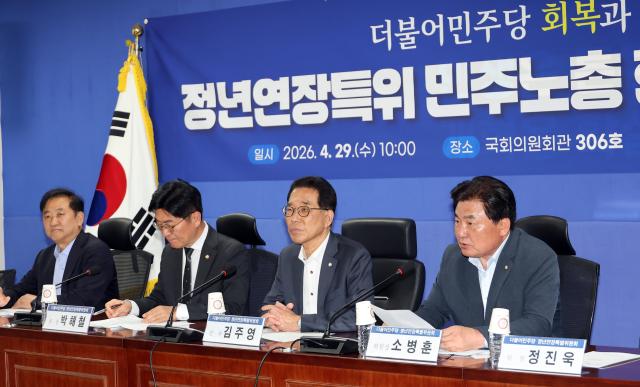
The most pressing issue is the retirement age extension. The Democratic Party's Special Committee on Retirement Age Extension is working on final recommendations ahead of its activities concluding at the end of this month. Once the National Assembly's new session is organized, discussions on related bills are expected to accelerate.
The retirement age extension has been a persistent topic aimed at bridging the gap between the legal retirement age and the age at which individuals can start receiving national pension benefits. Currently, the legal retirement age is 60, while the pension eligibility age is set to gradually rise to 65 by 2033, potentially creating a gap of up to five years without income.
Labor groups strongly advocate for the need for legislation to extend the retirement age. A recent public opinion survey conducted by the Korean Confederation of Trade Unions found that 88.3% of respondents support extending the legal retirement age to 65. Labor unions plan to increase pressure on the government and the National Assembly to advance related legislation in the upcoming session.
Conversely, the business sector expresses concerns about rising labor costs and potential impacts on youth employment, calling for a cautious approach.
The method of extending the retirement age itself is also a contentious issue. The business sector favors a continued employment model that involves terminating existing contracts and creating new ones, as this allows for easier wage adjustments. In contrast, labor groups oppose any retirement age extension that is predicated on wage reductions.
The Ministry of Employment and Labor emphasizes the need for discussions through social dialogue. Minister Kim Young-hoon stated in a recent press briefing, "The discussion on retirement age extension is a well-matured agenda," adding that efforts will be made to persuade stakeholders to aim for passage during the regular session.
◆Reviving the Basic Law for Workers and Worker Presumption System...Platform Worker Protections at Stake
Legislation aimed at protecting platform workers is also expected to be revisited. The Ministry of Employment and Labor's initiatives for the Worker Presumption System and the Basic Law for Workers were initially targeted for passage before Labor Day but faced delays due to opposition from small business groups and the business sector.
The Worker Presumption System aims to classify platform workers who meet certain criteria as employees, thereby expanding the application of labor laws. This initiative is driven by the rapid increase in special employment and platform workers. The current Labor Standards Act defines workers as those who provide labor for wages, leaving many, such as delivery drivers and private tutors, without legal protections. The number of workers not covered by labor laws has risen from 6.69 million in 2019 to an estimated 8.69 million in 2024.
The accompanying Basic Law for Workers seeks to establish a framework for guaranteeing basic rights for various labor providers, including platform workers and freelancers.
However, the business sector opposes this legislation, citing increased burdens on companies, while labor groups argue that the protections offered are too limited and call for enhancements. Both sides express negative views toward the current government proposal, suggesting that modifications may be necessary during the legislative process.
Additionally, discussions on reforms to the retirement pension system, changes to the employment insurance system, and expanding unemployment benefits for voluntarily leaving workers are also expected to be key labor policy issues in the second half of the year.
Given that many of the labor legislative issues in the upcoming session involve sharply conflicting interests between labor and management, there are calls for social consensus to precede these discussions. National research institutions, including the Korea Labor Institute, have recommended that social dialogue and consultations among stakeholders are crucial for resolving labor market issues.
* This article has been translated by AI.

Copyright ⓒ Aju Press All rights reserved.