

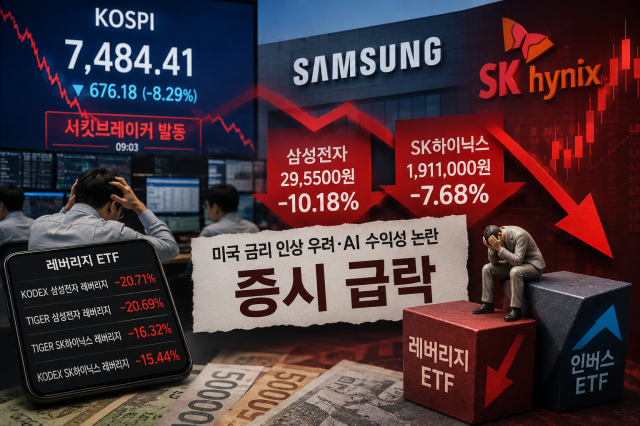
The Korean stock market experienced heightened volatility due to concerns over U.S. interest rate hikes and a sharp decline in global tech stocks. Individual investors, who had heavily invested in single-stock leveraged ETFs for Samsung Electronics and SK Hynix, now face significant risks of valuation losses as leading stocks plummet. Amid rising warnings of overheating in the market, concerns about the concentration of investments in the domestic stock market are also growing.
On June 8, the KOSPI index opened at 8,048.09, down 112.50 points (1.38%) from the previous trading day, and the decline accelerated, triggering a circuit breaker at 9:03 a.m. The index fell as low as 7,442.73, prompting a sell-side circuit breaker, and ultimately closed at 7,484.41, down 676.18 points (8.29%). The KOSPI index, which closed at 8,801.49 on June 2, has dropped 15% in just three trading days.
The decline follows strong U.S. employment data in May, raising concerns about the Federal Reserve's tightening measures, coupled with news of capital increases being considered by hyperscalers, igniting debates over AI profitability. Major players Samsung Electronics and SK Hynix were hit hard, with Samsung's stock falling 10.18% to 295,500 won and SK Hynix dropping 7.68% to 1,911,000 won.
Particularly affected were the single-stock leveraged ETFs that attracted individual investors. On this day, trading volume for 16 leveraged and inverse ETFs related to Samsung and SK Hynix reached 8.2 trillion won.
Since the listing of related products on May 27, the cumulative trading volume for 14 types of long-direction leveraged ETFs reached 58 trillion won, with individual net purchases amounting to 7.4 trillion won over just seven trading days until June 5. During the same period, approximately 79% of the total individual net purchases (7.7 trillion won) in domestic equity ETFs were concentrated in semiconductor-related products, intensifying the concentration phenomenon.
As the underlying assets plummeted, leveraged ETFs also experienced significant declines. The KODEX Samsung Electronics single-stock leveraged ETF fell by 20.71%, while the TIGER Samsung Electronics single-stock leveraged ETF dropped by 20.69%. The SK Hynix leveraged ETF also fell by 15% to 17%. In contrast, inverse products recorded double-digit gains.
While the exact scale of individual investor losses has not been quantified, industry experts believe that a significant number of investors have likely entered the valuation loss zone.
Historically, individual investors have shown a tendency to actively buy leveraged products during stock price declines. KB Securities analyst Park Yoo-an noted, "In the domestic leveraged ETF market, the correlation between individual supply and demand and daily returns is low, indicating that buying pressure tends to concentrate during downturns."
Opinions on the market outlook are divided. Bloomberg reported that global investors are shifting from optimism to caution regarding the Korean stock market. Some foreign investment institutions are reducing their exposure to AI-related stocks or increasing their hedging strategies, while European financial firm Optiver has warned that the proliferation of single-stock leveraged products could increase market volatility.
Conversely, domestic securities firms view the recent decline as a process of correcting overheating rather than a trend reversal. Samsung Securities analyst Jo A-in stated, "This adjustment is more about normalizing excessive positioning than damaging the AI semiconductor outlook, and the earnings estimates for domestic companies remain on an upward trajectory, making the valuation attractiveness of the Korean stock market even higher due to this decline." He suggested that rather than rushing into aggressive buying, a strategy of gradually increasing exposure to AI-leading stocks by leveraging upcoming major events this week would be effective.
However, with the U.S. Consumer Price Index (CPI) announcement and simultaneous expiration of futures and options scheduled for this week, short-term volatility is expected to continue.
Daishin Securities analyst Lee Kyung-min advised, "The excessive concentration of leading stocks has accumulated, and while it is necessary to consider the possibility of the KOSPI dropping to the low 7,000s or temporarily falling below that level, there is no need to hastily sell leading stocks."
* This article has been translated by AI.

Copyright ⓒ Aju Press All rights reserved.