

The Korea Maritime Promotion Corporation (KMP) released its "2025 Ship Financing Status" report, detailing the funding status and investment trends of major national shipping companies.
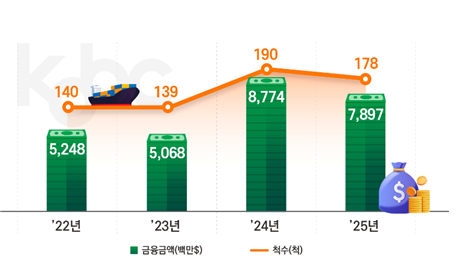
In the past year, the amount of new funding raised by these companies for ship acquisitions declined. The total executed ship financing for 1,041 vessels fell by 11.2% year-on-year to $7.89 billion. Meanwhile, the cumulative balance of outstanding ship financing, which has not been repaid, rose to approximately $27.3 billion, a 12.1% increase from the previous year.
The significant increase in the financing balance at the end of last year is attributed to the sequential delivery of large project vessels, such as the K-3 Qatar liquefied natural gas (LNG) carriers.
Foreign financial institutions dominate the domestic ship financing market, accounting for 66% of the total. Their financing execution increased by 3 percentage points compared to the previous year.
The proportion of policy financing reached its lowest level since 2022 at 27%, while private financing showed signs of recovery, recording a rate in the 7% range. A KMP official stated, "We have established a stable financing environment through continuous guarantees between shipping companies and private finance, resulting in increased private capital inflow into the shipping industry."
Last year, the ship financing market was primarily focused on second-hand vessels, with 74% of the total investment directed toward used ships. Among vessel types, bulk carriers accounted for the largest share at 36%, followed by tankers at 31%.
Over the past three years, investments in container ships and LNG carriers have primarily focused on new builds, while bulk carriers and tankers have seen a higher proportion of investment in used vessels.
An Byeong-gil, president of KMP, expressed hope that the ship financing statistics, created with the active cooperation of national shipping companies, will provide practical assistance to government policies, national shipping companies, industrial strategies, and private investments.
* This article has been translated by AI.

Copyright ⓒ Aju Press All rights reserved.