


The real estate market is difficult to read, and so is the path to homeownership. The government's policies are equally challenging. This is where the 'difficult' view of real estate begins.
The ruling party won most of the regional leadership positions in the June 3 local elections but lost in Seoul. The margin of defeat was narrow, but the significance lies in the distribution of votes. Candidate Jeong Won-o lost significantly in four districts, including Gangnam's three areas and Yongsan, which overshadowed his victories in the rest of the city. Despite winning in most of Seoul, he effectively surrendered all victories in the four districts in the south.
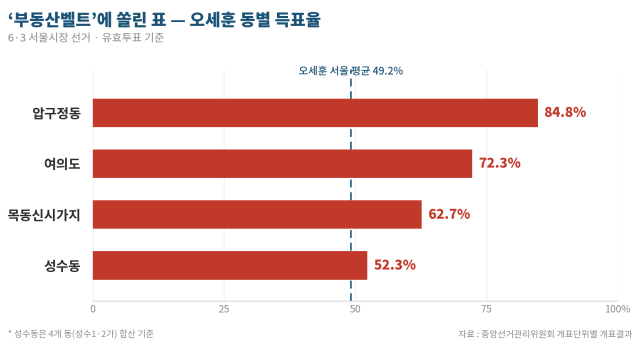
A notable trend extends beyond those four areas. Neighborhoods like Apgujeong, Yeouido, Mokdong, and Seongsu, which are banking on redevelopment, leaned in one direction. Mayor Oh Se-hoon secured 84.8% in Apgujeong along the Han River and 72.3% in Yeouido. Even in Mokdong New Town, which is not directly on the river, he garnered 62.7%. The trend was not limited to riverside areas; Seongsu-dong, part of Jeong Won-o's stronghold in Seongdong-gu, also tilted towards Oh Se-hoon.
What binds these areas together is not ideology but assets. Apgujeong is waiting for redevelopment, Mokdong New Town is set for revitalization, and Seongsu includes strategic redevelopment zones. While the neighborhoods and demographics vary, they share a common concern: the future value of their homes is tied to government policy. Voter sentiment is more sensitive to asset movement than political leanings. This signals that the Seoul elections are now interpreted through a 'real estate belt' rather than an 'ideological belt.' If this trend solidifies, the next mayoral election in Seoul could be uncertain.
The government now faces a two-year period without elections. With high approval ratings and a majority in the National Assembly, it has the greatest flexibility to push through its desired policies. In this context, the president directly addressed the direction of real estate during a press conference on June 8, marking his first anniversary in office. The key message was 'both.' He promised to expedite supply measures and redevelopment while stating, "Escaping from being a republic of real estate speculation is the way for this country to survive," emphasizing the need to curb demand as well. He indicated that tax reforms would be addressed alongside the July budget proposal. The government's objectives have effectively doubled.
First Goal — Curbing Speculation
One goal is to suppress speculative demand. The government has reinstated the heavy taxation on multiple homeowners, continued the adjustment of official property values, and tightened housing loan regulations last year. This direction has a clear rationale: to reclaim windfall profits, narrow the wealth gap, and discourage multiple homeownership, aligning with the values the government has promoted since its inception. This approach also consolidates support from the young and non-homeowners.
However, the market reacts to these measures. By increasing the burden of ownership while limiting the ability to sell, multiple homes are not entering the market. Remaining assets are consolidating into the safest option: a single property, typically a new apartment in Seoul. Even last year, when regulations were reintroduced, apartment prices in Seoul recorded double-digit increases. Supply is also dwindling. In a city with no vacant land, new apartments are primarily emerging from redevelopment, and stifling these projects closes off new construction. This year, the number of completed apartments in Seoul has dropped by over 40% compared to last year, and new construction has also declined. Yet, unsold inventory is virtually nonexistent—not due to lack of demand, but because there is insufficient supply. As demand is suppressed, supply is drying up first. Moreover, this neighborhood is not solely inhabited by investors; middle-class residents looking to upgrade their homes are also present. The longer the suppression lasts, the more likely these residents will shift from temporary indecision to firm opposition.
Second Goal — Increasing Supply
The other goal is to increase supply. However, the shape of the supply envisioned by the president is crucial. He stated that instead of green belts or new towns, "there is tremendous supply potential if homes held for investment or speculation are released to the market," indicating an intention to pressure multiple homeowners to sell their properties. Indeed, ahead of the reinstatement of heavy taxation, some urgent sales have emerged this spring. However, these properties are not newly built homes but rather existing ones changing hands. The total amount of housing in urban areas remains unchanged.
Increasing the number of new homes, which involves starting construction and facilitating occupancy, is a different matter. This government has not shied away from this path. Last fall, it promised large-scale housing supply and measures to promote redevelopment. Yet just months earlier, it effectively cut off relocation loans for multiple homeowners, causing many members of redevelopment associations in Seoul to halt their projects. The same government that promised supply also imposed restrictions on that supply. The June 8 declaration to "accelerate" is more a reaffirmation of last year's commitment than a new announcement.
Real supply ultimately hinges on construction starts. In a city with no vacant land, new apartments arise from redevelopment, and if project viability collapses, that path is blocked. Under the current conditions of tightened taxes, loans, and regulatory measures, both associations and construction companies are hesitant to act. To discuss supply, it is essential to determine where transactions, ownership, finance, and permits can be reactivated. This is a design that runs counter to the suppression of demand.
Of course, any shift in direction comes with costs. Adjusting ownership burdens may spark controversy over tax relief for multiple homeowners, while lowering transaction taxes could immediately impact revenue. Easing regulatory measures may invite accusations of favoritism, and it could take several years for new homes to be completed, preventing an immediate cooling of current prices. Most importantly, easing regulations may give the impression that the government is retreating in the face of real estate challenges. This could be interpreted as a retreat by its support base and as an opportunity for the opposition.
The fact that these two goals pull in opposite directions has already been demonstrated over the past year. Promised redevelopment projects stalled as loans tightened. The card intended to suppress demand has obstructed supply. Thus, the June 8 declaration of "both" is not merely a matter of will but a question of design. If the government promises to accelerate redevelopment while simultaneously tightening property taxes and regulatory measures, supply may remain only on paper. Neither goal is without justification.
Curbing speculation aligns with the government's beliefs, while increasing supply addresses the urgent demands of the market. The two-year period without elections provides an opportunity to balance both without concern for voter sentiment. However, once that period ends, the real estate belt will once again face the electorate. Whether the government's promised supply leads to the release of existing properties or results in new construction will determine the outcome of future votes.
