

Hyundai Motor Group has selected Saemangeum as the site for its next-generation hub for artificial intelligence (AI) and humanoid robots, primarily due to its potential for renewable energy. To enhance the competitiveness of physical AI, continuous learning for robots and autonomous vehicles is essential, which requires a stable power supply. The establishment of a robotics, AI, and hydrogen energy ecosystem in Saemangeum, with its ample sunlight and vast development space, could invigorate the domestic industry.
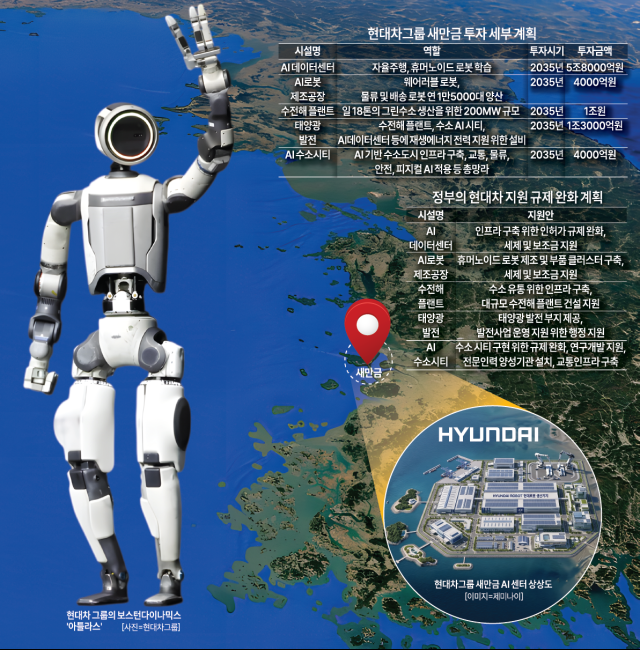
According to industry sources on June 8, Hyundai's investment plan for Saemangeum, totaling approximately 9 trillion won (about $7 billion), designates the AI data center as a key project, accounting for about 70% (6 trillion won) of the total budget. The data center, equipped with the capacity of 50,000 graphics processing units (GPUs), will handle vast amounts of data necessary for software-defined vehicles (SDVs), autonomous driving, and smart factory implementations. The group aims to create a virtuous cycle by collecting essential data across the entire value chain of manufacturing, logistics, and sales, thereby transforming into a physical AI company.
One of Saemangeum's advantages is its capability for stable power supply. The government and Hyundai are exploring the development of a co-location facility that would integrate the AI data center with a 200-megawatt (MW) electrolysis plant and gigawatt (GW)-scale solar power generation facilities.
The co-location development involves constructing a power plant adjacent to the AI data center, minimizing transmission distance to nearly zero, which is considered a preliminary step for direct power trading. U.S. companies like Amazon are actively pursuing nuclear co-location by building small nuclear power plants next to their AI data centers. In contrast, South Korea has yet to adopt this model due to the monopoly of Korea Electric Power Corporation's distribution network, equity issues regarding infrastructure costs, and conflicts among various government departments.
The government plans to designate Saemangeum as a distributed energy specialization area to alleviate such regulations. Once designated, direct power trading will be possible, allowing Hyundai to transmit electricity generated at the power plant directly to the AI data center, significantly reducing costs. The facility is also expected to receive certification for environmentally friendly AI data, which will help meet enhanced environmental export standards in Europe and the U.S. in the long term.
Additionally, the government has extended the land use permit for the power plant site to 100 years to ensure Hyundai's stable operations. It also plans to expedite the acquisition of agricultural land near the power plant and the environmental impact assessment approvals. Financial support will be strengthened through corporate and income tax reductions, AI robot investment subsidies, and support from the National Growth Fund. A senior government official stated, "The biggest challenge was determining who would bear the enormous costs of the power grid needed for the AI data center, but this regulatory relief has significantly addressed Hyundai's concerns."
Near the AI data center, solar power plants, electrolysis facilities, a robotics manufacturing cluster, and hydrogen charging stations will be established to create various synergies. The AI data center is scheduled to begin construction in 2027 and aims for completion by 2031, with the remaining facilities expected to be completed by 2035.
If Saemangeum becomes a cradle for AI and humanoids, it is anticipated that collaboration between academia and industry will increase, along with a surge in research and development personnel and small and medium-sized enterprises. Improvements in transportation infrastructure and living conditions due to population growth are also expected. This investment is projected to generate about 16 trillion won in production effects and create approximately 71,000 direct and indirect jobs. Hyundai Motor Group Vice Chairman Jang Jae-hoon remarked, "The next-generation industrial paradigm starting in Saemangeum will become a pivotal point in designing the future of South Korea, extending beyond Jeollabuk-do."
* This article has been translated by AI.

Copyright ⓒ Aju Press All rights reserved.