

South Korea's economy experienced significant growth in the first quarter of this year, driven by strong semiconductor exports. The nominal growth rate increased by 17% compared to the same period last year, marking the highest level in 30 years.
The Bank of Korea announced on June 9 that the real Gross Domestic Product (GDP) growth rate for the first quarter was recorded at 1.8%, an upward revision of 0.1 percentage points from the preliminary estimate released in April. This figure is double the initial forecast of 0.9% and represents the highest growth rate since the third quarter of 2020, when it was 2.3%.
Quarterly growth improved following a contraction of -0.2% in the first quarter of last year, with subsequent growth rates of 0.6% in the second quarter and 1.4% in the third quarter, before a slight decline of -0.1% in the fourth quarter. This year, however, the economy rebounded sharply.
Kim Hwa-yong, head of the Bank of Korea's National Income Division, stated, "The upward adjustment of 0.1 percentage points in the first quarter's real GDP growth rate will raise the annual growth rate by the same amount. We will revise our forecasts in August based on changing conditions." In May, the Bank of Korea projected a real GDP growth rate of 2.6% for the year.
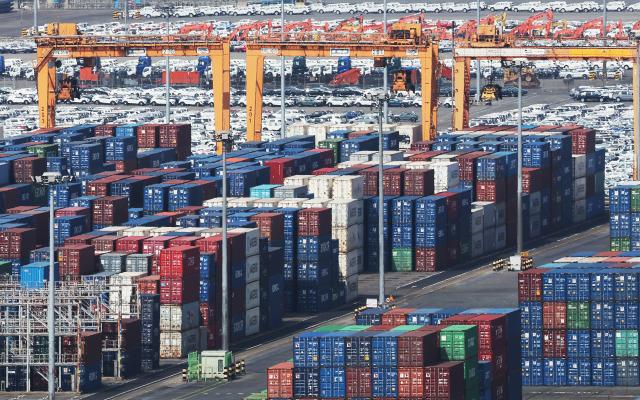
The growth in the first quarter was primarily driven by increases in exports and capital investment. Exports rose by 5.9%, mainly in information technology (IT) products such as semiconductors, while imports increased by 3.9%, driven by machinery, equipment, and automobiles.
This marks the highest growth rate for exports since the third quarter of 2020 (14.9%) and the highest for imports since the fourth quarter of 2021 (4.0%).
Construction investment grew by 1.4% due to increases in building and civil engineering projects, while capital investment surged by 6.6%, the highest growth rate since the first quarter of 2021 (9.2%).
Private consumption increased by 0.6%, supported by higher spending on goods such as clothing and services like finance, while government consumption fell by 0.4% due to reduced health insurance expenditure.
Compared to previous estimates, growth rates for capital investment (up 1.8 percentage points) and exports (up 0.8 percentage points) were revised upward, although imports also increased by 0.9 percentage points.
The contribution of each sector to the first quarter's growth rate showed that net exports (exports minus imports) boosted the growth rate by 1.1 percentage points. Despite an increase in imports, the growth in exports was greater. Contributions from private consumption (0.3 percentage points), construction investment (0.2 percentage points), and capital investment (0.6 percentage points) accounted for a total of 0.7 percentage points from domestic demand.
By sector, manufacturing grew by 3.9%, driven by increases in computers, electronics, optical instruments, and primary metals. The information and communication technology (ICT) manufacturing sector saw a remarkable growth of 15.4%, while non-ICT manufacturing experienced a decline of 0.9%.
The nominal GDP growth rate for the first quarter reached 10.5%, the highest since the first quarter of 1976 (13.0%). Compared to the same period last year, it grew by 17.1%, the highest since the third quarter of 1995 (19.2%).
The GDP deflator rose by 12.9% year-on-year. The GDP deflator, which is the ratio of nominal GDP to real GDP, serves as a comprehensive price index that includes exports and imports.
Kim explained, "The rise in domestic prices is not the cause; rather, it is due to significant improvements in the profitability of export companies." He added, "We need to closely examine whether the increase in the GDP deflator is driven by domestic consumption or rising prices of export goods, noting that the current rise is influenced by a 23.5% increase in the export deflator, particularly in semiconductors."
He emphasized that the expansion of nominal GDP growth is not due to rising domestic prices. "There were times in the 1970s, 1980s, and 1990s when the gap between nominal and real GDP exceeded 10%. It is important to distinguish this from cost-push inflation," he said.
He further noted, "The expansion of corporate profits can provide resources for fiscal stability through increased corporate taxes, as well as for fostering future industries and enhancing potential growth rates through structural reforms. This can positively impact domestic demand through increased research and development (R&D) and capital investment."
He added, "International organizations such as the Bank for International Settlements (BIS) measure household and government debt ratios against nominal GDP for international comparisons. The expansion of nominal GDP growth significantly lowers this ratio."
In the first quarter, nominal Gross National Income (GNI) surged by 11.0% compared to the previous quarter, reaching the highest level in 50 years. The net income from abroad increased from 9.2 trillion won to 13.7 trillion won, surpassing the nominal GDP growth rate of 10.5%.
The real GNI growth rate of 9.2% was at an all-time high. Improved terms of trade and an increase in real net income from abroad, which rose from 8.2 trillion won to 11.6 trillion won, significantly exceeded the real GDP growth rate of 1.8%.
The total savings rate for the first quarter was 41.7%, up 5.7 percentage points from the previous quarter, the highest level since the fourth quarter of 1988 (41.9%).
* This article has been translated by AI.
Copyright ⓒ Aju Press All rights reserved.