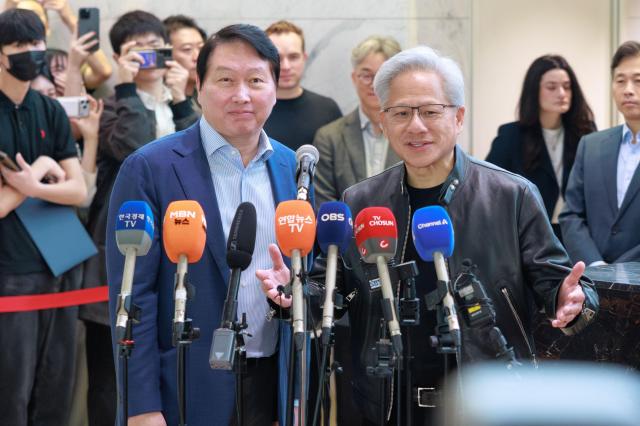
SEOUL, July 25 (AJP) - A partnership between SK Group and Nvidia will reach $500 billion, Nvidia chief executive Jensen Huang said in San Francisco on Friday (local time), naming a sum larger than everything the chipmaker sold in its last full fiscal year.
He said it in the future tense during a meeting with President Lee Jae Myung at a hotel downtown. The two companies would announce the partnership that day, he said, and the scale reached $500 billion (733 trillion won). As of Saturday morning in Seoul, no press release, regulatory filing, or statement from either company had put the figure on paper. The running blog Nvidia maintained through the summit carried a joint research lab with a Korean university and a note about a dinner in Woodside, California. It made no mention of $500 billion.
The number is worth measuring against the company that named it. Nvidia reported revenue of $215.9 billion for the fiscal year that ended in January, a record, up 65 percent from the year before. The figure Huang attached to SK Group is more than twice that. It sits close to the roughly $520 billion Samsung Electronics and SK hynix jointly committed last month to new fabrication plants in southwestern South Korea, and it matches the headline value of Stargate, the data center program OpenAI announced last year. What the money covers, over what period, and whether it represents new business or a value placed on an arrangement that already exists were all left undisclosed.
The last question is the live one. Nvidia and SK announced an expanded partnership in Seoul on June 8, and it was not small. SK hynix signed a multiyear technology agreement to co-develop memory for Nvidia's Vera Rubin AI supercomputers, Vera central processing units, RTX Spark personal computers and Jetson Thor robotics platforms. SK Telecom agreed to build a full-stack AI cloud on Nvidia's DSX platform, aimed at gigawatt-scale AI factories. SK Group chairman Chey Tae-won said at the time that cooperation with Nvidia, until then centered on memory supply, was being raised to the level of the whole group. Huang did not say on Friday whether the $500 billion is separate from that framework or a price now attached to it.
Around the headline figure sat a list of commitments that reached across most of South Korean industry. SK hynix and Samsung Electronics would work with Nvidia on chip design and memory design, Huang said. Naver would receive a large investment, and he described the company as South Korea's leading cloud provider, saying the partnership would support its expansion at home and abroad. With Hyundai Motor Group, Nvidia would jointly develop a self-driving Genesis vehicle and work on robotics. With LG, he said, the two companies are developing power generation systems for use in factories and in homes.
Two of the announcements concern where the research happens rather than what gets built. Nvidia is starting what Huang called an AI frontier lab in South Korea, and he said leading company researchers plan to relocate from California to work there. Nvidia and the Korea Advanced Institute of Science and Technology (KAIST) announced a joint AI research lab on Friday at the Kim Jaechul Graduate School of AI on the university's Seoul campus, a $300 million commitment over an initial five years that includes $50 million a year in computing resources, funding for at least 10 researchers annually and internships for each of them. Nvidia describes it as the first joint AI lab between a Korean university and any global technology company. Aju Press reported the terms on Friday.
Huang tied that work to something larger. Nvidia is cooperating with KAIST to build what he called Korea AI, he said, and plans to develop a Korean large language model in South Korea, for South Koreans. Partnerships now run from conglomerates to startups to research organizations, he added, and span AI chips, physical AI and infrastructure.
Physical AI is the government's term for machines that carry the technology off the screen, robots and vehicles and factory equipment that sense their surroundings and act on them. It is one of the three pillars of the investment package Lee announced on June 29, alongside semiconductors and AI data centers.
Blue House policy chief Kim Yong-beom told reporters on Thursday that more than half of the roughly eight gigawatts of first-phase AI data center capacity the government has planned is expected to take firm shape during the two-day visit. He declined to give values ahead of company announcements, and said the presidential trip had acted as a catalyst, helping close negotiations between South Korean and American companies that had run on for months.
Lee used the meeting to press for more. South Korea intends to become the country that leads the world on artificial intelligence and on putting AI to actual use, he said, asking Nvidia to take an active role. The government spent the past year preparing before launching the Three Mega Projects, he added, and is now building a society and a state with AI at the center.
The exchange was friendly. Lee told Huang he had watched broadcasts of the Nvidia chief eating fried chicken and drinking beer in Seoul more than once and had been sorry to miss it. Huang said the energy he felt in South Korea, from fried chicken through to grilled pork belly, had been remarkable, and credited Lee's stated goal of building an AI native nation with giving the country momentum.
Lee picked up a phrase Huang had used and returned it. Calling this an AI golden age is exactly right, he said, and the country is now entering the beginning of it.
"Under the president's leadership, Korea has achieved a great deal over the past year," Huang said. "It would not be an exaggeration to call this truly South Korea's golden age."
Copyright ⓒ Aju Press All rights reserved.