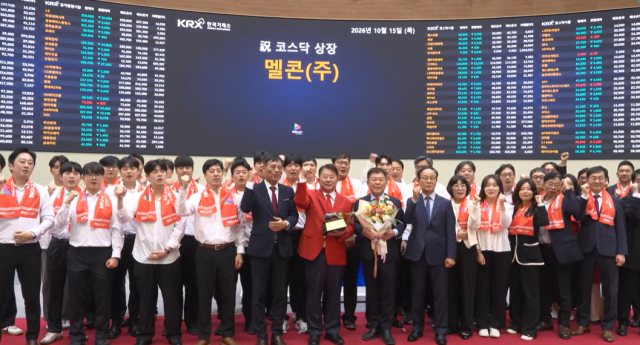
The enthusiasm, however, is uneven. Four companies that completed retail subscriptions this month drew bids for more than 1,000 times the shares available, led by semiconductor equipment maker Melcon. The other six recorded subscription ratios ranging from just 3.55 to 986.99 to one.
The divide runs through individual industries. Artificial intelligence video analytics firm Intellivix recorded a retail subscription ratio of 1,410.9 to one and attracted about 4 trillion won ($3 billion) in deposits. Fellow AI company Lablup, which develops computing infrastructure software, managed just 3.55 to one.
“Even as the stock market falls sharply, money is still flowing into IPOs because investors are selectively assessing individual companies’ growth potential and their ability to generate profits,” said Kim Dae-jong, a professor of business administration at Sejong University.
“Interest remains strong in areas tied to real industrial demand, including AI semiconductors, AI video analytics and data centers,” he added.
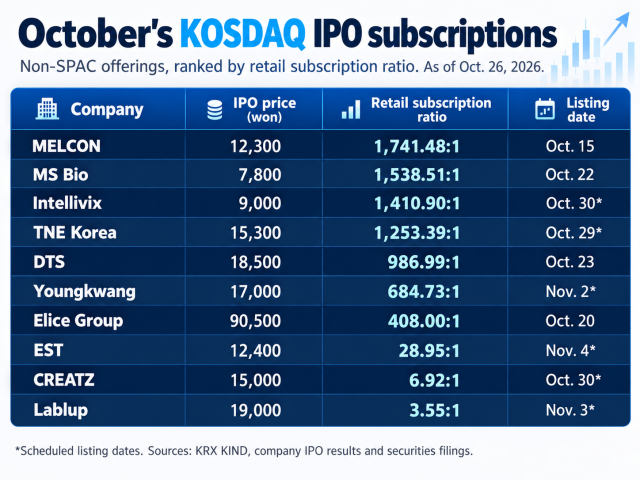
Five companies, excluding special purpose acquisition companies, made their KOSDAQ debuts between Oct. 1 and Oct. 23, with three more scheduled before the month ends. Cosmetics materials maker Jincostech also transferred from the smaller KONEX market on Oct. 15.
The most sought-after offerings have spanned several industries.
Melcon led October’s completed retail subscriptions with a ratio of 1,741.48 to one, followed by regenerative medicine company MS Bio at 1,538.51 to one. Industrial equipment maker TNE Korea attracted bids for 1,253.39 times the available shares and 5.75 trillion won in deposits.
Yet even the semiconductor supply chain produced sharply different results. While Melcon topped the subscription rankings, semiconductor and display equipment maker EST recorded a ratio of just 28.95 to one.
“Even among AI companies, subscription demand can vary widely depending on their technology, business models, revenue growth prospects and IPO pricing,” Kim said. “Investors should be wary of buying into a company simply because it belongs to a popular sector.”
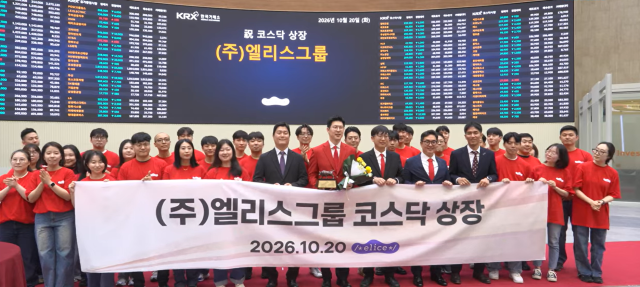
Strong subscriptions are also proving an unreliable guide to returns after listing.
AI cloud provider Elice Group attracted more than 10 trillion won in subscription deposits but plunged 32 percent on its KOSDAQ debut on Oct. 20.
Its shares subsequently recovered above the offering price before falling 18.58 percent on Monday to close at 76,700 won — 15.25 percent below its IPO price of 90,500 won, according to Korea Exchange data.
“Elice shows that even a heavily subscribed IPO can suffer a sharp decline if the company’s valuation fails to justify its offering price,” Kim said.
The scrutiny extends to the cost of building AI infrastructure and whether the eventual returns will justify the investment.
Questions about borrowing and profitability at U.S. AI cloud provider CoreWeave have weighed on sentiment toward similar businesses. Elice, which operates graphics processing unit cloud services and AI education platforms, plans to use its IPO proceeds to expand data center capacity.
Intellivix offers a different earnings profile.
The AI video surveillance and safety systems provider reported revenue of 46.6 billion won and operating profit of 4.9 billion won last year, marking its 13th consecutive year of operating profits.
The company drew institutional bids for about 1,234 times the shares available during bookbuilding and priced its IPO at the top of its proposed range.
“Investors are no longer looking at AI’s growth potential alone. They’re also examining actual revenue, operating profits, future cash flow and whether IPO prices are reasonable,” Kim said.
“Companies with a track record of operating profits and tangible business results are more likely to attract investors.”
The coming weeks will test how far that selective appetite extends.
TNE Korea is scheduled to begin trading Thursday, followed by Intellivix and CREATZ on Friday. Youngkwang, Lablup and EST are due to list in early November.
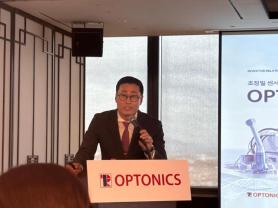
Precision optical components maker Optonix, which supplies parts used in defense systems, is also seeking a KOSDAQ listing.
Institutional bookbuilding runs through Tuesday, with an indicative price range of 10,000 to 12,000 won per share and a planned offering of 22 billion to 26.4 billion won.
Their debuts will show whether enthusiasm at subscription translates into sustained buying once trading begins.
“Ultimately, a company’s ability to turn growth into profits and offer shares at a reasonable price will be key to both IPO success and its performance after listing,” Kim said.

Copyright ⓒ Aju Press All rights reserved.