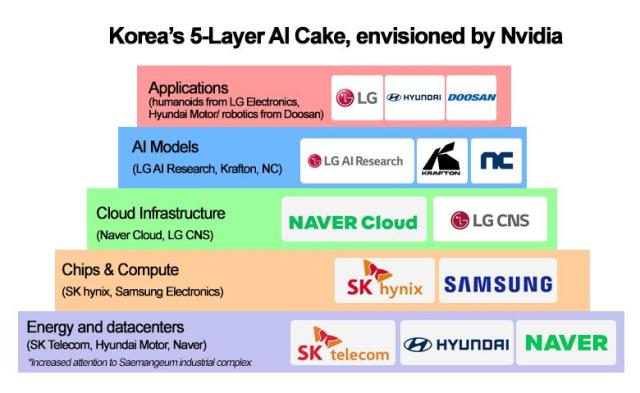
In Nvidia's telling, AI is a composite stack: energy at the bottom, then chips, then the infrastructure that houses and serves them, then the models, and finally the applications where economic value is harvested.
Every application, Huang argues, draws demand all the way down to the power plant, and supremacy in the AI era hinges on strength across all five layers.
Few nations hold more than a slice or two. China currently controls much of the stack through vertically integrated energy, infrastructure and applications. The United States remains ahead in frontier chips and models.
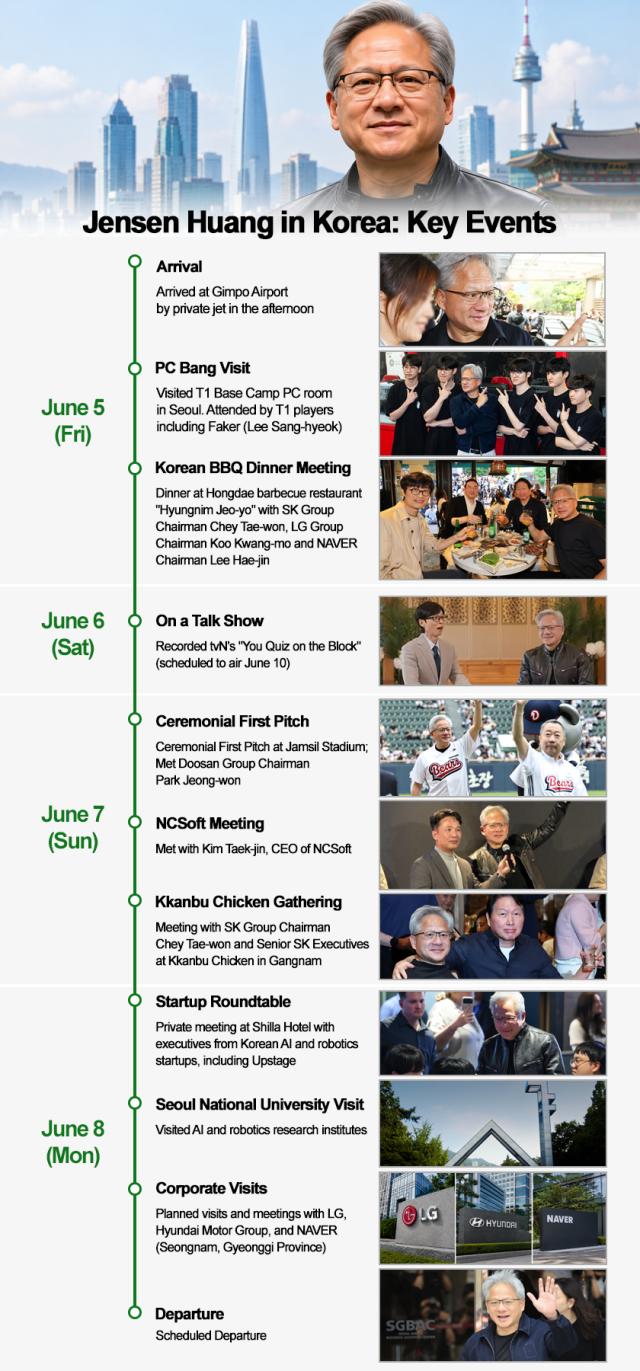
Korea, on the other hand, has the potential to deliver the full cake, judging from the enthusiasm Huang displayed during his tightly packed four-day visit.
"This is your time. You must take advantage of it," Huang pronounced before wrapping up his five-day visit in Korea Tuesday.
"Korea is in a unique place in a very special moment."
He began, as the cake does, at the bottom.
SK Telecom will build a gigawatt-scale AI cloud on Nvidia's DSX platform, with its first AI factory due online in 2027 to serve sovereign, physical and agentic AI services across Korea.
Naver mapped a parallel AI cloud ascent, starting with a 55-megawatt facility in the first half of 2027, expanding to 100 megawatts within the year and 200 megawatts by 2028 before eventually reaching gigawatt scale.
LG joined the same race through LG Uplus, which plans to build large-scale AI data centers on Nvidia's DSX platform to house the latest GPUs and support future AI cloud and GPU services. Sister company LG Energy Solution is developing 800-volt direct-current power systems to run them.
These are not data centers in the traditional sense but what Nvidia calls "AI factories" — facilities that convert power and data into tokens, the elemental output of modern intelligence.
The geography of that buildout stretched to the west coast, where Huang signaled Nvidia's intention to participate in an AI data center project Hyundai Motor Group plans to develop in Saemangeum, the vast reclaimed industrial zone on Korea's western shore.
It was the infrastructure layer made literal: land, power and cooling poured into concrete, forming the physical foundation beneath the cloud services SK Telecom, Naver and LG intend to sell.
Nvidia and SK hynix unveiled a multiyear technology partnership to co-develop memory across four Nvidia platforms spanning AI infrastructure, personal AI and physical AI — memory engineered alongside Nvidia's compute roadmap rather than purchased off the shelf.
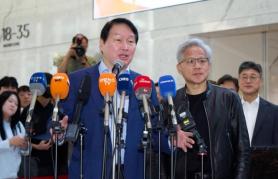
"SK is our largest memory partner," Huang told reporters after meeting SK Group executives in Seoul, adding that the relationship was expanding into many new markets.
Samsung Electronics anchored the other end of his calendar.
Huang capped his visit Monday evening with a private meeting with Samsung Electronics DS Division Vice Chairman Jun Young-hyun at the Guest House of the Shilla Hotel. The two sides reportedly discussed broader cooperation spanning next-generation high-bandwidth memory, advanced packaging and foundry manufacturing.
Speaking to reporters afterward, Huang returned to a theme that had run through the entire visit.
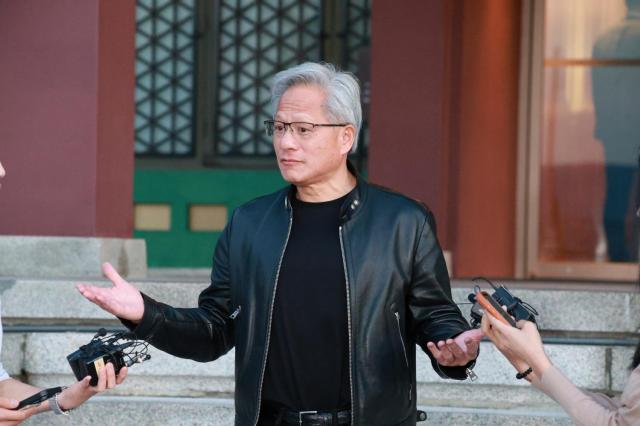
"Korea is very unique in the world because of the galvanization of the Korean society and culture. Today Korea is a world leader in heavy industry and manufacturing."
"Korea is also world class in electronics and it's very interesting that Korea is also among the world's leaders in software and AI."
"Countries that are excellent at manufacturing and heavy industry are not good at software. Countries that are very good at software are not good at heavy industry. Korea is great at all of it. This is a unique situation."
The next layer, the models, is the one many often assume Korea must import. The visit suggested otherwise.
Nvidia and LG AI Research are jointly advancing EXAONE, one of the country's leading sovereign AI models, with LG drawing on Nvidia's Blackwell GPUs and NeMo framework to train it — a Korean-built model sharpened on Korean-tuned computing infrastructure.
It does not stand alone.
Naver fields HyperCLOVA X, a model deeply rooted in the Korean language. NCSoft, whose technologies Huang highlighted during visits to gaming venues, developed its own VARCO family of models. Korea's leading AI models are increasingly home-grown, even if many of the accelerators powering them are not.
Atop them all sits the application layer, where Huang says the real economic value accrues and where his enthusiasm appeared strongest.
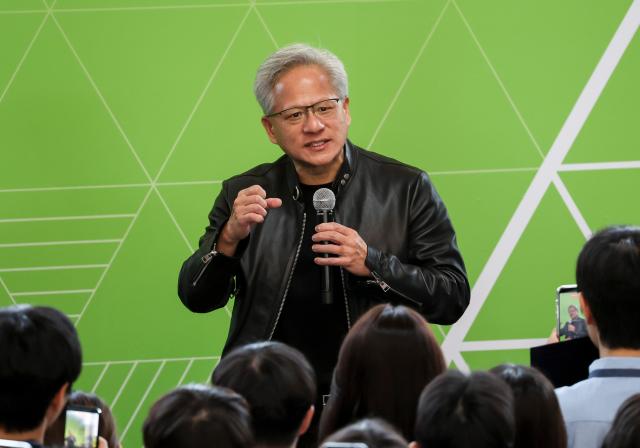
"Korea is extraordinary at manufacturing, mechatronics and AI, and the fusion of these strengths will make robotics and physical AI a major growth sector for the country," Huang said.
Robotics — physical AI in Nvidia's vocabulary — drew some of the broadest commitments during the visit.
LG Electronics is exploring Nvidia's Isaac GR00T reasoning model for future home robots, while LG CNS is integrating Nvidia technologies into industrial automation and logistics systems.
Doosan emerged as one of the trip's surprise beneficiaries. The industrial group now supplies advanced electronic materials used in AI accelerators while simultaneously adopting Nvidia platforms to develop and train its own robotic systems — a two-way relationship Huang underscored by throwing the ceremonial first pitch for the Doosan Bears at Jamsil Stadium.
It began with an informal samgyeopsal-and-soju gathering in Hongdae attended by SK Group Chairman Chey Tae-won, LG Group Chairman Koo Kwang-mo and Naver founder Lee Hae-jin. It moved through autonomous-driving discussions with Hyundai Motor Group Chairman Chung Eui-sun, memory negotiations at SK hynix, cloud infrastructure agreements with Naver and ended with Samsung's chip division at the Shilla Hotel.
By the time Huang left Seoul, the five-layer cake had become more than a presentation slide.
Energy came through Korea's nuclear ambitions and AI-factory buildout. Chips came from SK hynix and Samsung. Infrastructure emerged through SK Telecom, Naver and LG. Models were represented by EXAONE, HyperCLOVA X and other sovereign AI efforts. Applications were visible everywhere from autonomous vehicles to factory robots.
"Korea partners with Nvidia at every layer of the AI ecosystem — from energy to chips to infrastructure to robotics and applications," Huang said.
For a country long known primarily as a semiconductor powerhouse, Huang's message was broader. Korea's advantage may no longer lie in any single layer of the AI stack, but in the rare ability to build nearly all of them.
Copyright ⓒ Aju Press All rights reserved.