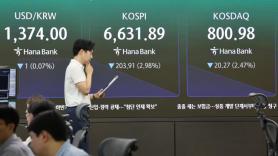
The benchmark KOSPI surged 8.18 percent to close at 8,096.93, recovering nearly all of the previous session's 8.29 percent plunge. The tech-heavy KOSDAQ also rebounded sharply, rising 6.19 percent to 967.81.
The violent swing pushed South Korea's market fear gauge to a record high, reflecting investor anxiety despite the recovery.
According to the Korea Exchange, the KOSPI 200 Volatility Index (VKOSPI) jumped 14.60 points, or 19.05 percent, to 91.23 on Tuesday, the highest level since the index was introduced in April 2009.
The VKOSPI measures expected future volatility using KOSPI 200 options prices. Often referred to as the market's "fear gauge," it rises when investors anticipate large swings in stock prices and typically spikes during periods of market stress.
The latest reading surpassed levels seen immediately after the outbreak of the U.S.-Iran conflict in March, highlighting the scale of uncertainty gripping investors despite Tuesday's rebound.
Semiconductor heavyweights led the roller-coaster ride. SK hynix soared 15.91 percent to 2,215,000 won, while Samsung Electronics jumped 8.97 percent to 322,000 won as investors rushed back into artificial intelligence and memory-chip plays that had been at the center of Monday's selloff.
Gains were broad-based across large-cap stocks as buying extended beyond technology into financial and industrial names.
Among Samsung affiliates, Samsung Electro-Mechanics surged 18.39 percent to 1,970,000 won, while Samsung Electronics preferred shares rose 5.71 percent to 203,500 won. Samsung Life Insurance gained 4.66 percent to 393,000 won, Samsung C&T advanced 5.02 percent to 429,000 won and Samsung Biologics added 4.26 percent to 1,296,000 won.
Automakers delivered mixed performances. Kia climbed 8.52 percent to 164,300 won, while Hyundai Motor finished unchanged at 639,000 won and Hyundai Mobis fell 2.78 percent to 595,000 won.
Doosan Enerbility rose 7.58 percent to 92,300 won, KB Financial Group increased 2.18 percent to 154,800 won and LG Energy Solution edged up 2.06 percent to 396,500 won.
On the downside, HD Hyundai Heavy Industries slipped 1.45 percent to 612,000 won, joining Hyundai Mobis as one of the few large-cap stocks to end lower.
Tuesday's rebound was essentially Monday in reverse.
The artificial-intelligence chip trade that collapsed a day earlier came roaring back, with gains concentrated in the market's most volatile names rather than spread evenly across sectors. NAVER, which had served as a refuge during Monday's crash, fell 7.89 percent as investors rotated out of defensive positions and back into semiconductor shares, effectively unwinding the previous session's flight to safety.
The sharp recovery also reinforced South Korea's status as the region's most volatile major equity market, where gains and losses have increasingly been amplified by the dominant influence of memory-chip makers and AI-related stocks.
Yet the rally carried the same warning that has shadowed the market all week.
Foreign investors remained net sellers despite the sharp advance, extending an exodus that has persisted through recent sessions amid concerns that the memory-chip cycle driving the rally may be approaching its peak. Domestic institutions accounted for much of the buying, providing the fuel for Tuesday's rebound.
A recovery of this magnitude, built largely on local money while overseas funds continue to head for the exit, rests on a narrower foundation than the headline gain suggests.
In the currency market, the won also strengthened as panic subsided, firming toward 1,517 against the U.S. dollar.
Across Asia, markets rebounded broadly, largely in proportion to how far they had fallen the previous day.
In Tokyo, the Nikkei 225 rose more than 2 percent, recovering part of Monday's near-4 percent drop, with gains concentrated in semiconductor-equipment makers. The notable exception was SoftBank Group, the market's main proxy for speculative AI investment, which finished little changed even as chip-equipment shares rallied. The divergence suggested investors were willing to buy back into the physical semiconductor supply chain while remaining cautious on the broader AI-investment story.
China moved the least, just as it had during the selloff. The Shanghai Composite gained about 1 percent, reinforcing its position as the region's steadiest major market in both directions. With less exposure to the global AI hardware cycle, it neither suffered the sharp declines seen elsewhere nor required a dramatic rebound. Chinese chip-related shares posted only modest gains, underscoring how heavily the recent volatility has been concentrated in South Korea's semiconductor-driven market.
Copyright ⓒ Aju Press All rights reserved.