

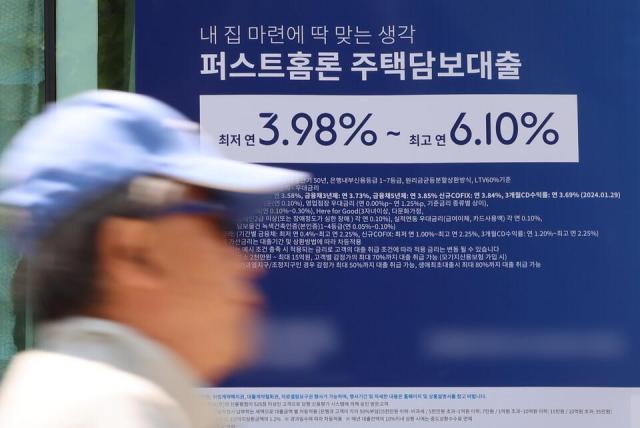
The possibility of interest rate hikes is resurfacing as the semiconductor market recovers and exports improve. With household debt nearing 2,000 trillion won, concerns are growing about the repayment burden on vulnerable borrowers and the financial sector's stability if rates rise.
According to the financial sector, the proportion of variable-rate loans in new household loans from deposit banks reached 72.2% in April, up 21.1 percentage points from 51.1% at the end of last year. A high percentage of variable-rate loans means that changes in interest rates will more quickly affect borrowers' interest burdens.
As the Bank of Korea hints at the possibility of raising the benchmark interest rate, fixed rates for mortgage loans have also begun to rise. If the benchmark rate increases, borrowers' repayment burdens could escalate rapidly, potentially leading to decreased consumer spending and higher delinquency rates.
The challenge lies in the fact that the pressure for rate hikes coincides with household debt approaching 2,000 trillion won. Given that the debt level is at an all-time high, the impact of interest rate fluctuations on households is expected to be significantly greater than in the past.
There are growing concerns that the repayment burdens will quickly escalate, particularly for vulnerable borrowers. Low-income and low-credit borrowers, as well as those with multiple debts, may lack the capacity to absorb the increased interest burden, raising the risk of defaults. The Bank of Korea anticipates that the credit risk for households will increase in the second quarter of this year due to declining repayment capabilities among vulnerable borrowers.
If the repayment abilities of these borrowers deteriorate, it could lead to rising delinquency rates. The financial sector views this potential increase in defaults as a factor that could heighten the burden of provisioning for financial institutions and increase bad debt costs.
Signs of deteriorating stability are already appearing in the non-bank sector. The delinquency rate for savings banks rose to 6.7% in the first quarter of this year, an increase of 0.7 percentage points from the previous quarter. During the same period, the non-performing loan (NPL) ratio also increased to 8.6%, up 0.2 percentage points.
Experts emphasize that during periods of rising interest rates, attention should focus more on changes in the repayment abilities of vulnerable borrowers rather than the total amount of household debt. With debt levels already high, the shock from rising rates is likely to concentrate on vulnerable groups and the non-bank sector, making proactive management a key challenge for the financial sector.
Kim Dae-jong, a professor at Sejong University, stated, "The most concerning aspect is the rising delinquency rates among multiple borrowers and high-risk borrowers. If defaults among vulnerable borrowers expand, it could lead to a deterioration in the stability of financial institutions, particularly in the second financial sector, potentially triggering a 'bank run' or credit crunch, which poses a risk to the financial system."
* This article has been translated by AI.
Copyright ⓒ Aju Press All rights reserved.