

Today, the world is once again questioning the direction of civilization. Artificial intelligence (AI) has begun to understand human language, mimic human thought, and replace human labor and judgment. While technology has advanced rapidly, the human mind does not always keep pace. The economy has grown, but communities have weakened; information is abundant, yet truth has become harder to find. Wars and conflicts continue around the globe, and hatred and division are spreading across borders. Humanity finds itself facing the oldest questions once more: What is good? What is evil? Why must humans seek justice?
Tracing the roots of these questions leads us back to an ancient Persian prophet: Zoroaster, also known as Zarathustra. Today, Zoroastrianism is considered a minority religion in terms of followers, but it is far from insignificant in the history of human civilization. It is one of the essential spiritual origins for understanding Judaism, Christianity, and Islam, and it serves as a crucial starting point for the core concepts of good and evil, heaven and hell, final judgment, and salvation in the history of world religions.
Zoroaster emerged during a time dominated by polytheism, seeking to present a path of ultimate truth for humanity. He introduced Ahura Mazda as the being who creates the universe and maintains order. Ahura Mazda means 'Lord of Wisdom.' He is the source of goodness and truth, sustaining the order of the universe. Zoroaster taught that humans can only live rightly by following the path of truth he presented.
People often refer to Zoroastrianism as the 'religion of fire,' but this is only partially accurate. What Zoroastrianism venerates is not fire itself; rather, fire symbolizes truth, purity, and divine light. Fire dispels darkness, burns away falsehood, and sacrifices itself to illuminate the world. Zoroastrianism finds the symbol of truth in this attribute. Therefore, it is more accurate to call Zoroastrianism a religion of light rather than a religion of fire.
One of the most significant features of Zoroastrianism is its direct engagement with the problem of good and evil. Zoroaster understood the world through the opposition of Ahura Mazda, the principle of goodness and truth, and Angra Mainyu, the symbol of falsehood and destruction. However, he did not view humans as mere beings swept along by fate. He believed that humans are free to choose between good and evil and must take responsibility for their choices. In this regard, Zoroastrianism marked a crucial turning point in the history of human religion.
Zoroastrianism presents three principles for human life: good thoughts, good words, and good deeds. These are not merely religious precepts but also the most fundamental ethics for maintaining civilization. When thoughts are distorted, words become distorted, and when words are distorted, actions become distorted. Ultimately, society as a whole falls into chaos. This teaching is particularly urgent in the age of AI.
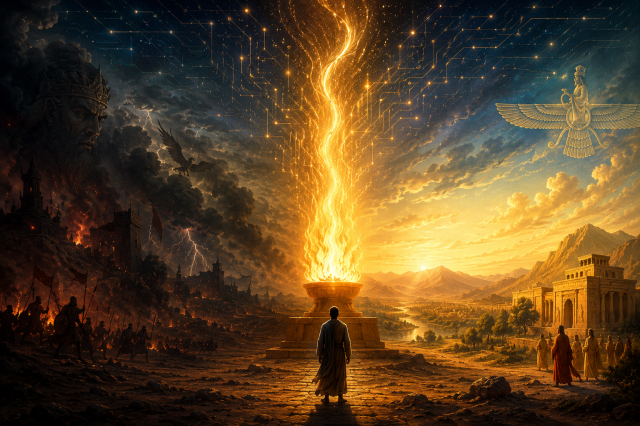
Zoroastrianism later emerged on the grand stage of world history alongside the Persian Empire. Notably, Cyrus II, known as Cyrus the Great, is regarded as one of the greatest rulers in human history. He established the Achaemenid Empire, creating the largest empire of the ancient world while practicing religious tolerance and cultural inclusivity. Even after conquering Babylon, he respected the faith and traditions of the conquered peoples, allowing the Jews, who suffered during the Babylonian captivity, to return and rebuild their temple. As a result, the Jewish people remember him not merely as a conqueror but as a liberator. His name is even mentioned in the Old Testament, reflecting his special status. Cyrus the Great exemplifies how the spirit of Zoroastrianism was embodied in politics and governance throughout history.
This event became a decisive moment in the historical intersection of Judaism and Zoroastrianism, creating a significant flow of civilization that would later influence Christianity and Islam. The history of world religions shows that sometimes an individual's tolerance can bring about greater change than war.
At one time, Zoroastrianism was one of the world's largest religions. However, following the spread of Islam, many followers migrated to India. Today, the Parsi community in India is descended from these individuals. Although small in number, this community has made significant contributions to modern India's economy and industrial development.
A prime example is the Tata Group, one of India's largest conglomerates, founded by Jamsetji Tata, who was of Parsi descent. The Tata Group has grown into a symbolic enterprise that has led India's industrialization, spanning steel, automobiles, aviation, information technology, energy, and hospitality. Even today, members of the Tata family, including Ratan Tata, are held in high regard in Indian society. This illustrates how the Zoroastrian community has contributed significantly to the advancement of modern India through education, industry, and social contributions, rather than merely maintaining their faith.
The influence of Zoroaster extends beyond religion into the realms of philosophy and literature. In the 19th century, German philosopher Friedrich Wilhelm Nietzsche featured Zarathustra as the protagonist in his seminal work, 'Thus Spoke Zarathustra.' While Nietzsche's Zarathustra is not the historical Zoroaster, the choice of this ancient Persian prophet as a philosophical symbol is significant. Nietzsche argued that humans must transcend existing value systems to create new values, selecting Zoroaster as a symbolic figure to pose such questions. This demonstrates that Zoroaster has become a monumental symbol in the history of human thought, transcending his role as a mere religious founder.
Today, the number of Zoroastrians is small, but their influence cannot be measured by numbers. The concepts of the struggle between good and evil, human free will, final judgment, heaven and hell, salvation, and messiah have left a profound mark on the subsequent history of world religions. And that spirit remains alive today. The protagonist of the film 'Bohemian Rhapsody,' Freddie Mercury, was also a member of a Zoroastrian family of Indian descent.
The age of AI provides humanity with tremendous capabilities. However, technology does not offer direction. What humans still need is the wisdom to discern what is good and what is evil. Zoroaster taught humanity good thoughts, good words, and good deeds 3,000 years ago, and this teaching remains relevant today.
Zoroastrianism is often known as the religion of fire, but it is more accurately described as a religion of light. What they worshipped was not fire, but the light of truth. In an age overflowing with falsehood, hatred, greed, and division, that light becomes even more precious. The small flame that began in ancient Persia continues to pose the same questions to humanity today.
“What thoughts are you having? What words are you speaking? And what actions are you taking?”
The future of human civilization may very well be contained in the answers to those simple questions.
※ This article was generated using generative AI and has been reviewed by an editor.
* This article has been translated by AI.
Copyright ⓒ Aju Press All rights reserved.