

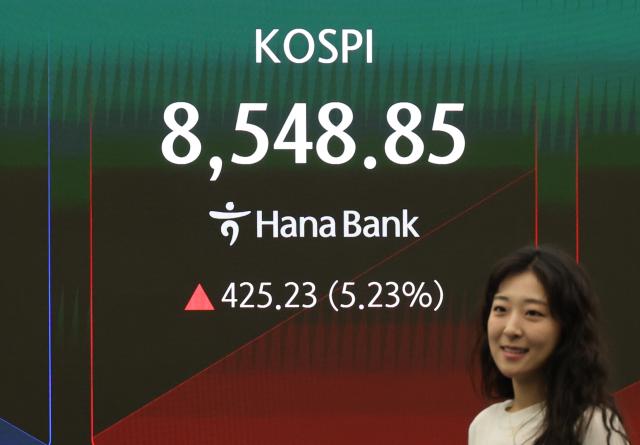
The benchmark KOSPI surged 5.46 percent to 8,567.05 in early trading, comfortably outpacing the roughly 3 percent gain in Japan's Nikkei 225.
Large-cap stocks did most of the heavy lifting. The KOSPI 200 jumped 5.5 percent, while the tech-heavy KOSDAQ rose a more modest 2.3 percent to 1,052.35.
Foreign investors bought a net 2.2 trillion won ($1.45 billion) worth of shares and institutions added another 2.29 trillion won, while retail investors locked in profits by selling a net 4.32 trillion won.
Memory chip makers led the charge. SK hynix rose 6.1 percent to 2,280,000 won ($1,507.90), while Samsung Electronics gained 4.7 percent to 337,500 won ($223.20). Samsung Electro-Mechanics, another key supplier in the AI hardware ecosystem, jumped 10.4 percent to 1,893,000 won ($1,252.00).
Monday's rally built on Friday's 4.6 percent advance and extended a memory-driven bull run that has propelled the market more than 180 percent over the past year.
Trade data have reinforced the optimism. South Korea's exports during the first 10 days of June surged 86 percent from a year earlier to a record high, with semiconductor shipments more than tripling.
The Korean won also strengthened sharply, rising to around 1,504.9 per dollar from levels near 1,530 last week as oil prices retreated.
Brent crude, the global benchmark, fell 4 percent to around $84 a barrel, extending last week's losses on expectations that a deal would fully restore shipping through the Strait of Hormuz. West Texas Intermediate, the U.S. benchmark, posted similar declines and traded near $81 a barrel in late Sunday trading.
Markets have been closely watching the Strait of Hormuz, the narrow waterway between Iran and Oman that normally carries roughly one-fifth of the world's oil supply and serves as a critical artery for global energy markets.
Copyright ⓒ Aju Press All rights reserved.
