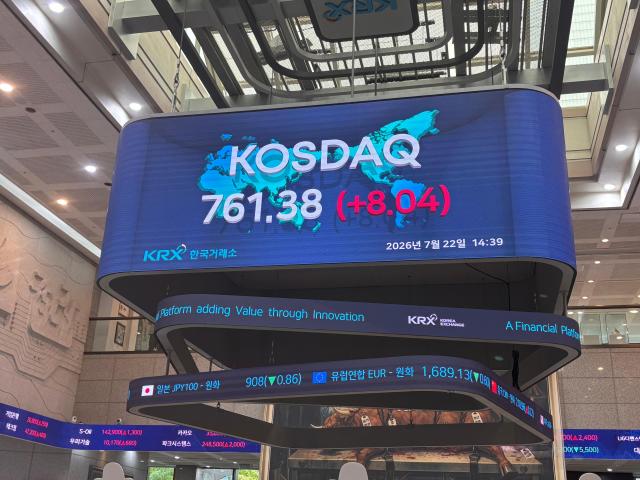
SEOUL, August 11 (AJP) — South Korea's long-neglected KOSDAQ is suddenly outrunning its bigger sibling and major stock markets around the world, gaining 19 percent in the first seven trading sessions of August as investors look beyond the leveraged chip trade that dominated the first half.
The junior market closed Tuesday at 857.84, up 19.2 percent from 719.76 at the end of July. The benchmark KOSPI, by contrast, has lost 3.8 percent over the same period to 6,345.53.
Among major global benchmarks tracked by AJP, KOSDAQ is the only one posting a double-digit gain so far this month. Yet the sudden reversal has barely dented the gulf built up over the year. KOSDAQ remains 7.7 percent below its 2025-end close of 928.99, while KOSPI is still up more than 50 percent from 4,214.17 at the end of last year.
KOSDAQ, largely bypassed during the AI-fueled rush into Samsung Electronics, SK hynix and leveraged products tied to the chipmakers, is benefiting from a rotation as that trade cools.
But the money flows so far point more to a tactical rebound than a broad vote of confidence in the junior market's earnings prospects.
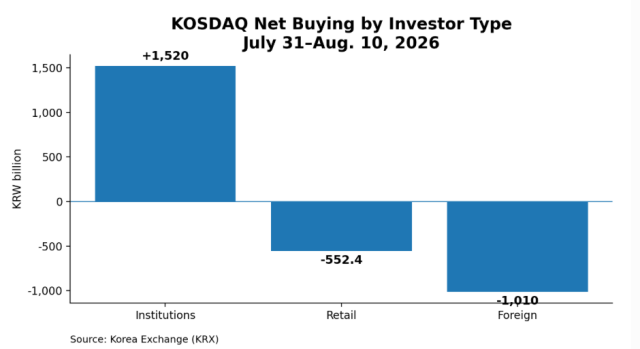
Korea Exchange data show institutional investors bought a net 1.52 trillion won ($1.07 billion) of KOSDAQ-listed shares between July 31 and Aug. 10. Retail investors sold a net 552.4 billion won, while foreign investors unloaded 1.01 trillion won.
Investment trusts led the institutional buying with 515.9 billion won, followed by financial investment firms at 347.6 billion won, private funds at 247.5 billion won and pension funds and other institutional accounts at 222.3 billion won.
Tuesday showed how quickly that pattern can change. Retail investors bought a net 558 billion won of KOSDAQ shares by the close, absorbing net selling of 482 billion won by foreigners and 98 billion won by institutions.
The reversal underscores how fluid the rally remains. Institutions drove much of the rebound through Monday, but foreign investors have yet to return on a sustained basis.
Woo Seok-jin, an economics professor at Myongji University, said part of the shift reflects Korean investors' strong appetite for higher-risk assets.
“Korean investors tend to have a relatively high appetite for risk, and leveraged ETFs had been one way of pursuing that,” Woo said. “Now that tighter regulations have raised the barrier for retail investors to trade those products, some of that search for opportunities appears to have shifted toward KOSDAQ.”
For institutions, he said, the motivation is more straightforward. “Institutional investors are naturally focused on finding opportunities that can generate returns.”
Funds rediscover KOSDAQ
Investment-trust activity provides another sign that fund managers have been rebuilding exposure to the junior market.
Between July 31 and Aug. 10, investment trusts bought a net 590.7 billion won of KODEX KOSDAQ 150, one of the largest ETFs tracking major KOSDAQ companies, while also accumulating KOSDAQ-listed shares.
ETF purchases and direct stock buying cannot simply be added together because of differences in the way the transactions are structured. Still, demand through both channels points to greater exposure to the junior market.
The contrast with the main board is striking. Institutions were net sellers of KOSPI shares over roughly the same period while buying more than 1 trillion won on KOSDAQ, suggesting their appetite had tilted toward the junior board.
But Yoon Jae-hong, an analyst at Mirae Asset Securities, cautioned that not everything recorded as institutional buying represents institutions making an independent bet on KOSDAQ.
“A significant portion of the inflows came through ETFs,” Yoon said. “When retail investors buy ETFs, some of that demand is recorded under the financial-investment category.”
The distinction matters because it makes the rally less clearly institution-led than the headline flow numbers suggest.
Still, other forces are working in KOSDAQ's favor.
Kim Dae-jong, an economics professor at Sejong University, pointed to the easing concentration in giant semiconductor stocks, bargain hunting after KOSDAQ's steep fall and expectations that government reforms will favor the junior market.
“Some of the money that had been concentrated in large semiconductor stocks is spreading out, while KOSDAQ is benefiting from its steep earlier losses and expectations for supportive policies,” Kim said.
Selling pressure has also eased as forced liquidation of margin positions subsided, he said, while investors returned to growth sectors including biotechnology, batteries, robotics and semiconductor materials and equipment.
But Kim cautioned against mistaking a sharp rotation for the beginning of a lasting bull market. “For now, the move has more of the characteristics of a rotation driven by market flows than a long-term rally backed by earnings,” he said. “For the gains to become sustainable, we need to see continued buying by institutions and foreign investors as well as improvements in corporate earnings.”
Woo pointed to another, less bullish explanation for renewed retail interest. “Some retail investors may have given up after taking losses, while others appear to be making one last attempt to recover before leaving the market,” he said.
From leveraged chips to KOSDAQ?
One catalyst coinciding with KOSDAQ's rebound has been the abrupt cooling of the speculative trade built around Korea's two biggest chipmakers.
Financial regulators tightened rules on single-stock leveraged ETFs after extreme turnover raised concerns that the products were amplifying swings in Samsung Electronics, SK hynix and the broader market.
The minimum cash deposit required for retail investors was raised from 10 million won to 30 million won, while authorities also restricted new products and advertising.
Trading turnover in the products subsequently plunged from 12.45 trillion won on July 30 to 845.2 billion won on Aug. 7, according to KRX data.
KOSDAQ began its sharp rebound at around the same time.
The overlap raises the possibility that investors who had crowded into Samsung, SK hynix and leveraged products tied to them began hunting for returns elsewhere. It does not establish that money leaving those products went directly into KOSDAQ.
“Some of the money appears to have moved over,” Woo said.
The timing nevertheless marks a sharp reversal in the market hierarchy of the first half, when the AI chip boom sucked capital and attention toward a handful of KOSPI giants and left much of KOSDAQ behind.
Rally meets a market cleanup
KOSDAQ's revival is also arriving just as regulators are making it harder for weak companies to remain there.
South Korea raised the KOSDAQ market-capitalization threshold for delisting to 20 billion won from July 1, with the floor scheduled to rise again to 30 billion won in 2027.
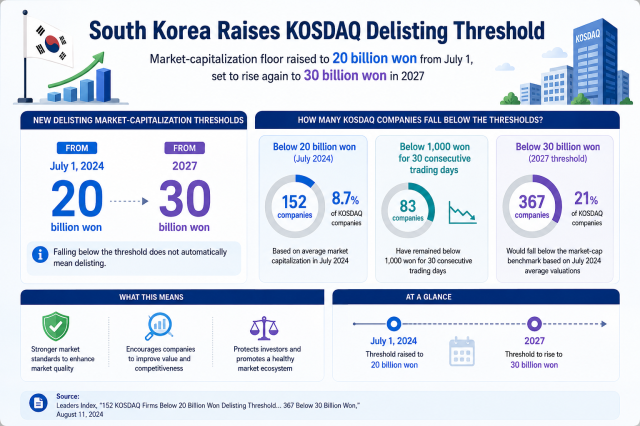
According to corporate research institute Leaders Index, 152 KOSDAQ companies, or 8.7 percent of the market, had an average market capitalization below the current 20 billion won threshold in July. Another 83 had remained below 1,000 won for 30 consecutive trading days.
At next year's 30 billion won threshold, 367 companies — about 21 percent of KOSDAQ — would fall below the market-cap benchmark based on their July average valuations, although falling below the line does not automatically mean delisting.
Woo said the tougher rules could improve the credibility of a market long criticized for allowing financially troubled companies to linger. “Penny stocks like these should have been removed from the market much earlier,” he said. “If a company is financially troubled, it should not be allowed to remain listed and continue trading.”
Allowing distressed companies to remain listed too long can instead attract speculative capital looking for heavily discounted assets, he said.
But cleaning out weak companies solves only half the problem. For KOSDAQ to sustain investor interest, Woo said, Korea also needs to rebuild the venture ecosystem that once supplied the market with companies capable of delivering rapid growth.
“Investors seeking higher returns are willing to bet on innovative companies because of their strong growth potential,” Woo said. “But there are too few promising venture companies right now. The venture ecosystem itself needs to recover.”
Yoon pointed to another potential catalyst: plans to introduce a tiered KOSDAQ structure that would separate stronger companies into a premium segment.
Such a structure could make it easier to build ETFs and other investment products around a smaller pool of higher-quality companies, potentially drawing more long-term money into the market.
“There are expectations that retail investors will come in if ETFs are created around the premium segment,” Yoon said. “For the rebound to continue, the market reforms now being introduced need to be sustained.”
For now, KOSDAQ has achieved something it rarely managed during the chip-dominated first half: it has investors' attention.
Whether it keeps it is the harder test.
Three decades after its launch, KOSDAQ's challenge is no longer simply getting investors back. It is giving them a reason to stay.
AJP Takeaways
• South Korea's KOSDAQ rose 17.79 percent from July 31 through August 11, 2026, sharply outperforming the benchmark KOSPI, which fell 3.16 percent over the same period.
• South Korea's tighter rules on single-stock leveraged products coincided with the KOSDAQ rebound, as turnover in products linked to major stocks plunged from 12.45 trillion won on July 30 to 845.2 billion won on August 7, 2026. Economists said some investment may have rotated toward the KOSDAQ, although a direct link cannot be established.
• Economists caution that the KOSDAQ rebound remains driven more by investment flows than stronger corporate earnings, meaning sustained institutional and foreign buying and improved earnings will be needed for the rally to last.
• South Korea's tougher KOSDAQ delisting standards could reshape the junior market, with 367 companies, or 21 percent of the market, below the 30 billion won market-capitalization threshold scheduled to take effect in 2027 based on July 2026 averages.

Copyright ⓒ Aju Press All rights reserved.