

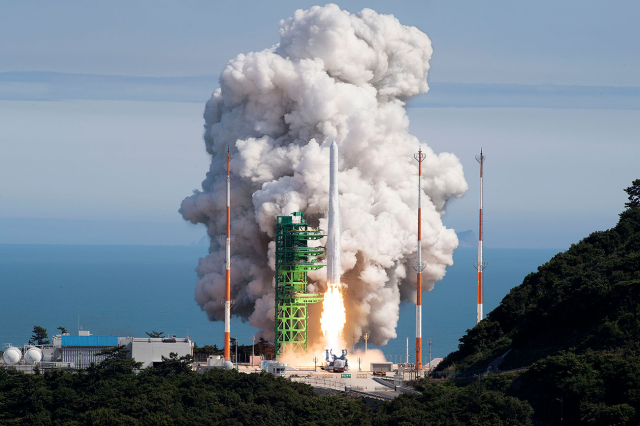
SEOUL, October 06 (AJP) - A South Korean ground station company will make first contact with seven of the 15 satellites riding the Nuri rocket into orbit on Wednesday. Its job is to confirm each satellite survived the ride and to work out exactly where it ended up. Among the seven are the five satellites that will form South Korea's first satellite constellation.
The Korea AeroSpace Administration has scheduled Nuri's fifth launch for a one-hour window opening at 12:23 p.m. at the Naro Space Center in Goheung, on the country's southern coast. The 15 satellites aboard are the most the rocket has ever carried, weighing 1,071 kilograms in total. The agency has reserved Oct. 8 to 14 as backup dates in case weather or technical problems force a delay.
Contec said Tuesday that it will provide ground communication for KAIST's NEONSAT satellites No. 2 through No. 6, the Daejeon city government's DaejeonSAT-1 and Sledge, a small satellite built by space startup OnB Space.
A satellite released from a rocket has to be found before it can be used. In the first hours after separation, operators on the ground listen for its first signal, check that its power and systems are working and calculate its exact path. That last task produces what is known as a TLE, short for two-line element set, the standard data format used worldwide to describe a satellite's orbit and predict where it will be.
Contec said it will handle all three tasks. It plans to use its station at the Asian Space Park in Jeju, the company's ground station complex on South Korea's southern island, together with stations run by partner companies. The company said it has set up a combined control system tailored to each satellite's mission and will analyze separation and early orbit data to produce the TLEs.
On launch day, Contec will station dedicated staff at the Korea Aerospace Research Institute and at the control room in its Daejeon headquarters. They will confirm contact with each satellite shortly after launch and run ground control through the early operations phase.
The company said the job shows it can track several satellites and analyze their orbits at the same time, from separation through initial operations.
"We feel a great sense of responsibility in joining the meaningful journey of Nuri's fifth launch as the ground station mission partner for its key satellites," Contec chief executive Lee Sung-hee said. He said the company would draw on its station network and operating experience to support "stable communication right after launch" and help the satellites settle into their proper orbits.
The NEONSAT satellites are the main payload. Each is a microsatellite developed by KAIST's Satellite Technology Research Center, and they are designed to work as a group, passing over the same areas more often than a single satellite could. The government has said their purpose is frequent, precise surveillance for national security and disaster response, and the launch time was set to suit that mission.
The constellation is also the reason for this year's delays. Nuri's fifth flight was first targeted for June and then pushed back several times. In August, the space agency said a prototype launched in 2024, along with a later test satellite, had shown in orbit that their thrusters fell short of expectations. Thrusters are the small engines a satellite uses to change or hold its orbit, and the five production satellites were refitted with improved versions and retested before shipping to the launch site.
Nuri itself is South Korea's first rocket built entirely with domestic technology. The three-stage vehicle was developed by the Korea Aerospace Research Institute (KARI). Its first flight, in October 2021, failed to place a dummy satellite in orbit. The rocket then succeeded in 2022, 2023 and November 2025. The November flight was the first in which a private company, Hanwha Aerospace, led assembly and launch preparation under a technology transfer from KARI, and Hanwha Aerospace leads this launch as well. A successful fifth flight would give Nuri four successes in five attempts.
Contec was founded in 2015 as a spin-off from KARI. Lee worked at KARI for 16 years in launch and satellite operations before starting the company. Contec trades on South Korea's tech-focused Kosdaq market and sells what it calls end-to-end space data services, covering the receiving, processing and analysis of satellite data for operators at home and abroad.
The company said it operates its own ground stations in 11 countries across North America, Europe and Asia.

Copyright ⓒ Aju Press All rights reserved.
