
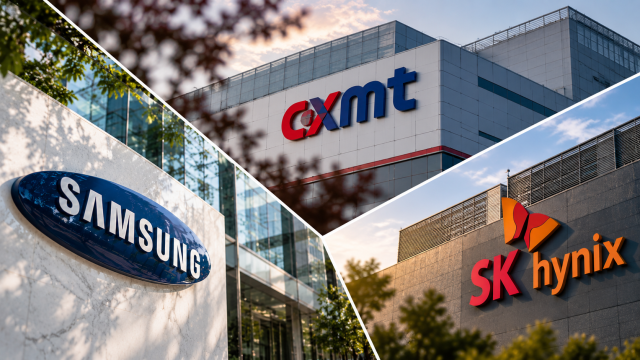
SEOUL, October 06 (AJP) - At least 27 veteran engineers from Samsung Electronics and SK hynix moved to Chinese memory chipmaker CXMT, but 26 have since left after staying an average of just 2.9 years, according to an analysis by a South Korean lawmaker.
The engineers had spent an average of 15.4 years at the Korean chipmakers, including six with more than two decades of experience, according to Rep. Choi Soo-jin of the ruling People Power Party. Her office analyzed publicly available career records, including LinkedIn profiles.
Their expertise spanned circuit design, process integration, equipment, yield analysis and advanced packaging, with some having experience in high-bandwidth memory and other advanced memory technologies.
Choi's office said recruiters offered some Korean engineers salary increases ranging from 60 percent to twice their previous pay, along with housing, education support and employment guarantees of three to five years.
"Semiconductor technology is not just about blueprints, but the experience and know-how accumulated by people over 20 or 30 years," Choi said, calling for stronger measures to track and retain key semiconductor personnel.

Candice Kim
Candice Kim is a dedicated business and technology reporter specializing in the intersection of high-tech innovation and fast-paced consumer trends. Her core beats span the semiconductor, IT, cosmetics, and retail sectors, where she provides in-depth coverage of industry titans including Samsung Electronics, SK hynix, and LG Electronics, alongside leading consumer brands like Olive Young and Musinsa. Whether analyzing complex silicon supply chains or tracking the latest shifts in beauty and fashion retail, Candice is committed to delivering sharp, accurate reporting that keeps readers informed on the forces shaping today's most dynamic markets.
Copyright ⓒ Aju Press All rights reserved.
Related News
-
 Investors Frustrated by 30 Million Won Rule Amid Semiconductor Stock Volatility
As semiconductor stocks experience significant volatility, investors trapped in single stock leverage products are increasingly frustrated with the government's 30 million won rule. Critics argue that the government's one-size-fits-all regulation fails to protect existing investors from risk and does not safeguard new investors either. Small investors, lacking cash reserves, are deprived of opportunities to adjust their positions, while those with more cash can enter the market, reinforcing an unequal market structure.According to the securities industry on October 6, small investors are voicing concerns about reverse discrimination stemming from the investment regulations on single stock leverage products introduced by the government in July. Every morning at 9 a.m., around 3,000 participants in a KakaoTalk open chat room for Samsung Electronics and SK Hynix leverage investors share figures like '-80%', '-85%', and '-97%', indicating their investment losses. An SK Hynix leverage investor, identified as A, stated, "The government listed leverage products at semiconductor peaks, and now, with the cash requirement of 30 million won, we can't even make a move without it. With our investment down 75%, being unable to buy more forces small investors to realize their losses."The government's supplementary measures for single stock leverage products (ETFs and ETNs) announced in July included raising the basic deposit requirement from 10 million won to 30 million won and excluding the value of substitute securities like stocks, ETFs (excluding leverage ETFs), and bonds from the calculation of the basic deposit. Starting in November, the trading unit will also increase from one share to 20 shares (tentative). Currently, the single stock leverage product with the largest decline, 'KODEX SK Hynix Single Stock Leverage,' has dropped 74% from its peak, while 'TIGER Samsung Electronics Single Stock Leverage' has fallen by 59.9% based on the closing price on October 2 (11,555 won).Leverage products track daily returns at double the rate, meaning that as stock prices fluctuate, investors face a 'negative compounding effect' that erodes asset value. Investors trapped at high points must actively lower their average purchase price to escape, given the product's structure that becomes less favorable over time. One anonymous investor remarked, "Having started investing in May and already being trapped at a high point, the lack of recognition for substitute securities and the requirement to hold over 30 million won in cash to trade further deprives small investors of the chance to lower their purchase price and exit the product. It’s as if only cash-rich investors can benefit from leverage products, similar to real estate." They added, "Existing investors are already exposed to the risks of these products, yet barriers for new investors are being raised, creating a vicious cycle."Another investor noted, "Existing investors, already hit hard by the product's issues, lack the capacity to buy more, while someone with 30 million won in cash can enter the market without prior investment. This is a paradoxical situation. Existing investors should be allowed to make additional purchases with a portion of their holdings." They criticized the government's blanket monetary regulation as an overly administrative approach that fails to acknowledge the product's introduction failures.Moreover, there are concerns that investors, in their attempts to recover from leverage losses, are turning to unregulated overseas leverage investments or falling prey to illegal investment schemes. According to the Korea Securities Depository, following the implementation of leverage regulations (from July 31 to August 19), domestic investors' trading volume for SOXL (a U.S. semiconductor triple leverage ETF) reached $6.54357 billion (approximately 9.1191 trillion won), accounting for 34.4% of the top 50 overseas stocks. This marks a 3.8 percentage point increase from the pre-regulation figure of 30.6%. In contrast, the trading volume for 16 domestic single stock leverage products plummeted by 90.8% to 1.069 trillion won during the same period. This indicates that the demand for leverage has not disappeared but has shifted to overseas markets.The government acknowledges these concerns but has stated that there are no plans for further review of the security measures for leverage products. A Financial Services Commission official remarked, "The security measures for leverage products are aimed at reducing market volatility and stabilizing the market. Additional security measures for existing investors are not under consideration."* This article has been translated by AI.
-
 AI boom spreads beyond Korean chipmakers to components and cooling
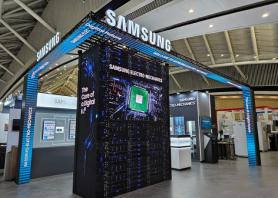
Samsung Electro-Mechanics unveiled the next-gen chip package system at KPCA Show 2026 Sept.9-11. Courtesy of Samsung Electro-Mechanics SEOUL, October 06 (AJP) -The AI boom is spilling beyond South Korea’s chipmakers, driving orders and investment in the components that stabilize power, connect processors and keep data centers from overheating. Samsung Electro-Mechanics on Tuesday disclosed a $210.24 million AI-server capacitor contract, bringing its announced long-term supply agreements this year to about 3.9 trillion won. LG Electronics on the same day announced a deal to supply cooling systems for 5 gigawatts of AI data center capacity in North America. The deals show how growing computing requirements are expanding demand across the infrastructure surrounding AI chips. More powerful processors need a stable electricity supply, increasingly sophisticated connections and cooling systems capable of removing concentrated heat. Investors turned to the stocks while dumping bigger chipmakers. At 3:00 p.m. Seoul time, Samsung Electro-Mechanics was up 5.19 percent at 1,663,000 won, while LG Electronics gained 7.18 percent to 231,500 won, according to Korea Investment & Securities market data. Shares of SK hynix fell 3.5 percent and Samsung Electronics 1.5 percent. Samsung Electro-Mechanics’ latest contract covers multilayer ceramic capacitors, or MLCCs, supplied to an unidentified global company throughout 2027. The filing valued the agreement at 285.6 billion won, equivalent to 2.5 percent of the company’s 2025 consolidated revenue. It is the sixth long-term supply agreement the company has disclosed this year, following another contract worth about 285 billion won on Sept. 29. Samsung Electro-Mechanics 2.5D and 2.1D package panel. Since May, its announced agreements have expanded across silicon capacitors, AI-server MLCCs and inductors, bringing the cumulative value to approximately 3.9 trillion won. The company is discussing further contracts with global customers. MLCCs store and release electrical energy to stabilize power supplied to chips and suppress electrical noise. AI servers require high-capacity components that can withstand demanding temperatures, voltages and continuous operation. Samsung Electro-Mechanics says AI servers can contain more than 10 times as many MLCCs as conventional servers. It estimates its share of the AI-server MLCC market at more than 40 percent. The company cites a Goldman Sachs forecast that the market will grow from $1.4 billion in 2025 to $5.8 billion in 2030, an annual compound growth rate of about 33 percent. “Customer requirements for high-performance MLCCs continue to rise alongside the growth of the AI market,” a Samsung Electro-Mechanics official said. “We will expand the share of AI-use MLCC products based on our technology and stable supply capabilities.” The company is also committing 6.78 trillion won to expand production of advanced semiconductor packaging substrates in South Korea and Vietnam. These substrates, known as flip-chip ball grid arrays, connect processors to circuit boards and carry electrical signals and power. As AI chips become more complex, the substrates must accommodate larger dimensions, more layers and denser connections. Samsung Electro-Mechanics will invest 4.27 trillion won at its Sejong operation, with mass production scheduled to begin in September 2028. Another 2.51 trillion won will go toward equipment for its Vietnamese expansion, where completion and operation are targeted for June 2030. The company said customer funding support and medium- to long-term volume commitments would help reduce the financial and utilization risks of the expansion. An illustration of an AI data center equipped with LG Electronics’ chillers and other cooling systems. Courtesy of LG Electronics. LG Electronics is pursuing the same AI investment cycle through heat management, expanding both its order book and manufacturing capacity. Its U.S. unit signed a long-term agreement with AIR Control Concepts to supply high-efficiency chillers and other cooling systems in phases for 5 gigawatts of North American AI data center capacity. Financial terms and a detailed delivery schedule were not disclosed. The agreement follows LG’s Oct. 1 announcement of a 150 billion won investment in a new U.S. chiller factory and expanded production lines in South Korea. The factory in Windsor, Virginia, is scheduled to begin production in the first half of 2027. It will manufacture air-cooled chillers for AI data centers, giving LG a local production base to serve the North American market. LG is also adding air-cooled chiller production lines and upgrading equipment at its Pyeongtaek and Changwon plants, with the domestic expansion proceeding in stages through the end of 2026. Chillers remove heat from water circulated through cooling systems. As AI processors become more powerful and densely packed, that heat-management infrastructure is essential to sustaining performance and preventing overheating. LG is broadening its offering into what it calls “chip-to-chiller” cooling: cold plates that absorb heat directly from processors, coolant distribution units that circulate and manage cooling fluid, and chillers that remove the collected heat. The company and AIR are discussing extending their partnership to coolant distribution units, linking the latest supply agreement to LG’s broader liquid-cooling business. LG said orders for its AI data center cooling solutions exceeded 600 billion won in the first half of 2026 and are expected to reach several trillion won by year-end. The company is also pursuing projects beyond North America. In Indonesia, it is supplying solutions for a large AI data center being developed by Sinar Mas Group in Jakarta, combining its cooling technology with LG Energy Solution’s batteries and LG CNS’s data center design, construction and operating capabilities. “We will continue to strengthen our ability to supply cooling solutions reliably as core infrastructure for AI data centers, and actively respond to rapidly growing market demand,” said Lee Jae-sung, president of LG’s Eco Solution business.
-
Political Debate Over Honam Semiconductor Cluster Investment
On October 6, lawmakers engaged in a heated debate during a National Assembly audit of the Ministry of Trade, Industry and Energy regarding the Honam semiconductor cluster investment, part of the government's three major mega-projects. The ruling People Power Party raised suspicions that the government pressured companies in the site selection process, while the opposition Democratic Party emphasized the autonomy of corporate decision-making.The National Assembly's Industry, Trade, and Small and Medium Enterprises Committee held the audit to scrutinize the ministry's actions.The People Power Party criticized the failure to summon key witnesses, including Lee Jae-yong, chairman of Samsung Electronics, and Chey Tae-won, chairman of SK Group. Lawmaker Seo Ji-young pointed out, "Today, there is only one witness for the audit. This is unprecedented. How can we conduct a proper audit without witnesses or references?"Seo added, "We requested witnesses from Samsung and SK Hynix regarding the Honam semiconductor mega-project, but all requests were ignored. We need to uncover why these witnesses were not selected and who blocked them."In response, Democratic Party lawmaker Jang Cheol-min, who serves as the committee's secretary, stated, "Discussions regarding audit witnesses among the secretaries are not yet finalized. We have not heard any requests from the opposition to summon anyone other than Lee Jae-yong and Chey Tae-won regarding Samsung or SK Hynix."The People Power Party focused its inquiries on the fairness of the site selection for the Honam semiconductor cluster. Lawmaker Jo Ji-yeon asked Minister of Trade, Industry and Energy Kim Jeong-kwan, "Was the site selection for the mega-project fair? Did the companies propose the southwestern region first?" Minister Kim responded, "The companies ultimately chose the southwestern region. That was part of the process."Jo countered, "The companies consistently claim they never suggested a specific region first. According to my confirmation yesterday, they have not disclosed any investment plans for the southwestern region and have not definitively stated they would invest in a specific area. We are now in a truth dispute between the government and the companies."Another lawmaker from the same party, Yoon Han-hong, noted, "After multiple inquiries to Samsung Electronics and SK Hynix, we received reports indicating that the southwestern semiconductor project was deemed impossible due to insufficient power, water, and workforce. When proposing sites, did they only suggest Honam, or did they consider other regions as well?" Minister Kim replied, "There were several regions, and non-Honam areas were certainly included. From the companies' perspective, they had to consider various sites, and the government did as well."The Democratic Party defended the government, stating that companies had explored multiple regions for semiconductor investment even before the official announcement. Lawmaker Park Hee-seung mentioned, "Before the investment announcement, I had the opportunity to dine with the president of Samsung Electronics and asked if there was land available for a 2 million pyeong semiconductor site in my constituency, Namwon, Jeonbuk. Wouldn't large corporations conduct their own cost-benefit analysis before making such a significant investment?"Additionally, citing the power and water conditions in the capital region, he argued, "For the sake of balanced regional development, the choice of the southwestern location seems reasonable, and strategically, dispersion is necessary. Samsung and Hynix chose the southwestern region because it has access to water and electricity; there was no coercion involved."* This article has been translated by AI.