

The KOSPI sank 5.21 percent to 4,869.96, closing below 4,900 for the first time in 10 months. The selloff spread across Asia as fresh allegations involving U.S. chipmakers' compliance with export restrictions on China rattled semiconductor-heavy markets.
Taiwan's TAIEX plunged 6.63 percent to 35,877.63, while Japan's Nikkei 225 fell 4.77 percent to 56,606, reflecting the region's heavy dependence on semiconductor manufacturing and AI investment.
The regional rout followed sharp losses on Wall Street Thursday. The Nasdaq Composite fell 2.25 percent, while the Philadelphia Semiconductor Index declined 2.42 percent. Investors reassessed risks surrounding AI investments and U.S. restrictions on technology exports to China.
Adding to those concerns, Hunterbrook Media, an investigative outlet affiliated with short-selling firm Hunterbrook Capital, reported Thursday that newer versions of Advanced Micro Devices (AMD) firmware — software that helps its chips operate in servers — had appeared in products from IEIT Systems, a Chinese server maker placed on a U.S. trade blacklist in March 2025.
The report did not establish any violation of U.S. export laws, and AMD said it complies with applicable export controls. Its shares fell 7.72 percent Thursday, adding to concerns over regulatory scrutiny of U.S. chipmakers, including Nvidia.
In Seoul, the fallout was concentrated in the semiconductor stocks that had powered the earlier rally. Samsung Electronics tumbled 7.01 percent to 183,100 won ($136.94), while its rival SK hynix lost 5.92 percent to 1,113,000 won.
Other large-cap stocks also declined. Samsung Electro-Mechanics plunged 12.54 percent, while SK Square lost 8.39 percent and Samsung Electronics' preferred shares fell 8.38 percent. LG Energy Solution slipped 0.83 percent and Samsung Biologics declined 1.45 percent.
Heavy foreign selling compounded the losses. Foreign investors sold a net 1.132 trillion won ($847 million) of KOSPI shares, while institutions offloaded 951.3 billion won. Retail investors bought a net 1.595 trillion won, seeking bargains amid the decline, but their purchases failed to stem the selloff.
The pressure intensified enough to trigger emergency trading curbs on both exchanges. The selloff triggered five-minute suspensions of program sell orders, known locally as sidecars, on the KOSPI at 11:54 a.m. and the KOSDAQ at 1:28 p.m., the first such dual activation since November 6.
The junior KOSDAQ also fell 5.71 percent, to 645.68, extending the losses beyond large-cap semiconductor stocks.
Battery materials producer EcoPro BM dropped 4.50 percent, its parent company EcoPro fell 5.05 percent and robotics developer Rainbow Robotics declined 4.00 percent. Biotechnology company Alteogen, known for its drug-delivery technology, bucked the trend with a 1.39 percent gain.
The latest losses have erased much of the KOSPI's extraordinary rally earlier this year. The index has now fallen 48.1 percent from its June 19 intraday peak of 9,385.59. Its year-to-date return has dropped below 20 percent, down from 116.3 percent in late June, leaving the Korean market trailing several European benchmarks that have proved more resilient to the global technology selloff.
Beyond the immediate regulatory concerns, the prolonged decline reflects growing doubts about whether massive investments in AI infrastructure will deliver sufficient returns. Even the high-profile Nasdaq debut of Anthropic, the developer of the Claude chatbot, failed to revive confidence in technology shares. The company opened at $111.50, well above its $83 offering price, but closed at $97.17.
The pressure also extended to the currency market. The Korean won weakened, with the dollar rising to 1,336.2 won, compared to 1,330.0 won the previous day.
The declines across South Korea, Japan and Taiwan underscored how closely Asia's stock markets remain tied to the fortunes of the global AI industry.
With chip stocks under pressure and the possibility of another Federal Reserve rate hike in December, foreign investors may have little incentive to return to Korean equities anytime soon, leaving the market's recovery increasingly uncertain.

Ryu Yuna
Yuna Ryu covers finance, capital markets and Southeast Asian affairs.
She is drawn to the questions that numbers raise and the stories that data alone cannot answer.
Prior to journalism, she worked at Hyundai Motor Company and the Singapore Chamber of Commerce, focusing on business strategy and international affairs. She has also hosted diplomatic receptions and international conferences as an MC.
Ryu holds a master's degree in Media and Communication from Korea University, where her research focused on neuroscience-based studies of media effects.
Copyright ⓒ Aju Press All rights reserved.
Related News
-
 KOSPI Drops Over 5% Amid U.S. Market Plunge, Falls Below 4900 in 'Black Friday'
The domestic stock market plummeted in response to a sharp decline in the U.S. New York Stock Exchange. The KOSPI fell by more than 5%, dropping below the 4900 mark, while the KOSDAQ also experienced a decline of over 5%, marking a 'Black Friday.' In both markets, sell-side circuit breakers were triggered in response to the rapid decline. According to the Korea Exchange on November 20, the KOSPI closed at 4869.96, down 267.93 points (5.21%) from the previous trading day. The index opened at 4928.51, down 209.38 points (4.08%), and continued to widen its losses. At one point during the trading session, it fell to 4831.69, dipping below the 4900 mark. As the decline persisted, a sell-side circuit breaker was activated around 11:54 a.m. In terms of supply and demand, foreign investors and institutions sold a net 1.59 trillion won (KRW) and 1.24 trillion won (KRW), respectively, in the securities market. In contrast, individual investors purchased a net 2.32 trillion won (KRW), absorbing the selling pressure from foreign and institutional investors. Major stocks by market capitalization also showed widespread weakness. Samsung Electronics (-7.01%) and SK Hynix (-5.92%), along with SK Square (-8.39%), LG Energy Solution (-0.83%), Samsung Biologics (-1.45%), Samsung Electro-Mechanics (-12.54%), KB Financial (-0.33%), Hyundai Motor (-4.67%), and Celltrion (-0.93%) all declined. The KOSDAQ index also fell sharply by over 5%. It closed at 645.68, down 39.13 points (5.71%) from the previous trading day. The index opened at 660.98, down 23.83 points (3.48%), and continued to widen its losses. At 1:28 p.m., the KOSDAQ 150 futures price and index decline rate met the criteria for triggering a sell-side circuit breaker. During the session, the decline rate expanded to 6.23%. In the KOSDAQ market, foreign investors and institutions sold a net 226.6 billion won (KRW) and 112.3 billion won (KRW), respectively, while individuals purchased a net 346.8 billion won (KRW). Most major stocks by market capitalization fell. EcoPro (-4.61%), EcoPro BM (-5.92%), Rainbow Robotics (-4.11%), Juseong Engineering (-9.31%), Simtech (-11.61%), HLB (-2.52%), IOTechniques (-14.03%), Rino Industrial (-15.07%), and Robotis (-8.07%) all declined. In contrast, Alteogen (0.98%) closed higher. The sharp decline in the U.S. New York Stock Exchange overnight exerted downward pressure on the domestic stock market. On November 19 (local time), the Dow Jones Industrial Average and the S&P 500 fell by 2.19% and 2.02%, respectively. The tech-heavy Nasdaq Composite also dropped by 2.25%. The backdrop for the market decline includes a dampening of investment sentiment in artificial intelligence (AI) and concerns over increased regulations surrounding the semiconductor sector. Lee Kyung-min, a researcher at Daishin Securities, analyzed that "the domestic stock market weakened as AI investment sentiment was once again dampened," adding that "concerns over regulatory tightening in the semiconductor sector have spread following allegations of export control violations against AMD, following Nvidia." Han Ji-young, a researcher at Kiwoom Securities, diagnosed that "despite the emergence of positive news such as Nvidia's earnings surprise and the successful IPO of Anthropic, the continuous decline in stock prices has weakened the buying willingness of most market participants, which is the main reason for the downturn."* This article has been translated by AI.
-
KOSPI Plummets Over 4%, Briefly Falls Below 4900
The domestic stock market is experiencing a decline of over 4% due to the impact of a sharp drop in the U.S. New York Stock Exchange. The KOSPI lost the 5000 mark shortly after opening and briefly fell below 4900. While foreign and institutional investors continue to sell off, individuals have net purchased over 1.4 trillion won (KRW), absorbing some of the volume. However, weakness persists, particularly among large semiconductor stocks, raising questions about whether the market can reduce its losses.According to the Korea Exchange, as of 10:49 a.m. on the 20th, the KOSPI recorded a decline of 212.38 points (4.13%) to 4925.51. The index opened down 209.38 points (4.08%) at 4928.51 and continued to widen its losses, dipping as low as 4889.57.In terms of supply and demand, foreign and institutional investors have net sold 1.01 trillion won (KRW) and 561.8 billion won (KRW), respectively, in the securities market. In contrast, individuals have net purchased 1.41 trillion won (KRW).Most of the top market capitalization stocks are showing weakness. Samsung Electronics (-6.04%) and SK Hynix (-6.68%) are among those declining, along with SK Square (-7.17%), LG Energy Solution (-0.83%), Samsung Biologics (-0.65%), Samsung Electro-Mechanics (-9.83%), Hyundai Motor (-4.11%), and Celltrion (-0.47%). Conversely, KB Financial is showing an upward trend at 0.92%.The KOSDAQ index is also down over 3%. At the same time, the KOSDAQ index recorded a decline of 26.31 points (3.84%) to 658.50. The index opened down 23.83 points (3.48%) at 660.98 and at one point expanded its decline to 4.57%.In the KOSDAQ market, foreign and institutional investors have net sold 232.7 billion won (KRW) and 31.6 billion won (KRW), respectively. Individuals are net purchasing 277.3 billion won (KRW).Most of the top market capitalization stocks are also declining. EcoPro (-5.05%), EcoPro BM (-4.84%), Rainbow Robotics (-3.64%), Juseong Engineering (-7.44%), Simtech (-8.07%), IOTechniques (-11.04%), HLB (-1.26%), Rino Industry (-12.27%), and Robotis (-4.92%) are all showing weakness. In contrast, Alteogen is up 3.53%.* This article has been translated by AI.
-
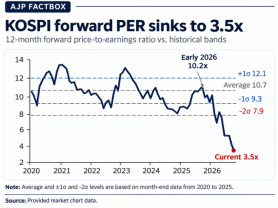 AJP Factbox: KOSPI valuation crashes to 3.5x
Compiled and edited by AJP. Graphics AI-assisted.