
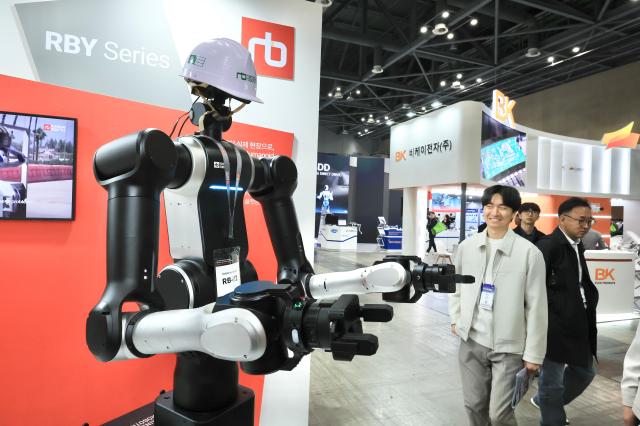
Chinese companies accounted for 21 of the 38 humanoid exhibitors at CES 2026, although Hyundai Motor Group-controlled Boston Dynamics took CNET Group's Best Robot award with Atlas. The next edition runs Jan. 6 to 9.
The competition is expected to shift from crowd-pleasing stunts toward machines that can handle tools, move goods and complete tasks with less human intervention.
"More than half will probably move toward autonomous work," said Park Dong-il, head of the advanced robotics research center at the Korea Institute of Machinery and Materials, who leads the team developing the state-backed KAIROS humanoid.
"Especially in the United States, autonomous work is being put far out front."
Only a handful of exhibitors emphasized their robots' work skills at the last show, drawing a lukewarm reception, Park said. Dancing, boxing and other athletic demonstrations will increasingly be taken for granted, with more companies expected to showcase practical tasks.
But development is moving so quickly that the demonstrations themselves remain a work in progress.
Industry sources say Samsung plans to unveil two humanoids: HR, short for Human Reference, and HE, or Humanoid Extreme. HE is the higher-end model, with more degrees of freedom — independently controlled movements that provide greater flexibility for complex tasks. Samsung has not confirmed the plans.
Samsung has also been testing a bipedal humanoid intended for round-the-clock work in factories and warehouses, with employees monitoring it in three shifts, according to sources.
Much of the attention is likely to fall on its hands.
The two models reportedly have five-fingered hands operated through tendon-like cables. A Samsung U.S. patent application published Oct. 22 describes a cable-driven finger mechanism, although the filing alone does not establish which technology will appear in the finished robots.
"Without tendons, you would have to fit an actuator into every finger joint," said You Bum-jae, a principal research scientist and former head of humanoid development at the Korea Institute of Science and Technology, who developed the MAHRU humanoid. "With tendons, the actuators can gather in the palm, so the fingers can be made slimmer."
That compact design brings its own engineering demands.
"But you have to keep the tension constant so the cables never sag," You said. "Whether they have secured all those technologies, we will have to see."
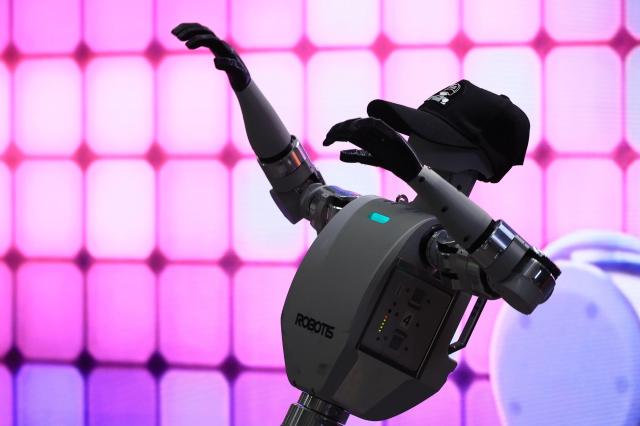
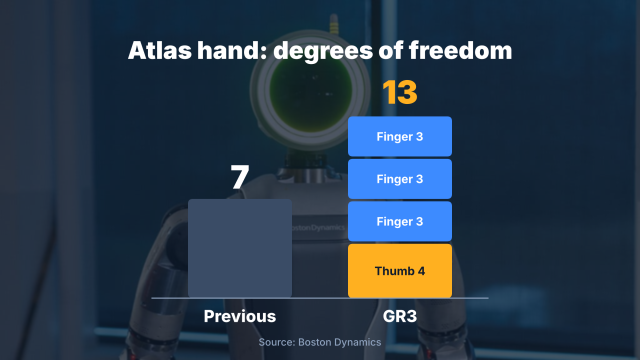
Boston Dynamics has taken a different approach with the GR3 hand unveiled for Atlas on Oct. 1. Its four fingers are driven directly at the joints, with 13 degrees of freedom. The design allows the robot to manipulate objects and operate tools, including gripping a handle while pressing a trigger.
Park said Samsung's apparent emphasis on hand dexterity reflects the same push to prove that humanoids can perform useful work.
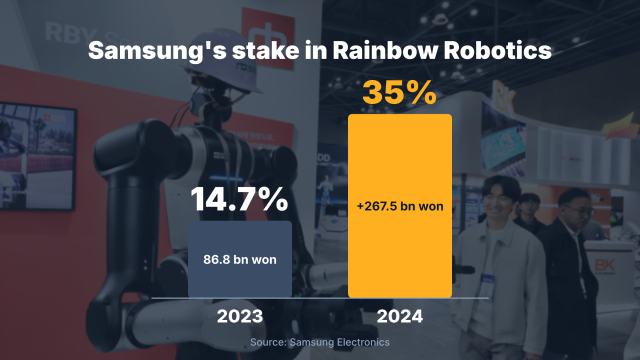
Rainbow Robotics, the HUBO developer that Samsung took control of through a deal announced in December 2024, will not operate its own booth at CES. A company official said it would participate in a government-organized robotics pavilion and declined to discuss Samsung's plans.
Oh Jun-ho, who led HUBO's development and co-founded Rainbow, continues to head Samsung's Future Robotics Office, which was incorporated into the company's new robotics unit in July. The Rainbow official declined to disclose the extent of his advice to Samsung.
The competition extends well beyond the exhibition floor.
Hyundai Motor Group aims to establish annual production capacity for 30,000 Atlas robots by 2028 as it prepares to introduce the machines into automotive manufacturing.
LG plans to unveil a bipedal humanoid in the first quarter of 2027 using Nvidia's Isaac GR00T model and Jetson Thor computing platform. That timetable makes CES a possible debut venue, although LG's announcement did not identify the show.
Tesla said in October that early production of Optimus had begun at its Fremont factory. It has announced no plans for the Las Vegas show.
Chinese manufacturers already have a substantial lead in shipments. Unitree Robotics and AgiBot each shipped more than 5,000 humanoids in 2025, out of approximately 15,000 worldwide, according to figures reported by The Associated Press.
Access to the U.S. market presents a separate hurdle. Since July 28, the Federal Communications Commission has restricted new equipment authorizations for foreign-produced advanced robotic devices, including covered humanoids made in South Korea, unless they receive conditional approval.
For Korean developers, the challenge is also to establish that the components behind their demonstrations can compete.
Reliability remains another obstacle between a compelling demonstration and a machine that can earn its place on a factory floor.
"Task success rates for models around the world are still below 90 percent," You said. "To unveil physical AI, performance has to go beyond that."
"How well it works, we will only know on the day," Park said.
Kim Dong-young
Kim Dong-young is a bilingual journalist at AJU Press (AJP), covering Korean tech, energy, and bio/pharma.
He reports from the field at events like CES and APEC, runs AJP's YouTube channels,
and is pursuing a master's at Sogang's MOT program.
Copyright ⓒ Aju Press All rights reserved.
Related News
-
 Kyobo Securities Expects Improved Performance for Samsung SDI Amid U.S. ESS Production Expansion
Kyobo Securities stated that it expects improved performance for Samsung SDI due to the expansion of energy storage system (ESS) orders in North America and the commencement of local production in the U.S., maintaining a 'buy' rating and a target price of 880,000 won (KRW). Analysts believe that increased investment in artificial intelligence (AI) data centers and power grids will support ESS demand.Choi Bo-young, a researcher at Kyobo Securities, revealed that Samsung SDI secured over 60 gigawatt-hours (GWh) of new ESS orders as of the end of October this year.The recent lithium iron phosphate (LFP) battery supply contract signed with U.S. ESS specialist Jupiter Power was also viewed positively. Samsung SDI plans to supply a total of 16 GWh of batteries to Jupiter Power over three years starting in 2029. The cumulative order volume, including existing contracts, is approximately 27 GWh.The expansion of local production in the U.S. was also cited as a factor for improved performance. Samsung SDI began mass production of LFP batteries at StarPlus Energy in the U.S. last October and is expanding its supply capacity through additional production line conversions.Kyobo Securities forecasts that increased ESS shipments and higher factory utilization rates will alleviate fixed cost burdens, and the increase in advanced manufacturing production tax credits (AMPC) due to expanded local production will support profitability. However, the stabilization of initial production yields and the ability to respond to delivery timelines for different clients are expected to influence the pace of performance improvement.In the small battery business, new market entries such as battery backup units (BBU) and aerospace and humanoid sectors are seen as growth drivers. Solid-state batteries are also being prepared for commercialization with sample shipments and evaluations by clients.Kyobo Securities projects Samsung SDI's consolidated revenue for this year to be 16.82 trillion won (KRW) and operating profit to be 558 billion won (KRW). For next year, it expects revenue to reach 20.87 trillion won (KRW) and operating profit to be 1.13 trillion won (KRW).Choi highlighted the long-term expansion of ESS orders in the U.S. and local production of LFP batteries as key investment factors. In particular, the increase in ESS shipments and the expansion of U.S. production are expected to be central to future profit growth.* This article has been translated by AI.
-
LG Group Appoints New Leadership to Drive Future Businesses in Robotics and AI
LG Group has appointed a significant number of research and development (R&D) talents to lead future businesses in robotics and artificial intelligence (AI). Most of the CEOs of major affiliates have been retained to maintain management continuity while focusing on securing technological competitiveness in emerging growth areas such as physical AI and AI infrastructure.On November 19, LG held board meetings for each affiliate and conducted its regular executive appointments for 2027. A total of 132 individuals were promoted, including 89 new executives. Among the promoted executive directors, 30% were selected from core R&D talents, and two senior research fellows at the executive level and nine senior research and specialist executives were also promoted.This appointment follows last year's generational shift focused on core business leadership and emphasizes organizational stability and enhanced execution. The retention of most CEOs and heads of business units from major affiliates highlights the advancement of talents who have achieved results in core businesses and AI transformation (AX) areas. Significant Appointments of Robotics and AI Talent; 30% of Executive Promotions from R&DThe most notable change in this appointment is the promotion of key talents in the fields of physical AI and robotics. LG Electronics promoted Song Si-yong, head of the Robotics Business Center, to executive vice president. In his 40s, Song has been instrumental in identifying business opportunities in the robotics sector and driving growth across sales, supply chain, and manufacturing.Park Gi-beom, who led the development of the Robot Foundation Model (RFM), Lee Jae-wook, head of the HS Robotics Research Institute, and Jung Woong, a research fellow responsible for humanoid robot research, were also promoted to executive directors. This move places personnel who can connect technology development with commercialization at the forefront.LG Innotek has also increased the proportion of R&D personnel among its new executives. Of the seven new executive directors, four come from the research and development sector, accounting for approximately 57%. New executives include Park Min-ha from the autonomous driving and robotics sector, Nam Sang-hyuk from the semiconductor substrate sector, Park Jae-man from the advanced packaging sector, and Lee Ji-myung from the packaging technology sector.LG Innotek is expanding its business areas into semiconductor packaging substrates such as flip-chip ball grid arrays (FC-BGA) and autonomous driving and robotics. This appointment is seen as a measure to enhance technological competitiveness in these fields and secure a growth foundation for new businesses.LG Display has also emphasized technology talent centered on OLED. Kwon Kyung-jun, who led the commercialization of core technologies, was promoted to executive vice president and appointed head of the advanced technology research institute. Yoo Jun-seok, a senior research fellow who has driven OLED technology innovation, was also promoted to the executive level. This appointment is interpreted as an effort to connect technological development achievements with product competitiveness and profitability. LG Electronics' Baek Seung-tae and Lee Sang-woo Promoted; Strengthening Performance-Based LeadershipIn core businesses, individuals who contributed to enhancing management performance and business competitiveness were promoted.In this appointment, LG Electronics promoted two presidents, three vice presidents, ten executive directors, and 29 executive directors, totaling 44 promotions. This is a 33.3% increase from 33 last year.Baek Seung-tae, head of the Home Appliance Solutions (HS) division, and Lee Sang-woo, head of the Media and Entertainment Solutions (MS) division, were promoted to presidents.Baek was recognized for leading the growth of the home appliance business and promoting the commercialization of robotic actuators. He is tasked with expanding growth areas while maintaining the competitiveness of existing home appliances and developing new businesses such as robotic components.Lee has experience in both the TV business and group management strategy. He was appointed as head of LG Electronics' MS division and display division based on his experience in management strategy at LG Corp. He now faces the challenge of enhancing profitability and competitiveness in the media business amid intensified competition in the TV market.The new vice presidents include Park Ji-hwan, chief financial officer (CFO) and chief risk management officer (CRO), Lee Jae-hyun, head of the ES Applied Division, and Lee Jin-hyo, head of the Legal Group and compliance office.Vice President Park was recognized for improving cost competitiveness, Vice President Lee Jae-hyun for production and logistics efficiency, and Vice President Lee Jin-hyo for legal risk management and governance improvement. This reflects an intention to strengthen management capabilities in finance and law alongside business expansion.In LG Innotek, Jo Gi-tae, head of the Package Solutions Division, was promoted to vice president. In LG Chem, Kim Sang-min, head of the petrochemical division, and Kim Mu-yong, head of the life sciences division, were also promoted to vice president. This appointment empowers executives to enhance the competitiveness of existing businesses and drive business structure improvements. Expansion of AI Data Center Cooling Business; Reorganization Focused on OLEDThis appointment is linked not only to personnel renewal but also to the reorganization of business structures. LG Electronics has reorganized its business units focused on growth areas such as AI data center (AIDC) cooling solutions, mobility, and smart factories.A new Applied Division has been established under the Eco Solutions (ES) division. This organization aims to expand the cooling solutions business for AI data centers. A new production subsidiary will be established in Virginia, USA, to enhance the production capacity of large cooling equipment, including chillers.With the expansion of investments in AI data centers, the importance of cooling technologies that efficiently manage heat generated in servers and semiconductors is increasing. LG Electronics plans to target the data center cooling market based on its existing heating, ventilation, and air conditioning (HVAC) technology.In the mobility sector, new organizations for high-performance computing (HPC) and advanced driver-assistance systems (ADAS) development have been established. The smart factory business organization has also been reorganized to lay the groundwork for expanding automation technologies in production sites to external businesses.Overseas regional representatives have been reorganized to report directly to the CEO, and a new Global Partnership Center has been established. This measure aims to reduce decision-making steps in overseas operations while strengthening cooperation with global big tech companies.LG Display has also reorganized its structure to align with the transition to an OLED-centered business model. The existing three business units for large, medium, and small displays have been integrated into two units for medium-large and small displays. This aims to enhance the competitiveness of the medium OLED business and improve decision-making efficiency and resource allocation between business units.In this appointment, a total of 17 individuals, including six executive directors and eleven executive directors, were promoted or newly appointed. Lee Jeong-hee, who transferred from LG Electronics, was promoted to executive vice president and appointed CFO. This strengthens financial management capabilities alongside technological competitiveness. Most CEOs Retained; Strengthening Internal Controls for Management StabilityIn this appointment, LG retained most of the CEOs and heads of business units of major affiliates. Following last year's generational shift focused on core business management, this year aims to allow existing executives to concentrate on achieving business results.However, new leadership has been reinforced in some organizations that require a response to changes in the business environment. Three heads of business units were newly appointed in LG Electronics and LG Chem, and the CEOs of LG HelloVision and Farm Hannong were also replaced.The group-level internal control system has also been reorganized. Ha Beom-jong, head of LG's management support division, will serve as the CEO of the LG Management Development Institute and lead the Integrity Management Task Force (TFT). He will oversee group audits and management diagnostics while strengthening compliance, security, and internal control functions. Ha is expected to be appointed as CEO after the upcoming shareholders' meeting and board of directors.This appointment also includes the selection of seven new female executives. Continuing the trend of selecting talents based on expertise and performance, it aims to enhance diversity in leadership within the organization.* This article has been translated by AI.
-
Chinese Ambassador: 'Hot Pot and Tteokbokki in Daily Life'... China Promotes Korea-China Cooperation
The People's Daily, the official newspaper of the Chinese Communist Party, published an op-ed by the Diving Ambassador to South Korea on November 19, expressing optimism for Korea-China friendship and cooperation. The front page of the People's Daily also featured articles and photos related to the Korea-China summit held the previous day during the Asia-Pacific Economic Cooperation (APEC) leaders' meeting. Chinese state media have been consistently promoting messages of improving Korea-China relations and expanding cooperation in economic and cultural fields in conjunction with the Shenzhen APEC.In the op-ed titled 'From Gyeongju to Shenzhen, We Must Leap to a New Stage of Korea-China Friendship and Cooperation,' the Diving Ambassador assessed that there is great potential for the development of Korea-China relations as the two countries approach the 35th anniversary of diplomatic ties next year.The ambassador stated, 'Currently, a transformation not seen in a century is rapidly unfolding globally, and various challenges are constantly emerging,' emphasizing that in the new international situation, both countries must work together to eliminate external obstacles and elevate their friendship and cooperation to a new level.He particularly noted, 'China's development and progress are not a threat to Korea but an opportunity,' asserting that the two countries should solidify their strategic cooperative partnership and respect each other's core interests to become 'long-term neighbors and reliable partners.'The ambassador also evaluated that Korea-China cooperation has encountered new opportunities amid the ongoing technological and industrial revolutions. While it is true that competition between the two countries has somewhat intensified, the strategic importance of cooperation and mutual benefit remains unchanged. He emphasized that China possesses a vast market, a complete industrial supply chain, abundant talent, and extensive application fields, indicating significant potential for expanding cooperation areas and innovating cooperation models.The importance of expanding people-to-people and cultural exchanges was also highlighted. The ambassador noted that thanks to visa facilitation measures, a convenient living zone across the Korea-China border is being formed. He mentioned that Chinese-style hot pot and Korean-style grilled pork belly, as well as Chinese-style mala soup and Korean-style tteokbokki, are increasingly becoming a natural part of daily life for the citizens of both countries. He also expressed hope that active exchanges in various fields such as think tanks, media, sports, and culture will bring the two peoples closer together.Regarding the situation on the Korean Peninsula, he stated, 'China has consistently worked to safeguard peace and stability on the Korean Peninsula and will continue to play an active and constructive role.' He emphasized that Korea and China should jointly oppose protectionism and practice genuine multilateralism. He argued that being vigilant against 'new military imperialism' would help protect the legitimate rights and interests of both countries and uphold fairness and justice in the international community.The front page of the People's Daily prominently featured articles and photos related to the Korea-China summit between President Lee Jae-myung and Chinese President Xi Jinping, alongside articles on the China-Russia summit and U.S. President Donald Trump's visit to China.The main headlines on the front page included Xi's keynote speech at the APEC CEO Summit and his welcoming remarks at the APEC welcome dinner, while the article on the Korea-China summit was published as a major diplomatic agenda alongside the China-Russia summit and Xi's meeting with President Trump.According to reports, during the Korea-China summit, the leaders of both countries evaluated the achievements in the development of Korea-China relations and discussed practical cooperation measures that citizens can feel, including expanding mutually beneficial economic cooperation in trade and investment, revitalizing people-to-people exchanges, and enhancing cultural and content exchanges. Notably, President Xi expressed his willingness to 'gradually promote healthy and beneficial cultural exchanges,' raising expectations for a substantial easing of the Korean cultural content ban and the resumption of exchanges.Chinese state media are highlighting the potential for Korea-China cooperation not only in economic and diplomatic areas but also in culture and advanced technology, in light of the Shenzhen APEC. The previous day, the Chinese state-run Global Times introduced a physical artificial intelligence (AI) fashion show called 'Maha 33' held in Hong Kong on November 16. This event featured participation from Korean and Chinese companies, and Chinese humanoid robots drew attention by dancing to K-Pop music.The Global Times noted the business model that combines Korea's entertainment content with China's humanoid robot manufacturing technology, evaluating that this event showcased new possibilities for technological cooperation between Korea and China.* This article has been translated by AI.