
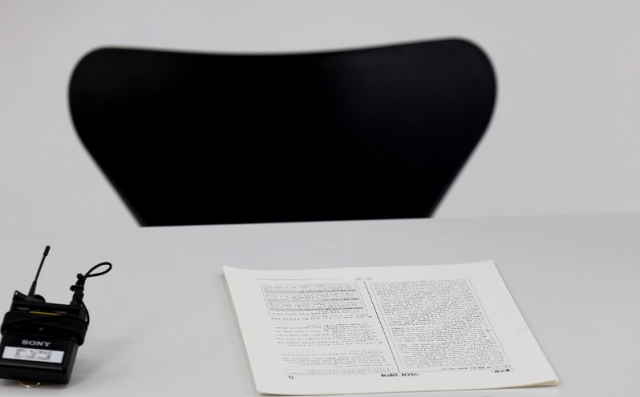
SEOUL, November 20 (AJP) - South Korean teachers were told to inspect glasses, cover clothing buttons and watch for hidden cameras during Thursday’s college entrance examination. Some now doubt whether even that level of vigilance can guarantee a fair result.
“How are we supposed to stop someone who is determined to cheat?” said one teacher interviewed by AJP. “It almost feels like we have reached a point where there is nothing we can do.”
For teachers supervising the College Scholastic Ability Test, known as the CSAT or suneung, artificial intelligence has added a new burden to an already demanding assignment. They must detect increasingly discreet devices while keeping examination rooms quiet and avoiding disruptions that could disadvantage honest candidates.
The challenge is no longer simply whether a supervisor can catch someone cheating. It is whether students, parents and teachers can remain confident that everyone in the room is working under the same conditions.
“The Suneung determines whether students get into university. It is also the final stage of their public school education, so the pressure and stress are enormous,” another teacher told AJP.
That pressure extends to supervisors, the teacher said. Students and parents are sensitive to anything that might interrupt concentration, leaving teachers anxious about how actively they can monitor the room.
“In the past, teachers could walk around and check whether students were taking the exam properly or cheating,” the teacher said. “Now, we often have to remain almost completely silent at the front or back of the classroom. Even making a noise or disturbing a student could lead to complaints or legal action.”
Concealed electronics make that tension harder to manage. Detecting a miniature camera may require closer inspection; closer inspection may itself disturb an examination.
“Fairness is the lifeblood of an examination. Now that very fairness is being tested,” the teacher said. “Once that trust is broken, how can we possibly rebuild it?”
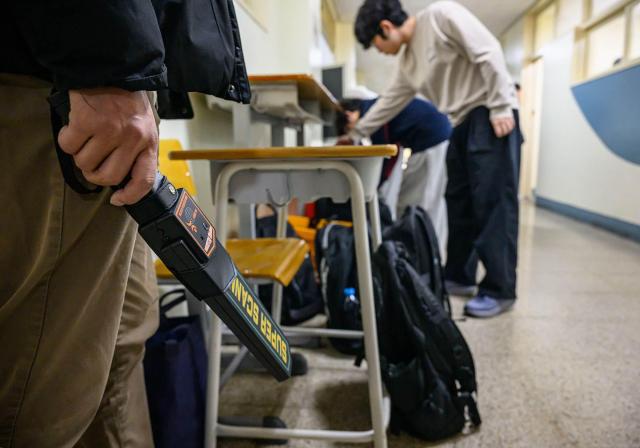
Another rule for teachers to learn
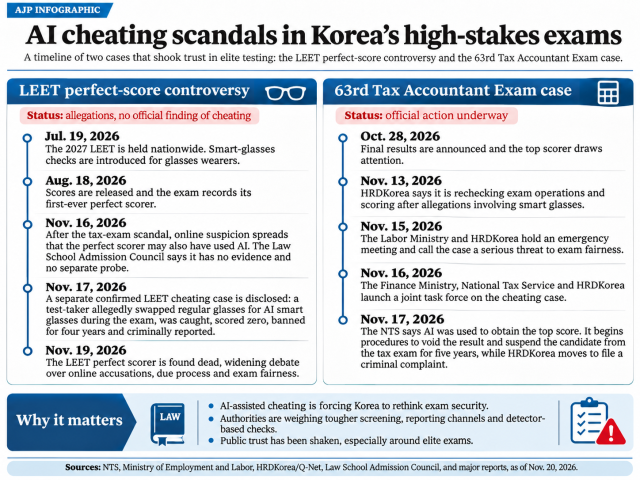
The security measures followed revelations that the top scorer in this year’s national tax accountant examination had used generative AI and concealed electronics to cheat.
The 34-year-old, identified by his surname Han, returned to police on Friday for procedures involving the examination of digital forensic material. It was his third appearance that week. Investigators had searched his home and seized equipment.
Local reports describe equipment disguised as ordinary examination supplies, including a miniature camera hidden in a correction-tape dispenser and a modified calculator, alongside a smartphone and a small display. Police are examining how the devices were used.
The case brought the threat directly into the familiar surroundings of an examination desk. Stationery and eyewear could no longer be treated simply as stationery and eyewear.
Ahead of Thursday’s CSAT, authorities tightened restrictions on personal writing supplies, introduced additional eyewear inspections and instructed supervisors to cover buttons that might conceal cameras. Teachers faced further training and changes to procedures close to examination day.
For the teacher who questioned whether determined cheating could be stopped, each additional precaution also meant another responsibility.
“Whenever something goes wrong, new rules are introduced, and teachers are the ones who have to learn them,” the teacher said. “We might end up staying awake all night trying to understand another set of regulations.”
“Putting stickers over buttons honestly seems excessive. We need to find a way to stop these electronic devices, but I don’t think the answer will come easily or quickly.”
The concern is not that examination security is unnecessary. It is that teachers are being asked to enforce an expanding set of technical precautions without confidence that those precautions can keep pace with the equipment they are meant to detect.
What the checks uncovered
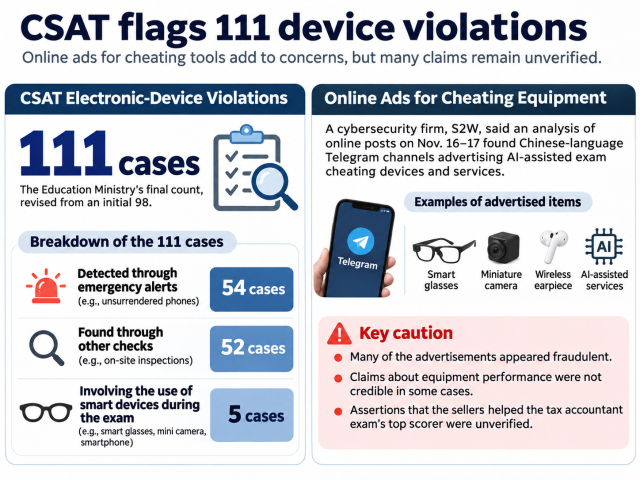
The Education Ministry said Friday that 111 electronic-device-related violations had been detected during the CSAT, revising its initial tally of 98.
Emergency alerts exposed devices in 54 cases, while other checks uncovered another 52. Five cases involved the use of smart devices during the examination.
Those figures do not establish that 111 candidates used AI. Most concerned breaches of rules on electronic devices. Possessing a prohibited phone and using a device to obtain outside assistance are different findings, even though both can violate examination regulations.
The distinction matters for public confidence. The tally shows that checks detected prohibited equipment. It cannot establish how much misconduct went undetected, or justify treating every electronic-device violation as evidence of AI-assisted cheating.
Meanwhile, advertisements for purported cheating equipment are feeding fears about what supervisors might miss.
South Korean cybersecurity company S2W said an analysis of online posts on Nov. 16 and 17 found Chinese-language Telegram channels advertising AI-assisted examination devices and services. Some sellers invoked the Korean tax accountant scandal to promote their products.
But S2W also warned that many advertisements appeared fraudulent, including claims about equipment that could not plausibly perform as promised. Sellers’ assertions that they had helped the tax accountant examination’s top scorer were unverified.
The advertisements are therefore not proof of a functioning device or a completed transaction. They nevertheless add to an information environment in which candidates and supervisors struggle to distinguish demonstrated capabilities from sales pitches and rumors.
When a high score invites suspicion
Evidence of declining confidence extends beyond examination rooms.
In a survey released Wednesday by research company PMI, 79.5 percent of 1,000 respondents aged 20 to 59 said their trust in high examination scores had fallen following the tax accountant scandal.
The survey also found that 77 percent supported stronger supervision, but respondents differed over acceptable limits. While 46.7 percent favored stronger measures even with privacy concerns, 30.3 percent supported only limited reinforcement that minimized intrusion.
The findings capture the competing demands facing supervisors: detect more, inspect more closely and provide greater reassurance, while protecting candidates from unnecessary scrutiny.
For honest students, the uncertainty cuts both ways. They need protection from competitors receiving unauthorized help. They also need confidence that an unusual pair of glasses, an innocent movement or an exceptional score will not automatically be treated as evidence against them.
President Lee Jae Myung acknowledged the limits of existing safeguards on Friday, calling for a comprehensive overhaul of the state examination system to reflect technological change.
He directed authorities to work with AI companies to investigate suspected misconduct and called for coordinated measures covering both public and private examinations.
For teachers, the practical question is what that overhaul will require of the people standing at the front and back of the room. More instructions may expand their duties without resolving their doubts about what they can reliably detect.
The teacher who described the fear of complaints returned to the question of confidence in the result.
“Even if we continue supervising examinations, how can we restore fairness once people no longer believe in it?”
Joonha Yoo
Joonha Yoo is a bilingual journalist at AJU Press (AJP), covering music, culture, entertainment and Korea’s automotive industry.
Raised in Fort Collins, Colorado, he often writes from the scene, bringing firsthand detail to stories ranging
from BTS comeback concerts to unique cultural events that catch the world's eye.
Copyright ⓒ Aju Press All rights reserved.
Related News
-
 Easier CSAT raises the bar for Korea's top universities
SEOUL, November 20 (AJP) - South Korea's top universities are expected to see higher admission score cutoffs after an easier national college entrance exam, with leading medical schools projected to require nearly perfect scores. Jongro Academy, a major private education institute, estimated Friday that Seoul National University's medical school would require 298 out of 300 points, up four from last year. The forecast was based on preliminary results from Thursday's College Scholastic Ability Test (CSAT), South Korea's national university entrance exam. At Seoul National, Yonsei and Korea universities, widely regarded as the country's three most prestigious institutions, business program cutoffs were estimated at 287, 283 and 283 points, respectively. Semiconductor engineering programs at Yonsei and Korea universities were expected to require 281 points, up 10 and 12 points, respectively. The estimates apply to regular admissions, which rely heavily on CSAT scores, and remain preliminary pending official exam results. Tags: South Korea CSAT, 2027 College Entrance Exam, Seoul National University, Medical School Admissions, University Admission Scores
-
College Entrance Exams Begin Following the CSAT; 14 Universities Start Essays and Interviews This Weekend
The 2027 College Scholastic Ability Test (CSAT) has concluded, and the schedule for university-specific entrance exams (essays and interviews) is set to begin immediately. Starting this weekend (November 21-22), 14 universities, including Korea University, Sogang University, Sungkyunkwan University, and Kyung Hee University, will conduct essay exams, followed by a flurry of interviews for comprehensive student evaluations that will continue into early December. On November 20, the admissions information platform JinHakSa reported that 44 universities conducting essay evaluations have concentrated their schedules over the next two weekends (November 21-22 and November 28-29), with 14 universities holding exams during this period. This weekend, on the 21st, the following universities will conduct essay exams: Konkuk University, Kyung Hee University (some humanities and medicine), Korea University (natural sciences), Sogang University (natural sciences), Sungkyunkwan University (language type), Sookmyung Women’s University (some humanities and natural sciences), Soongsil University, Seoul Women’s University, Suwon University (natural sciences), and Korea Aerospace University. On the 22nd, the following universities will continue: Catholic University (medicine), Kyung Hee University (some humanities and natural sciences), Korea University (humanities), Dongguk University, Sogang University (humanities), Sungkyunkwan University (mathematics type), Sookmyung Women’s University (some humanities), Suwon University (humanities), Korea University of Technology and Education, and Hongik University (Sejong). Among these, Sogang University (123.65 to 1) and Sungkyunkwan University (102.37 to 1) recorded high competition ratios exceeding 100 to 1 this year. Next weekend, on November 28-29, Hanyang University (134.47 to 1), which recorded the highest overall competition ratio among the 44 universities, will hold its essay exam, along with Chung-Ang University (general type), Ewha Womans University, Hankuk University of Foreign Studies, Kyungpook National University, Pusan National University, Sejong University, Kwangwoon University, and Gachon University. Following that, on December 5-6, the second highest overall competition ratio, Kookmin University (131.63 to 1), along with Ajou University, Inha University, and Hanshin University, will complete the final essay schedule. This year, the average competition ratio for essay evaluations was around 48 to 1, with a significant influx of applicants in the medical and pharmacy fields. Kyung Hee University’s Korean Medicine program (humanities) saw 3,111 applicants for 5 spots, resulting in a record competition ratio of 622.20 to 1. Other notable programs included Samyook University’s pharmacy program (563.40 to 1), Ajou University’s pharmacy program (527.00 to 1), and Sungkyunkwan University’s medical program (524.60 to 1), all exceeding 500 to 1. However, experts in the admissions industry agree that there is no need to be intimidated by the apparent high competition ratios. The essay evaluations often see high absentee rates as students may decide to forgo the exam if they believe they are better suited for regular admissions based on preliminary CSAT scores or if they do not meet the minimum CSAT requirements. Consequently, the actual competition ratios drop significantly. In fact, an analysis of the 2026 essay evaluation results released by Kyung Hee University, Korea University, Dongguk University, and Sogang University revealed that only 23 to 35% of initial applicants actually took the essay exam and met the minimum CSAT requirements. For Korea University, the initial competition ratio was 71.8 to 1, but the actual competition ratio, considering those who took the exam and met the minimum CSAT requirements, plummeted to 16.8 to 1. Excluding those who failed the essay, the ratio fell below 13.0 to 1, dropping to one-fifth of the initial competition ratio. Similarly, Kyung Hee University (66.6 to 1 to 19.4 to 1), Dongguk University (54.4 to 1 to 16.0 to 1), and Sogang University (107.1 to 1 to 37.2 to 1) also saw their actual competition ratios reduced to about one-third of their initial ratios. Alongside the essays, the interview schedules for comprehensive evaluations at major universities are also ramping up. On the 21st, Yonsei University’s outstanding activity type (humanities/integrated) and Ewha Womans University’s future talent type (humanities) will kick off, followed by Seoul City University (natural sciences) and Yonsei University’s international type on the 29th, and on December 6, Kyung Hee University’s Neo-Renaissance, Sungkyunkwan University’s Sungkyun Talent, and Chung-Ang University’s inquiry type talent interviews will continue every weekend. CSAT score reports will be issued on December 11, and the first round of early admission results will be finalized by December 18. Following that, early registration will take place from December 21-23, with supplementary admissions from December 24-29, and regular admissions applications will be conducted by each university from January 4-7 next year. JinHakSa’s admissions strategy research director Woo Hyun-cheol advised, “Students should quickly assess their chances for regular admissions based on their preliminary CSAT scores and decide whether to take the essay exam. Especially if they are near the expected cutoff and are uncertain about meeting the minimum CSAT requirements, it would be advantageous to actively participate in the essay exam, considering the possibility that the final cutoff may differ from expectations.”* This article has been translated by AI.
-
 Heartfelt scenes at 2027 CSAT in Yeouido, Seoul
AJP Yoo Na-hyun A student hugs her mother after completing the 2027 College Scholastic Ability Test (CSAT), South Korea's annual college entrance exam, at Yeouido Girls' High School in Yeongdeungpo District, Seoul, on the afternoon of November 19, 2026.