
Jongro Academy, a major private education institute, estimated Friday that Seoul National University's medical school would require 298 out of 300 points, up four from last year. The forecast was based on preliminary results from Thursday's College Scholastic Ability Test (CSAT), South Korea's national university entrance exam.
At Seoul National, Yonsei and Korea universities, widely regarded as the country's three most prestigious institutions, business program cutoffs were estimated at 287, 283 and 283 points, respectively. Semiconductor engineering programs at Yonsei and Korea universities were expected to require 281 points, up 10 and 12 points, respectively. The estimates apply to regular admissions, which rely heavily on CSAT scores, and remain preliminary pending official exam results.
Tags: South Korea CSAT, 2027 College Entrance Exam, Seoul National University, Medical School Admissions, University Admission Scores
Ryu Yuna
Yuna Ryu covers finance, capital markets and Southeast Asian affairs.
She is drawn to the questions that numbers raise and the stories that data alone cannot answer.
Prior to journalism, she worked at Hyundai Motor Company and the Singapore Chamber of Commerce, focusing on business strategy and international affairs. She has also hosted diplomatic receptions and international conferences as an MC.
Ryu holds a master's degree in Media and Communication from Korea University, where her research focused on neuroscience-based studies of media effects.
Copyright ⓒ Aju Press All rights reserved.
Related News
-
 First Cholera Case in South Korea in 10 Years Raises Infection Route Concerns
A cholera case has been reported in South Korea for the first time in 10 years. With no recent history of overseas travel, the infection is presumed to be domestic, and health authorities are investigating the exact route of infection.According to the Korea Disease Control and Prevention Agency (KDCA) on November 20, the patient visited an emergency room at a medical facility in Changwon, South Gyeongsang Province, on November 6 due to symptoms of vomiting and diarrhea.Medical staff suspected cholera infection and reported it on November 9, but the initial test results returned negative on November 16. However, a retest of samples taken before antibiotic treatment yielded a positive result on November 18, and the KDCA confirmed the presence of the toxin-producing cholera bacterium, Vibrio cholerae O1 Ogawa type, early on November 19.The patient was discharged on November 17 after symptoms subsided and is currently under isolation management until two consecutive follow-up tests return negative results.Notably, the patient has no history of overseas travel in the past two months, raising the possibility of domestic infection. Health authorities are conducting an epidemiological investigation to verify the patient's food intake history and travel routes, while also monitoring for symptoms among contacts.This is the first confirmed cholera case presumed to be domestically acquired since 2016. At that time, three patients were reported in Geoje, South Gyeongsang Province, prompting an investigation into the infection route.The first patient in 2016 was confirmed to have cholera after consuming raw seafood, including sashimi. Following the identification of additional cases, health authorities conducted extensive testing of seawater and shellfish in the Geoje area.During approximately 1,000 seawater tests conducted at that time, only one case of cholera bacteria was detected. The strain found at Daegye Port in Geoje showed a high genetic similarity to the strain isolated from the patient, but the exact route of infection was not clearly identified.With another patient emerging without a history of overseas travel, the likelihood of domestic infection is increasing, but the source of the infection remains unconfirmed.Cholera is primarily transmitted through food or water contaminated with the cholera bacterium. The incubation period ranges from a few hours to a maximum of five days, with severe watery diarrhea being a common symptom. In severe cases, dehydration and shock can occur, making prompt treatment crucial.Im Seung-kwan, head of the KDCA, emphasized the importance of following preventive measures such as proper handwashing, safe drinking water, and cooking food thoroughly to prevent cholera and other waterborne and foodborne infectious diseases. He urged individuals to seek medical attention if they experience recurring or persistent watery diarrhea after traveling abroad or consuming seafood.* This article has been translated by AI.
-
AI blocks 512 million spam calls, texts in Korea
SEOUL, November 20 (AJP) - SEOUL, November 20 (AJP) — South Korea blocked 500 million malicious texts and 12 million spam calls using artificial intelligence (AI) and data shared with Samsung Electronics and LG Uplus, the Korea Internet & Security Agency (KISA) said Friday. Samsung's AI-powered message blocking service has filtered malicious texts since its launch in March 2025. LG Uplus's AI calling service, ixi-O, helped block 12 million spam calls in three months after joining the initiative in July. KISA and the Korea Media and Communications Commission (KMCC) announced the results Friday in Seoul. KISA uses AI to analyze spam reports and shares the data with companies and authorities to combat fraud and illegal activities. Tags: South Korea, AI Spam Blocking, KISA, Samsung Electronics, LG Uplus, ixi-O, Smishing, Cybersecurity
-
 Editorial: Korea needs new direction in education and a new chief
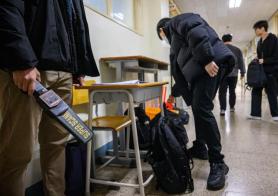
Student bags searched with metal detectors at this year's College Scholastic Ability Test sites on Nov. 19, 2026 (Pool photo) South Korea’s education system stands at a crossroads. Artificial intelligence is transforming how knowledge is produced and shared, how industries operate and how people work. Yet education remains bound to examinations, scores and university rankings. A system that should be preparing the country for its future is preoccupied with administering its past. The government must confront whether the Education Ministry has the vision, authority and leadership to meet this transformation. Replacing the minister should be part of that reckoning. The College Scholastic Ability Test held on Nov. 19 for 2027 university admissions exposed the problem. The ministry reported 111 device-related violations, including five cases involving the use of smart devices during the examination. Smart glasses, miniature cameras and wireless earphones have become threats to examination integrity. Authorities deployed emergency alerts and electronic detection measures to uncover prohibited devices. The discoveries show that parts of the monitoring system worked. Whether that system can continue to guarantee fairness as cheating methods become more sophisticated is another question. The death of a perfect scorer on the Legal Education Eligibility Test amid allegations of misconduct has also shaken the country. Neither the allegations nor the circumstances of his death should invite premature conclusions. The case has nevertheless intensified debate about a society that attaches extraordinary weight to examination results. The fundamental issue extends beyond individual violations. What kind of people is Korea educating for an age in which AI is reshaping intellectual work? Does the ministry have a coherent national strategy for developing their abilities? The Education Ministry must become capable of answering those questions. China’s university reforms offer a useful comparison. Beginning in the 1990s, Beijing pursued sustained investment in higher education and research through Project 211, followed by Project 985 in 1998 to develop world-class research universities. These initiatives connected university development to the country’s scientific and technological ambitions. Tsinghua University extended its engineering strengths into semiconductors, information technology and AI. Peking University maintained its traditions in the humanities and social sciences while strengthening mathematics, physics, computer science and the life sciences. Both became central institutions in China’s research system. Korea should not copy China’s state-directed model. Academic freedom, university autonomy and the freedom to pursue unconventional research are indispensable. But the discipline of connecting a long-term national strategy with sustained investment in universities deserves attention. Korea has outstanding research institutions, including the Korea Advanced Institute of Science and Technology, Pohang University of Science and Technology and Seoul National University. It also has researchers producing world-class work in semiconductors, AI and biotechnology. The challenge is to bring the wider education system up to the pace of the changes around them. The concentration of talented students in medicine illustrates the imbalance. Medicine, law and business are necessary disciplines. The problem is a system in which pursuing scientific research, technological innovation or entrepreneurship too often offers less security, reward and recognition than entering an established profession. As countries compete in AI, semiconductors, robotics and aerospace, Korea continues to place excessive weight on entrance scores and the name of the university on a graduate’s résumé. Simply adding places in science and engineering departments will not resolve this. Universities must strengthen basic science and advanced engineering while connecting them more closely with the humanities, social sciences and business. Students need to learn how to identify new problems, assess technology’s social consequences and devise original solutions, as well as how to use AI. The ministry is already pursuing AI education and talent-development programs. It designated 1,141 schools to lead AI education this year and established a joint AI talent task force with the science ministry. These are meaningful initiatives. They do not, by themselves, amount to a transformation of the education system. Success should be measured by changes in teaching and research, the development of researchers and the strength of connections between education and working life. Counting programs and distributing grants is insufficient. The ministry’s organization and responsibilities need a comprehensive redesign. First, it should take a stronger coordinating role in national talent strategy. The ministries responsible for education, science, industry and employment must work within a common framework. University teaching, research funding, workforce needs and lifelong learning cannot continue to be administered as separate concerns. Second, universities need greater autonomy alongside clearer accountability. The ministry should retreat from detailed control through enrollment quotas, institutional evaluations and narrowly prescribed funding programs. Universities should have greater freedom to establish departments, redesign interdisciplinary courses and pursue joint research with companies. In return, they must answer for educational quality, research performance and students’ development. Third, universities should be encouraged to serve different purposes. Not every institution needs to compete for the same place in the same hierarchy. Research universities, institutions specializing in regional industries, vocational colleges and centers for lifelong learning should each have a distinct role. Regional universities need opportunities to grow with local industries, research institutes and governments, rather than being treated as smaller replicas of institutions in Seoul. Fourth, AI literacy must become a basic capability available to everyone. Schools should teach responsible AI use alongside mathematics, science, logical reasoning and ethical judgment. Universities should connect AI with individual disciplines. Workers need accessible retraining, while older people and retirees must also have opportunities to learn and participate. Education for the AI age cannot end at graduation. Fifth, technological and humanistic education must advance together. As AI processes more knowledge and robots perform more work, conscience, responsibility and moral judgment become increasingly consequential. History, philosophy, literature and the arts deserve a central place in education. Korea needs people capable of creating technology and deciding wisely how it should be used. Leading this transformation requires a different standard for the education minister. Familiarity with administrative practice is no longer enough. The minister must understand scientific and technological change and have demonstrated the ability to lead institutional reform. Experience running a university — managing teaching, research, appointments, finances, international partnerships and industry collaboration — would be a substantial asset. The next minister must understand industry’s needs while defending academic freedom and education’s public purpose. Above all, that person must see AI education as an opportunity for the whole population, rather than a program reserved for a small technical elite. Education Minister Choi Kyo-jin brings long experience as a teacher, education activist and superintendent of education in Sejong. That record deserves respect. But the reform Korea now needs extends beyond school administration and educational welfare. It reaches into the country’s scientific capabilities, industrial development and capacity to adapt over the coming decades. The government must assess its education leadership against that responsibility. Changing one person will not repair the system. Nevertheless, changing national strategy requires someone able to design it, secure support for it and carry it through. A new minister should take office with a plan to reorganize the ministry, reform universities and expand AI education across society — and accept responsibility for measurable results. The timetable should be explicit. Within 100 days, the government should establish a coordinated reform structure across the relevant ministries. Within a year, it should implement changes to regulations governing university teaching, research and industry collaboration. Progress should then be assessed at three-year intervals against access to AI education, the development of talent in advanced fields and the research and employment outcomes of regional universities. Where results fall short, policies, budgets and leadership should be reconsidered together. Education helped Korea achieve industrialization and democratization. It must now equip the country for another transformation. The examination-centered system associated with past success cannot be assumed to guarantee future prosperity. The education minister’s responsibility reaches beyond the next examination cycle to the next generation. Korea needs leadership capable of preparing for the next 30 years. The government should appoint it — and give it the mandate to rebuild.