

Concerns are rising in Japan as Jensen Huang, CEO of Nvidia, recently visited China, Taiwan, and South Korea but skipped Japan. Despite Japan's strengths in semiconductor materials and equipment, it is falling behind in the AI revolution led by Nvidia's key partnerships with South Korea and Taiwan.
The Nikkei reported on June 14 that Huang's absence from Japan during his tour of Asia indicates not only a weakening of Japan's semiconductor industry but also the risk of falling behind in the AI revolution.
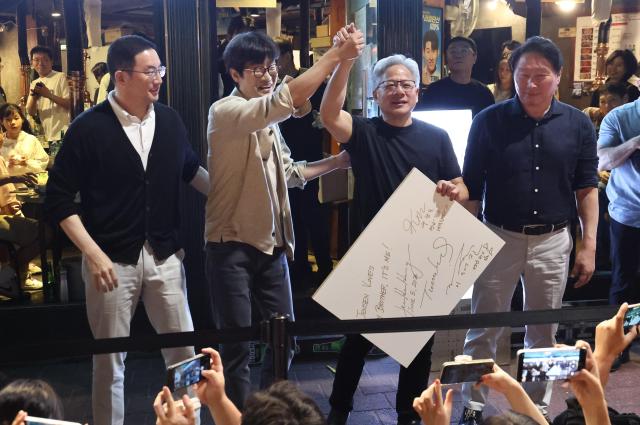
Huang visited Taiwan and South Korea from late May to early June. In Taiwan, he described the country as the "center of the AI revolution," while in South Korea, he expressed gratitude to local partners. He met with executives from major companies like TSMC and Foxconn in Taiwan and engaged with key figures in South Korea's business community, including SK Group's Chey Tae-won. His visit also included appearances on popular entertainment programs and throwing the first pitch at a professional baseball game, garnering significant local media attention.
The Nikkei noted that all the countries Huang visited play crucial roles in Nvidia's AI semiconductor supply chain. As a fabless company, Nvidia heavily relies on TSMC for advanced semiconductor production. Additionally, Nvidia's graphics processing units (GPUs) require high-bandwidth memory (HBM) from South Korea's SK Hynix and Samsung Electronics to achieve optimal performance.
Nvidia plans to launch an "AI Factory" in collaboration with SK Group in South Korea by 2027. This initiative aims to combine GPUs and HBM to enhance computational efficiency while reducing power consumption. SK intends to market this AI Factory to Asian markets, including Japan. Nvidia is also collaborating with LG, Hyundai Motor, and Doosan in the field of "Physical AI" for autonomous robots.
In contrast, collaboration with Japanese companies is relatively limited. While Japan has semiconductor manufacturing equipment firms like Tokyo Electron and Advantest, and wafer material companies like Shin-Etsu Chemical, few engage directly with Nvidia. The Nikkei reported that an executive from a Japanese equipment company referred to Nvidia as merely a "customer's supplier," suggesting that Nvidia is seen more as a partner to existing clients like TSMC rather than a direct customer.
However, Nvidia is not entirely absent from Japan. Huang announced last year that Nvidia would collaborate with Fujitsu to jointly develop AI semiconductors. Additionally, major industrial robot manufacturer Fanuc is working with Nvidia to develop AI-enabled robots. Nonetheless, the Nikkei pointed out that the scope of joint development with Japan is narrower compared to that with South Korea and Taiwan.
The Nikkei emphasized that the issue is not just about which countries Huang visited. Nvidia is elevating Taiwanese and South Korean companies from mere component suppliers to partners in designing AI infrastructure. During a lecture in Taiwan, Huang referred to Nvidia multiple times as an "AI infrastructure company." This strategy aims to expand revenue sources beyond GPU supply to include data centers, AI PCs, robots, and manufacturing automation in collaboration with partners.
For Japan, this could mean remaining merely a "customer" for American tech giants' services and systems in the AI era. The Nikkei noted that while prominent AI companies like Anthropic and Palantir have recently visited Japan, they view the country more as a market for selling systems rather than as a partner in AI development.
The Japanese government is also concerned about its reliance on foreign technology in the digital sector. The Ministry of Economy, Trade and Industry estimated last April that Japan's digital trade deficit could reach 18 trillion yen by 2035. The Nikkei concluded that whether Japan can become a partner to leading companies like Nvidia in the AI revolution will significantly impact its future economic prosperity.
* This article has been translated by AI.
Copyright ⓒ Aju Press All rights reserved.