
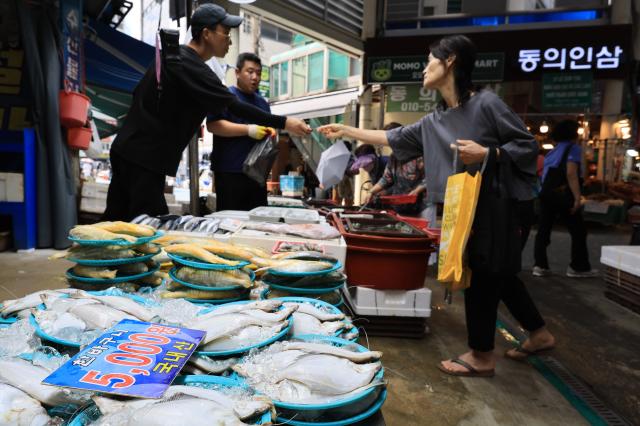
A citizen purchases seafood at Gyeongdong Market in Jegi-dong, Dongdaemun-gu, Seoul, August 13, 2026.

Han Jun-gu
Photojournalist, AJU PRESS (AJP)
Covering Asia's defining stories — from pressing issues and politics to culture and society — through a distinctly Asian lens.
Copyright ⓒ Aju Press All rights reserved.
Related News
-
 Ministry of Oceans and Fisheries to Conduct Special Inspections on Salt and Fermented Seafood Origin During Kimjang Season
The government is set to launch special inspections on the origin labeling of key seafood products, including solar salt and fermented seafood, as the kimjang season approaches. This initiative aims to prevent the sale of imported goods disguised as domestic products, ensuring consumers can purchase kimjang ingredients with confidence.The Ministry of Oceans and Fisheries announced on the 22nd that it will conduct special inspections on the origin labeling of seafood products from the 23rd to December 4th. This inspection comes as demand for key ingredients like solar salt and fermented seafood surges during the kimjang season, raising the likelihood of fraudulent distribution practices that misrepresent cheap imports as domestic products.Key inspection targets include solar salt and fermented seafood, as well as frozen squid, frozen mackerel, and frozen anglerfish, which have seen increased import volumes this year. Also included in the inspection are sea cucumbers and fish such as yellowtail and sea bream, which have recently seen a rise in imports due to high temperatures causing mortality.The ministry plans to focus on verifying the accuracy of origin labeling among fermented seafood markets and salt sellers. It will utilize distribution history information for imported seafood to ensure that the actual distribution routes align with the stated origin labeling.Companies that falsely label their products' origins may face imprisonment for up to seven years or fines of up to 100 million won (KRW) under the Act on the Labeling of Origin of Agricultural and Fishery Products. Failure to label the origin may result in fines of up to 10 million won (KRW).Park Seung-jun, director of the Ministry of Oceans and Fisheries' Aquaculture Policy Division, stated, "As the kimjang season approaches, we will thoroughly monitor traditional markets and online sales to prevent the sale of cheap imports disguised as domestic products. I urge sellers to actively participate in accurate origin labeling."* This article has been translated by AI.
-
Mokpo Opens First National Seafood Export Complex with 117.9 Billion Won Investment
A national-level infrastructure aimed at transforming the southwestern seafood industry of South Jeolla Province into a high-value processing and export sector has been established in Mokpo. The completion of the country's first seafood export complex, which consolidates processing, storage, distribution, research and development, and export support functions, positions Mokpo as a potential key hub in the global seaweed industry. The Jeonnam-Gwangju Integrated Special City announced on October 30 that it held a completion ceremony for the 'Mokpo Seafood Export Complex' at the Daeyang General Industrial Complex, with a total investment of 117.9 billion won. The ceremony was attended by over 300 participants, including Jeonnam-Gwangju Integrated Special Mayor Min Hyung-bae, the Director of Fisheries Policy at the Ministry of Oceans and Fisheries, the Mayor of Mokpo, the Chair of the Mokpo City Council, special city council members, and industry representatives. The export complex was developed over seven years from 2020 to this year, with a total investment of 770 billion won from the national government, 165 billion won from the Jeonnam-Gwangju Integrated Special City, and 244 billion won from Mokpo City. Covering an area of 28,133 square meters with a total floor area of 46,612 square meters, the complex includes 36 rental processing facilities, 10 cold storage and refrigerated warehouses, export support facilities, and an International Dried Seaweed Exchange. The core of this project is to establish an industrial base that goes beyond simple raw material sales of locally produced seafood, focusing on processing, commercialization, and research and development for overseas markets. The complex is expected to alleviate the production and distribution burdens for small and medium-sized seafood companies by consolidating processing facilities, cold storage, and export support functions that individual companies may find difficult to secure on their own. A key facility is the International Dried Seaweed Exchange. Set to begin pilot operations in February, the exchange aims to enhance price formation based on the quality of dried seaweed and improve transaction transparency, fostering trust between producers and buyers. While the seaweed industry has focused on increasing production and export growth, the standardization of quality and the establishment of a reliable trading system are emerging as critical challenges for competitiveness. If the International Dried Seaweed Exchange operates stably, it is expected to provide producers with a reasonable trading foundation and export companies with stable raw material procurement and market information. The Jeonnam-Gwangju Integrated Special City plans to link this export complex with existing seaweed industry institutions in Mokpo to create an industrial ecosystem that connects research and development, product production, and overseas market expansion. Additionally, efforts are underway to attract the National Seaweed Industry Promotion Institute and designate a seaweed industry promotion zone to develop the southwestern region into a core hub for the domestic seaweed industry. However, given the significant budget invested in the facility, securing actual operational results such as attracting tenant companies, operational rates of processing facilities, and export performance will remain important tasks. The International Dried Seaweed Exchange will also need to establish a stable trading participation base and solidify quality standards and trading operational systems to determine future competitiveness. Min Hyung-bae, Mayor of Jeonnam-Gwangju Integrated Special City, stated, "The Mokpo Seafood Export Complex is a solid foundation that connects processing, research, trading, and export to enhance the added value of seafood products while boosting the competitiveness of companies and the income of fishermen." He added, "We will fully support Mokpo in leading the global market for K-seaweed and K-seafood, ensuring that the potential of the sea translates into business growth, which in turn will enhance fishermen's incomes and create jobs in the region." The Mokpo Seafood Export Complex is the country's first national seafood export complex, and as the pilot operations of the International Dried Seaweed Exchange and the production activities of tenant companies commence, it is expected to support the high value-added and export expansion of seafood products in the southwestern region of Jeolla. There is growing interest in whether the local seafood industry can evolve from a production-centric model to one that encompasses processing, distribution, and export.* This article has been translated by AI.
-
Shinsegae Centum City Introduces Abalone Dumplings at Seafood Festival
As abalone production increases and prices drop, Wando abalone is being featured in various dishes such as dumplings, sushi, and fried chicken at a department store food hall in Busan.By offering abalone as a convenient ready-to-eat product, the festival aims to change consumer habits regarding this premium seafood.Shinsegae Centum City announced on the 16th that it will host an 'Abalone Festival' on the first basement level of its food hall until the 22nd, featuring nine types of ready-to-eat dishes made with abalone.The event will showcase a variety of dishes prepared on-site using fresh Wando abalone shipped directly from the source.Highlight dishes include abalone dumplings filled with whole abalone and abalone fried rice infused with a grilled flavor. There will also be abalone yaki, featuring grilled octopus and abalone topped with bonito flakes.Additionally, the menu includes abalone fried chicken seasoned with soy sauce, mini kimbap with abalone and seaweed, abalone fish cakes, and whole abalone snacks, all designed to be enjoyed without much fuss.This event has garnered attention due to the drop in prices linked to the increase in abalone production. Wando, which accounts for about 74% of the country's abalone production, has seen a steady rise in supply due to expanded farming facilities and improved production techniques.National abalone production increased from 23,317 tons in 2024 to 27,177 tons last year, with projections suggesting it will exceed 30,000 tons this year. The number of farming cages in Wando has also grown from approximately 660,000 in 2013 to over 1,080,000 last year. However, prices at the source have been declining.According to the Korea Maritime Institute (KMI), the price of abalone at the source fell by about 33%, from 20,664 won in 2022 to 13,851 won last year.The price of abalone, based on 1 kg (20 pieces), as reported by Wando County, also dropped from 26,000 won in 2022 to 13,000 won in July of this year. Early harvesting by farmers concerned about high summer temperatures has also contributed to the price decline.In response, the government and local authorities are working on measures to adjust supply and expand consumption. The Ministry of Oceans and Fisheries, along with the Jeonnam-Gwangju Integrated Special City and Wando County, held a meeting in July to discuss plans to reduce farming cages by 50,000 each year starting next year, and to promote the consumption of 5,000 tons of excess abalone.They are also considering promotional events in collaboration with large retailers and price compensation measures. Wando County is pushing for the establishment of processing facilities worth 20 billion won to improve the distribution structure centered on live abalone.In this context, the sale of processed abalone products through department store food halls is seen as an effort to broaden the consumer market beyond live abalone. However, it is difficult to directly compare source prices with department store prices, as ready-to-eat products also include costs for preparation, labor, and distribution.A representative from Shinsegae Centum City stated, “We have prepared Wando abalone, secured for its freshness and quality through a direct shipping system, in unique dishes. We hope visitors will enjoy this gourmet event featuring a variety of abalone menus all in one place.”* This article has been translated by AI.