

SEOUL, November 22 (AJP) - More than 45 percent of students and graduates surveyed in South Korea said it was harder for new graduates to find work this year than last year, according to a survey released Sunday.
The Federation of Korean Industries surveyed 2,489 students and graduates of four-year universities nationwide. The share who said the job market had worsened rose to 45.1 percent from 37.1 percent in last year’s survey. Just 4.8 percent said it had improved.
Active job seekers submitted an average of 10.2 applications this year. Only 18.6 percent of applications made it past the initial screening, and 23.5 percent of active job seekers said every application they submitted was rejected at that stage.
Lee Jung-woo
I studied philosophy in college, and sociology and journalism in graduate school. I cover North Korea, South Korean politics, foreign affairs and films. I enjoy Nordic cinema, Indian cuisine and Japanese detective novels. I have a cat and like bright, acidic coffee.
Copyright ⓒ Aju Press All rights reserved.
Related News
-
 Director Kim Jung-hoon's 'Final Interview' Explores Job Market Fears
The feelings experienced while watching a film, along with the day's temperature and humidity, often serve as benchmarks for evaluation. 'Choi's Review' aims to introduce films in a more relaxed and everyday manner, infused with the author's perspective and experiences. <Editor’s Note>To navigate the narrow job market, young people willingly become products themselves. They recite model answers with bright faces and embellish their qualifications to prove their flawlessness. But what if the true self hidden behind a seemingly perfect resume were to be exposed? Director Kim Jung-hoon's latest film, 'Final Interview,' unravels the most realistic fear for the youth: employment, presenting it as a closed-room thriller that questions what remains at the end of success achieved by stepping on others' shortcomings.Six candidates who have overcome odds of 5,000 to 1 gather for the final interview at the global IT company 'Spira Links.' Moon Hye-in (played by Joy Hyun), Han Jin-woo (Kim Jae-won), Baek Seung-bin (Shin Seung-ho), Lee Hee-chan (Kang Yoo-seok), Jeon Yo-han (Kwak Dong-yeon), and Cha Joo-won (Bae Kang-hee) have prepared for a month, expecting that all will pass. However, the task on interview day is unexpected: they must discuss for two hours and decide on a single successful candidate through five rounds of public voting. As candidates become evaluators, envelopes with each candidate's name reveal secrets not found on their resumes. The interview room, once promising fair competition, transforms into a stage for suspicion and accusations.Based on the novel 'Six Liars' by Japanese author Akira Asakura, 'Final Interview' primarily unfolds within the confines of the interview room. With only six characters and a two-hour timeframe, director Kim Jung-hoon, known for blending humor and adventure in films like 'Petty Romance,' 'Detective: The Beginning,' and 'Pirates: Goblin Flag,' cleverly utilizes these constraints as strengths of the genre. Each envelope opened distorts the relationships among the six, and with each completed vote, new doubts arise. They can leave at any moment, but doing so means forfeiting their chance at success. This single condition turns the space into a 'voluntary closed room' driven by desire rather than a forced confinement.The film's rhythm stands out. Although most scenes involve characters sitting across from each other, the rapid interplay of voting, revelations, suspicions, and rebuttals, combined with observational cameras and timers, heightens the pressure in the interview room. As director Kim noted, the film captures the moments when a single expression can shift the balance. The quick editing enhances the film's rhythm, alleviating the potential monotony of a closed-room drama.Another strength of the film lies in the ensemble of actors. The combination of mostly unfamiliar newcomers creates a refreshing dynamic, as their less established images make it difficult to predict who is hiding what. Their unfamiliarity aligns well with the film's mood of candidates standing at the threshold of society. Leading actors Joy Hyun and Kim Jae-won deliver strong performances at the center of the narrative, while Shin Seung-ho and Kang Yoo-seok also provide stable portrayals. Notably, Kwak Dong-yeon and Bae Kang-hee stand out; Kwak's extensive acting experience is evident on screen, while Bae exudes a compelling presence that maintains tension.Set against the backdrop of the fierce job market during the COVID-19 pandemic, the film convincingly portrays why the youth hesitate to leave even when they reach the final position. The urgent goal of passing the interview quickly erodes the trust built over a month, and the structure that requires them to evaluate each other transforms the familiar interview process into a brutal survival game. The psychological pressure depicted resonates with the younger generation, making the tension in the interview room feel relatable.The secrets within the envelopes turn the characters against each other. These contents are not entirely false but rather fragments of truth. However, when revealed without context, perceptions of the individuals change. Director Kim highlights the tendency to judge others based on limited information as a central theme of the original work. As characters oscillate between trust and suspicion, the audience becomes the 'seventh candidate' in the interview room.There are some shortcomings. While the reasons characters cannot leave are convincingly established, the path toward the story's twists and conclusion is less solid. Some parts flow functionally, and there are points where plausibility feels thin. The effectiveness and satisfaction of the twists in the latter half may vary among viewers.Nonetheless, the film's originality has ample potential to bridge these gaps. With its clever premise drawn from the original novel, combined with rhythmic editing and a strong ensemble of young actors, 'Final Interview' is set to captivate audiences. It premiered on November 4, with a runtime of 107 minutes and a rating suitable for viewers aged 15 and older.* This article has been translated by AI.
-
Job Market Disparities Persist Across Age Groups in South Korea
Disparities in the labor market based on education and region have been observed across all age groups, from youth to seniors. The youth demographic shows a concentration of stable jobs in the metropolitan area and among highly educated individuals, while middle-aged workers experience a decline in job quality after retirement, and seniors face inadequate institutional protections. The Korea Employment Information Service released a report on July 27, titled 'In-Depth Analysis of the Labor Market Using Employment Panels,' which utilized data from youth and aging employment panels to analyze labor market participation and job quality across different life stages. According to the report, a clear trend of concentration in the metropolitan area was evident in the youth labor market. More than half of the surveyed youth resided in the metropolitan area, where stable jobs were also concentrated. Those with a college degree had a higher employment rate and a lower rate of inactivity, while those with a high school diploma or less had relatively higher rates of inactivity and unstable employment. Although employment increased with age, disparities based on education and region remained unresolved. Overall, employment conditions for youth have improved. The proportion of employed youth in permanent positions rose from 64.9% in 2021 to 74.6% in 2023, while the share of temporary and daily workers decreased from 28.2% to 18.9% during the same period. However, these changes were not uniform across all groups. The proportion of permanent positions was relatively high among those in the metropolitan area and those with a college degree, while unstable employment was concentrated among those in non-metropolitan areas and those with a high school diploma or less. Thus, education and region emerged as key factors dividing the labor market. For middle-aged workers, the quality of employment significantly declined after leaving their primary jobs. Approximately 31% of respondents had already retired from their main jobs, and many of them re-entered the labor market through temporary, daily, or self-employed positions. Re-employment opportunities were often short-term, non-regular, and low-paying. Men primarily transitioned to self-employment, while women tended to concentrate in low-skilled service sectors such as caregiving, sales, and cleaning. Disparities based on education and region persisted. Social security levels also varied significantly by employment type. The enrollment rates for the National Pension among permanent workers were 73%, for employment insurance 72%, and for severance pay 83%. In contrast, the social insurance enrollment rate for temporary and daily workers remained below 30%. The Korea Employment Information Service diagnosed that re-employment positions often fall outside the protective framework of institutional support. Seniors demonstrated a strong desire to remain in the labor market. An analysis of 747 individuals aged 59 to 92 who participated in the Aging Research Panel from 2014 to 2022 revealed that 68.3%, or 510 individuals, currently held jobs. Over 90% of wage workers, self-employed individuals, and unpaid family workers expressed a desire to continue working. The Korea Employment Information Service interpreted that labor among seniors serves not only as a means of securing income but also as a way to maintain social relationships and identity. However, more than half of the employed seniors reported having no formal employment contracts, and the proportion of self-employed individuals without employees and unpaid family workers was also high, indicating that institutional protections remain weak. Kim Min-jeong, head of the Employment Statistics Survey Team at the Korea Employment Information Service, stated, "Structural disparities based on education and region persist in labor market participation and job quality from youth to seniors. Tailored employment policies that address regional disparities for youth, improve re-employment quality for middle-aged workers, and expand social security for seniors are essential." * This article has been translated by AI.
-
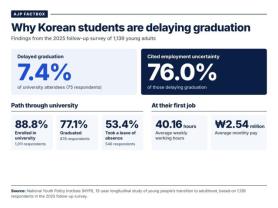 AJP Factbox: Slim job market keeps Koreans at school
Edited and compiled by AJP. Graphics AI assisted Edited and compiled by AJP. Graphics AI assisted More than three in four South Korean university students who postponed graduation cited employment uncertainty, according to a 15-year study by the National Youth Policy Institute (NYPI). Of the 1,139 respondents surveyed in 2025, 88.8 percent had attended university, while 7.4 percent of university attendees had delayed graduation. Among those who postponed graduation, 76 percent cited the need for more time to prepare for employment or fears of struggling to find a job after graduating. The study also found disparities in early employment. More than half of university attendees had taken a leave of absence, mainly for military service or career preparation. At their first jobs, respondents worked an average of 40.16 hours per week and earned 2.54 million won ($1,900) a month.