In a report on consumer prices released Wednesday, the central bank estimated headline inflation would hover around 3 percent in the second half. Core inflation, excluding food and energy, is projected to stay in the mid-to-high 2 percent range.
Inflationary pressure will likely persist into next year as income gains from higher wages and stock returns gradually replace oil-related cost pressures, the BOK said.
The latest assessment marks a sharp reversal from its previous semiannual inflation review in December, when the BOK projected inflation would remain safely around its 2 percent target.
In the near term, petroleum prices are likely to remain elevated, while later in the year the oil shock is expected to spread to non-energy core items.
Consumer prices rose 2.4 percent from a year earlier in the first five months of this year, up from 2.2 percent in the second half of 2025.
Inflation, which had been stable around 2 percent before the outbreak of the Iran war, jumped to 3.1 percent in May, the first reading above 3 percent since March 2024.
Living-cost inflation accelerated to 3.3 percent in May, adding pressure on lower-income households that spend a larger share of their income on necessities.
Core inflation also rose to 2.5 percent in May as higher fuel surcharges pushed up airfares and package tour prices.
The first-half pickup was driven mainly by petroleum and service prices. Agricultural, livestock and fishery products, by contrast, helped ease some of the upward pressure.
Before the war, the weak won and elevated fresh food prices caused by volatile weather had been the main inflation drivers.
The conflict complicated the outlook by triggering a surge in energy costs that is filtering through to groceries, production inputs and service charges on top of persistent currency weakness.
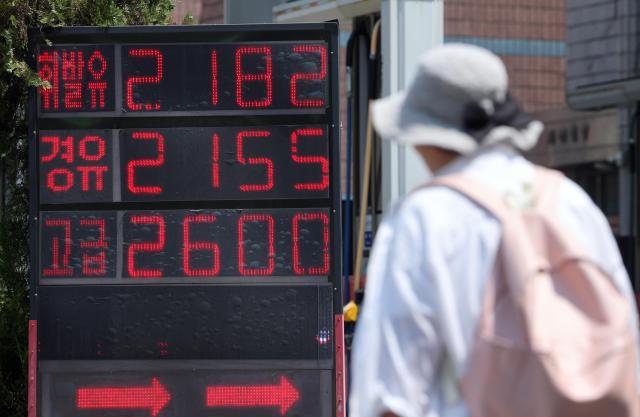
The benchmark KOSPI has more than doubled since the beginning of the year. The dollar averaged 1,467.35 won in December and 1,491.39 won in May. In June, it averaged 1,526.58 won through June 16, more than 5 percent higher than the year-to-date average.
The oil environment has softened as tensions in the Gulf have eased. The three major crude benchmarks fell below $80 a barrel on June 17 after renewed U.S.-Iran talks revived hopes that oil flows through the Strait of Hormuz could recover.
That is well below the wartime highs seen earlier this year, but still above the level that underpinned the BOK's more benign view in December.
The BOK said oil prices could continue to decline if U.S.-Iran negotiations make progress and shipping traffic through the Strait of Hormuz normalizes. But the adjustment is likely to be gradual because of infrastructure repairs and restocking demand.
The central bank also warned that earlier gains in oil prices could continue to filter through the economy with a lag even if spot prices retreat further.
The report is likely to reinforce expectations that the BOK could raise interest rates as early as its July policy meeting.
The central bank held its benchmark rate at 2.50 percent last month, but board members Chang Yong-sung and Ryoo Sang-dai dissented in favor of a 25-basis-point increase.
The BOK's latest dot plot also leaned heavily toward tighter policy, with 19 of 21 six-month rate projections pointing to a policy rate above the current level.
Market analysts increasingly expect the BOK to raise rates by 25 basis points in July, or by August at the latest, citing higher inflation and growth forecasts, elevated oil prices and a weaker won.
The BOK cited the Russia-Ukraine war as a guide to how oil shocks propagate through the economy.
During that episode, higher crude prices were rapidly reflected in petroleum products, while indirect effects on non-energy goods began to emerge about six months later.
A similar pattern could unfold this time, the central bank said. Cost pressures could spread to processed foods, dining-out services and manufactured goods even after the direct impact of higher oil prices begins to fade.
Government measures have so far cushioned some of the pressure, including caps on refinery supply prices, expanded fuel-tax cuts and frozen public utility fees.
However, the BOK warned that pressure to raise utility charges could build later this year as the oil shock works its way through the economy with a lag.
Wages are another source of risk. Special bonus payments in the IT sector surged 60.6 percent in the first quarter.
The inflationary impact would remain limited if the gains stay concentrated among a small number of companies. But broader spillovers into other sectors could amplify overall price pressures, the report said.
Inflation expectations have also moved higher. Households' one-year inflation expectations rose to 2.8 percent in May, while short-term expectations among experts moved into the mid-2 percent range.
Long-term expectations among experts, however, remained slightly below 2 percent.
The BOK said it will closely monitor inflation conditions, as price pressures are expected to remain elevated for a considerable period.
Bond yields retreated sharply as expectations of a rate-hike cycle prompted investors to take profits on earlier bets, with longer-dated securities leading the decline. By midday Wednesday, the three-year government bond yield had slipped 1.4 basis points to 3.70 percent, down sharply from 3.94 percent last Thursday. The 10-year and 20-year government bond yields fell 3.0 basis points and 3.3 basis points, respectively, to 4.08 percent and 4.22 percent.

Copyright ⓒ Aju Press All rights reserved.