

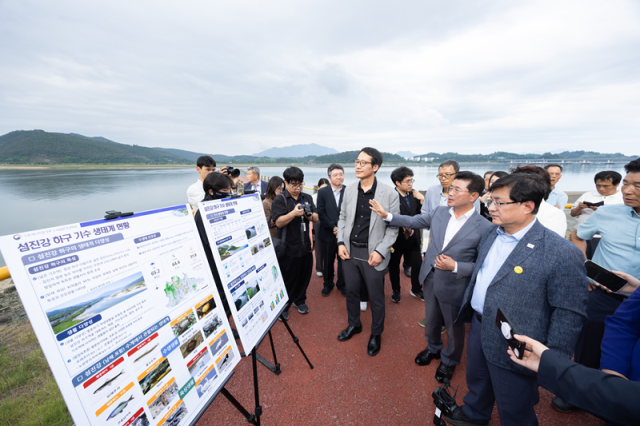
Although the inspection was timely ahead of the summer flood season, the focus was not solely on flood control. Minister Kim emphasized the need for establishing an independent Seomjin River Basin Management Office and transitioning to a 'Five Major Rivers System.'
◆ "Longer than the Yeongsan River, but lacks independent organization"...Call for transition to Five Major Rivers System
After touring the Baedaldo waterfront park in Gwangyang, Minister Kim stated at a press conference, "I believe it would be better to shift from the Four Major Rivers System to a Five Major Rivers System. It is essential to have a system that the government can manage responsibly."
The Seomjin River, a national river, stretches 222.14 kilometers with a basin area of 4,913.22 square kilometers, making it significantly longer than the Yeongsan River, which is 133 kilometers long. However, it currently lacks an independent management office and is instead managed under the Yeongsan River Basin Environmental Office and a divided structure between Jeollabuk-do and the Yeongsan River Office.
In terms of river lengths, the major rivers in South Korea are the Nakdong River at 510 kilometers, the Han River at 490 kilometers, the Geum River at 398 kilometers, the Seomjin River at 222 kilometers, and the Yeongsan River at 133 kilometers. Despite being longer than the Yeongsan River, the Seomjin River has not established an independent management system, leading to ongoing calls for a restructuring of its management.
Minister Kim noted, "This has been a concern since I took office. The Seomjin River is highly valued, ranking first among the Five Major Rivers in terms of ecological health indicators such as riparian vegetation and benthic organisms."
He added, "We are reviewing plans to establish a Seomjin River Basin Management Office to systematically manage ecological value and water quantity, and we will expedite this through consultations with relevant departments, including the Ministry of the Interior and Safety."
Regarding competition among local governments for the office's location, he said, "Namwon, Gokseong, Gurye, Gwangyang, and Hadong all hope to host it. Once the government’s decision is made, we will conduct a public recruitment process and form a fair evaluation committee to make the decision."
◆ Clam resources, water distribution, flood response...Seomjin River issues pile up
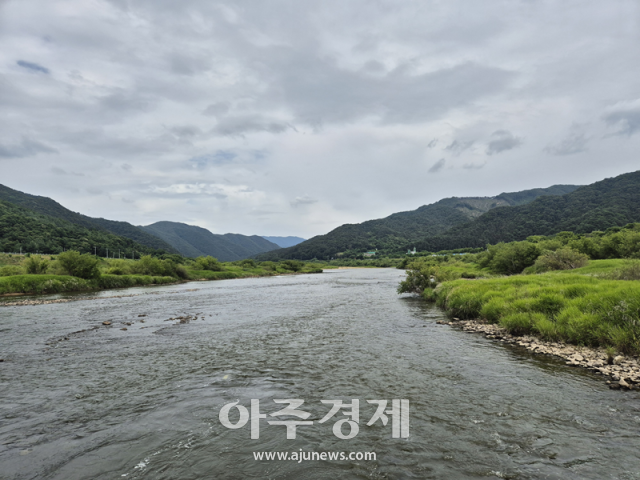
During the press conference, the decline of clam resources in the Seomjin River estuary was also a significant topic. The estuary is the largest habitat for clams in the country and represents a typical 'open estuary' where the sea and river connect naturally. While it boasts high biodiversity, it has recently suffered from reduced water quantity and salinity changes.
Minister Kim remarked, "In the past, clams were abundant in the estuary, but as the water quantity of the Seomjin River has decreased and salinity levels have risen, the areas where clams are caught have gradually moved upstream. The decrease in catch has caused harm to fishermen, and we will review systematic measures to address this issue."
The government is currently conducting related research through the Korea Environment Institute (KEI) from 2023 to next year. Minister Kim stated, "We have received a mid-term report and will further systematize the measures. We will establish a system that allows fishermen to check salinity changes in real-time and include initiatives to distribute clam seeds to support local fishermen's income."
Additionally, Minister Kim identified 'water distribution imbalance between basins' as the biggest challenge for Seomjin River policy. This issue has been entrenched since the construction of the Seomjin River Dam in 1965.
He pointed out, "Unlike other multipurpose dams, the Seomjin River Dam has a very high agricultural water supply ratio of 85%, with 83% of that water directed towards the Jeollabuk-do Dongjin River area, while only 17% flows downstream to the Seomjin River estuary."
He continued, "Regions that have historically used a lot of water consider it their right, while downstream areas always feel a sense of shortage, creating a kind of 'zero-sum' structure. In principle, it is right to consider the demands of downstream areas and increase water quantity, but we also need to prepare alternatives for the existing water-using regions in Jeollabuk-do, which is the most challenging aspect."
Regarding the primary purpose of the visit, flood measures for the summer season, Minister Kim stated, "Since the flood damage in the Seomjin River in 2020, we have expanded flood control capacity and established an AI-based flood forecasting system to enhance our response capabilities. We will thoroughly prepare to minimize loss of life."
* This article has been translated by AI.
Copyright ⓒ Aju Press All rights reserved.