

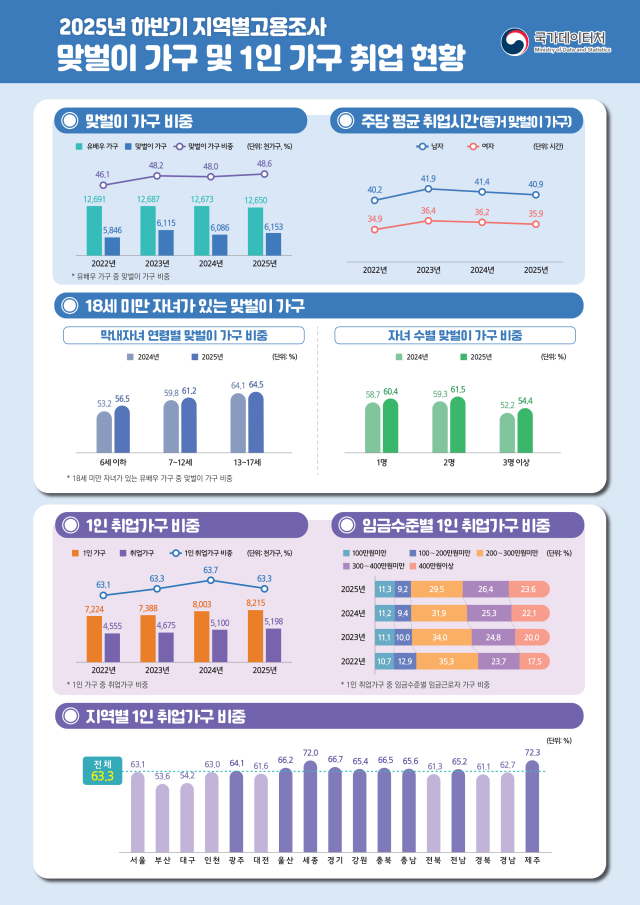
According to the National Data Agency's report on dual-income households from 2025, the total number of married couples was 12.65 million, a decrease of 22,000 from the previous year. Among these, 6.15 million were dual-income households, an increase of 67,000 from the previous year. The proportion of dual-income households among married couples rose to 48.6%, up 0.6 percentage points from the previous year.
Among dual-income households, those living together numbered 5.29 million, an increase of 62,000 from the previous year. The share of cohabiting dual-income households rose to 86.0%, up 0.1 percentage points.
By age group, the largest number of dual-income households was found among those aged 50 to 59, totaling 1.887 million, followed by 1.701 million for those aged 60 and older, and 1.624 million for those aged 40 to 49.
The proportion of dual-income households was highest among those aged 30 to 39 at 63.3% and 61.3% for those aged 40 to 49.
Married couples with children under 18 numbered 3.785 million, a decrease of 153,000 from the previous year. Among these, dual-income households with the youngest child aged 7 to 12 totaled 859,000, those with children aged 6 and under numbered 757,000, and those with children aged 13 to 17 totaled 672,000.
The average weekly working hours for dual-income households with children under 18 decreased by 0.4 hours from the previous year to 38.6 hours. Men worked an average of 42.1 hours, while women worked 35.1 hours.
The number of single-person households also surpassed 8 million for the second consecutive year, reaching 8.215 million, an increase of 212,000 from the previous year. Among these, 5.198 million were employed, an increase of 98,000 from the previous year.
By age group, employed single-person households numbered 1.286 million for those aged 30 to 39, 1.261 million for those aged 60 and older, and 925,000 for those aged 15 to 29. The employment rate among single-person households was highest at 87.0% for those aged 30 to 39 and 82.1% for those aged 40 to 49.
In terms of income levels, 29.5% earned between 2 million and 3 million won, while 26.4% earned between 3 million and 4 million won. The average weekly working hours for these households was recorded at 37.7 hours.
* This article has been translated by AI.
Copyright ⓒ Aju Press All rights reserved.