

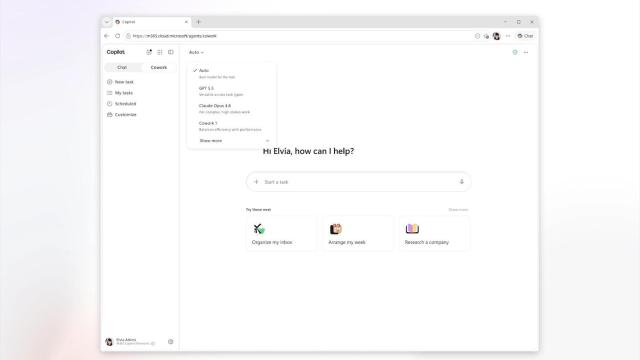
Microsoft announced on June 18 that it has officially launched the Copilot Co-Work agent system globally.
Copilot Co-Work is designed to handle complex and time-consuming tasks using various tools and provide results. Prior to its official launch, Microsoft operated a three-month preview in its Frontier program. According to the company, more than half of the Fortune 500 companies, including Accenture, Avanade, and Capital Group, are currently using Copilot Co-Work.
The company describes Copilot Co-Work as a system that effectively completes complex and lengthy tasks. Key features include cloud-hosted execution, work IQ-based contextual integration, enterprise-grade security and compliance, multi-model design, and cost efficiency based on usage.
Copilot Co-Work is designed to operate without saving files locally, allowing tasks to continue even if the device is powered off. Security and compliance are based on enterprise environments, supporting adherence to existing organizational policies and controls within Microsoft 365. Users can select and execute the models needed for their tasks through the multi-model design.
The company also highlighted cost efficiency based on usage as a distinguishing feature. It has achieved cost competitiveness through efficient runtime for finding appropriate information and tools, selecting suitable models for each task, and a billing structure that reflects actual usage. Internal testing showed that costs per prompt were 30-40% lower compared to cloud co-work using Microsoft 365 connectors.
The billing method for Copilot Co-Work operates on a usage basis with Copilot credits. The price for each task is determined by four factors: model usage, contextual search, tool invocation, and runtime. A Microsoft 365 Copilot subscription license (USL) is also required, which includes Copilot for Chat, Word, Excel, PowerPoint, Outlook, Teams, work IQ, multi-model systems, pre-built agents like researchers and analysts, and custom agents based on agent builders.
Microsoft has categorized task types into three levels: lightweight, medium, and high difficulty, based on data from the Frontier program. Lightweight tasks use a limited number of knowledge sources and apply restricted reasoning, generating fewer than one output. Medium tasks perform structured reasoning based on multiple sources and generate two or more outputs. High-difficulty tasks synthesize extensive information and produce numerous outputs through in-depth reasoning.
Currently, Copilot Co-Work operates based on Anthropic's Opus 4.8 and Sonnet 4.6 models. In the Frontier environment, GPT 5.5 is also available. The company plans to add a cost-effective fine-tuning model, Co-Work 1, soon.
Microsoft has observed that the approach to AI in the workplace is expanding from simple question-and-answer interactions to delegating tasks. While individual and organizational AI experiences have focused on users asking questions and receiving answers, it is now moving into a phase where agents not only provide answers but also execute tasks directly.
Charles Lamanna, Microsoft’s Executive Vice President of Copilot, Agents, and Platform, stated, "Copilot Co-Work is the fastest-growing feature in the Frontier program. Microsoft has improved quality based on learnings from operations and customer feedback, adding model selection capabilities, plugin extensibility, and cost management features."
* This article has been translated by AI.
Copyright ⓒ Aju Press All rights reserved.