

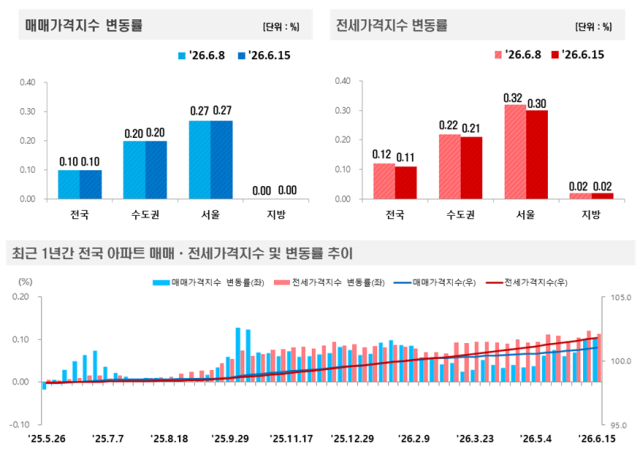
Apartment prices in Seoul have increased by 0.27% for three consecutive weeks, while the new city of Dongtan in Hwaseong has seen a significant surge of over 2%. In contrast, regional markets are showing stability, highlighting ongoing polarization across different areas.
On June 18, the Korea Real Estate Agency released its weekly report on apartment prices nationwide for the week ending June 15. The national average apartment sale price rose by 0.10% compared to the previous week, while lease prices increased by 0.11%.
In Seoul, the apartment sale price maintained a steady increase of 0.27%. Although some complexes are experiencing a wait-and-see approach, demand remains strong in areas near transit stations, large complexes, and redevelopment projects, contributing to continued upward transactions. The agency noted that the lease market is also seeing price increases in preferred locations.
In the northern districts, Seongbuk-gu recorded the highest increase at 0.40%, driven by small and medium-sized complexes in Jongam and Gilim-dong. This was followed by Dobong-gu (0.38%), Eunpyeong-gu (0.37%), Dongdaemun-gu (0.35%), and Gangbuk-gu (0.33%).
In the southern districts, Guro-gu saw a notable rise of 0.39%, particularly in complexes near the Guro and Gaebong stations. Other areas like Gangseo-gu (0.32%), Gangnam-gu (0.31%), Songpa-gu (0.28%), and Yeongdeungpo-gu (0.26%) also continued their upward trends. Notably, prices in Gangnam-gu increased primarily in redevelopment areas such as Apgujeong and Yeoksam-dong.
In Gyeonggi Province, the increase expanded from 0.20% to 0.21%. The most significant rise was observed in Hwaseong's Dongtan, which surged by 2.22%, marking the highest increase nationwide. Prices rose sharply in complexes near Cheonggye-dong and Yeongcheon-dong.
Bundang-gu in Seongnam (0.49%) and Jungwon-gu (0.46%) also showed notable increases. Conversely, Gwacheon (-0.30%) and Hwaseong's Manseong-gu (-0.11%) experienced declines.
In Incheon, prices rose by 0.04%, with increases in Yeonsu-gu (0.12%), Bupyeong-gu (0.09%), and Michuhol-gu (0.07%), while Jung-gu (-0.04%) and Seo-gu (-0.01%) saw decreases.
In regional markets, apartment sale prices remained stable at 0.00%. The five major metropolitan cities experienced a slight decline of 0.01%. Gwangju saw a drop of 0.09%, continuing its downward trend, while Daegu fell by 0.02%. In contrast, Ulsan recorded a rise of 0.11%.
Sejong City rebounded from a previous decline of -0.21% to a slight increase of 0.02%. Among the eight provinces, Jeonbuk (0.07%) recorded the highest increase, led by rises in Wansan-gu (0.20%) and Deokjin-gu (0.15%). However, Jeju (-0.05%), Chungnam (-0.03%), Gyeongbuk (-0.02%), and Gangwon (-0.01%) saw declines.
Nationally, apartment lease prices rose by 0.11%. The metropolitan area saw an increase of 0.21%, while regional areas rose by 0.02%.
In Seoul, lease prices increased slightly from 0.32% to 0.30%, maintaining a high level. Demand for leases continues in preferred areas such as school districts, transit zones, and large complexes, leading to ongoing upward contracts.
Seongdong-gu (0.53%) recorded the largest increase, followed by Songpa-gu (0.50%), Seongbuk-gu (0.43%), Nowon-gu (0.42%), and Dongdaemun-gu (0.37%).
In Gyeonggi Province, Dongtan in Hwaseong saw the highest increase at 0.87%. Gwangmyeong (0.49%) and Seongnam's Sujeong-gu (0.41%) also showed strong performance.
In regional areas, Sejong City increased by 0.11%, expanding from the previous week's 0.06%. Jeonbuk recorded a rise of 0.06%, the highest among the eight provinces.
Nam Hyuk-woo, a researcher at Woori Bank's Real Estate Research Lab, stated, "Expectations for a recovery in the semiconductor industry are driving strong price increases in the southern Gyeonggi area centered around Dongtan. The demand for upgrading due to rising prices in Dongtan is spreading to Bundang and Suwon's Yeongtong-gu, contributing to the upward trend."
He added, "The housing demand from semiconductor industry workers is flowing into adjacent areas such as Yongin's Giheung and Hwaseong's Byeongjeom, causing a ripple effect of price increases throughout southern Gyeonggi."
* This article has been translated by AI.
Copyright ⓒ Aju Press All rights reserved.