

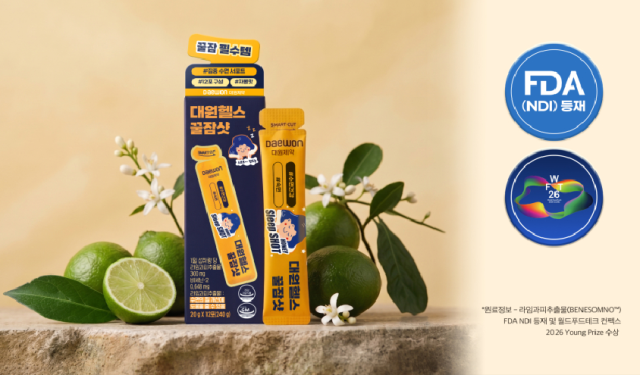
Daewon Pharmaceutical's key ingredient for its sleep health supplement, 'Honey Sleep Shot,' has once again been recognized for its technological prowess on the global stage. This ingredient was acknowledged last year by the Ministry of Food and Drug Safety for its potential to improve sleep quality and was also registered as a new dietary ingredient (NDI) by the U.S. Food and Drug Administration (FDA).
On June 18, Daewon Pharmaceutical announced that the main ingredient, lime peel extract, received the Young Prize at the World Food Tech Conflux 2026, a global food technology event.
The extract was developed by Nutraight, a startup founded by faculty from Pukyong National University, which was recognized for its sleep improvement technology and commercialization potential during the event held from June 9 to 12 at KINTEX in Goyang, South Korea.
Now in its fifth year, the World Food Tech Conflux is an international event in the food industry attended by government officials and companies from over 30 countries. The Young Prize is awarded to companies contributing to future industrial development through innovative technologies.
Lime peel extract, derived from lime skin, is based on a mechanism that activates GABA receptors in the brain to stabilize nerves. The company explains that this can help reduce the time it takes to fall asleep and increase total sleep duration.
A Daewon Pharmaceutical representative stated, "Following the individual recognition from the Ministry of Food and Drug Safety and the FDA NDI registration, this international award reaffirms the technological capability and safety of our ingredient. We will continue to offer products that consumers can trust."
Meanwhile, Daewon Pharmaceutical managed to maintain its revenue in the first quarter of this year. The company reported consolidated revenue of 158.1 billion won, a slight increase of 0.1% compared to the same period last year. However, operating profit (4.4 billion won) and net profit (1.9 billion won) saw significant declines of 53.4% and 60.8%, respectively. The operating profit margin also dropped from 5.96% to 2.77%. While revenue remained nearly unchanged, profit margins fell to less than half.
Analysts note that despite the disappointing first-quarter results, there is potential for mid- to long-term recovery. They identify the normalization of subsidiaries, growth in the health supplement business, expansion of the chronic disease portfolio, and the P-CAB new drug and obesity pipeline as key growth drivers. There is also optimism surrounding the P-CAB candidate drug 'DW4421,' which is currently in Phase 3 clinical trials for treating gastroesophageal reflux disease.
* This article has been translated by AI.
Copyright ⓒ Aju Press All rights reserved.