

The South Korean government has effectively ended its nuclear phase-out policy by confirming two new nuclear power plant sites. This shift has renewed interest in nuclear energy stocks as the construction of new large reactors and small modular reactors (SMRs) becomes more tangible.
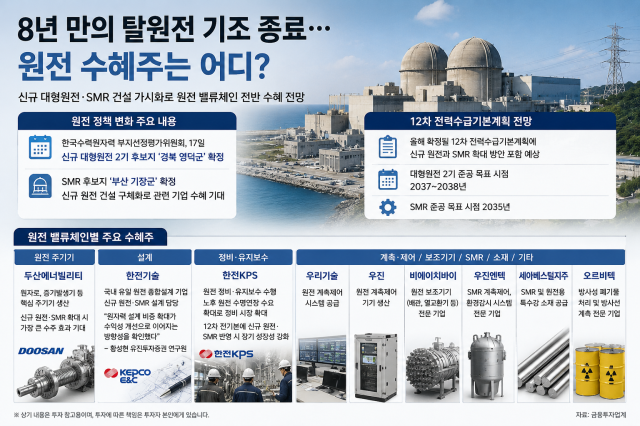
According to financial investment sources on June 18, the Korea Hydro & Nuclear Power Site Selection Evaluation Committee designated Yeongdeok County in North Gyeongsang Province for the two new large reactors and Busan's Gijang County for the SMR. This site selection is expected to lead to increased orders for companies involved in nuclear energy.
Doosan Enerbility is identified as the primary beneficiary of the policy change. As a leading domestic nuclear company that manufactures key components such as reactors and steam generators, Doosan Enerbility stands to gain significantly from the expansion of new reactors and SMRs.
Korea Electric Power Corporation (KEPCO) Technology is also seen as a major beneficiary. As the only comprehensive nuclear design firm in the country, it is responsible for the design of new reactors and SMRs. With ongoing projects like the comprehensive design for the Dukovany Nuclear Power Plant in the Czech Republic and the Shin Hanul Units 3 and 4, additional nuclear construction could yield direct benefits.
Hwang Seong-hyun, a researcher at Eugene Investment & Securities, noted, "The increased share of nuclear design is expected to lead to improved profitability."
KEPCO KPS, which handles maintenance and repair for nuclear plants, is also mentioned as a beneficiary. As the demand for new nuclear construction and the lifespan extension of aging reactors grows, the maintenance market is expected to expand. Kiwoom Securities researcher Jo Jae-won stated, "With the operation of Gori Unit 2 and Shin Ulju Units 3 and 4 this year, the revenue base for nuclear energy is expected to grow, and nuclear energy will drive overall revenue growth."
Other companies mentioned as beneficiaries include Woori Technology and Woojin, which supply nuclear measurement and control systems, BHI, a supplier of auxiliary nuclear equipment, and SMR-related firms such as Woojin Entech and SeAH Steel Holdings, as well as OrbiTech, which handles radioactive waste disposal. As the government's SMR initiative gains momentum, the benefits for companies supplying related materials and equipment are expected to increase.
The government is expected to include plans for expanding new reactors and SMRs in the 12th Basic Plan for Power Supply and Demand, which will be finalized this year. However, the completion target for the two large reactors is set for 2037-2038, while the SMR is scheduled for 2035, indicating that it may take considerable time before actual orders translate into results.
* This article has been translated by AI.
Copyright ⓒ Aju Press All rights reserved.