

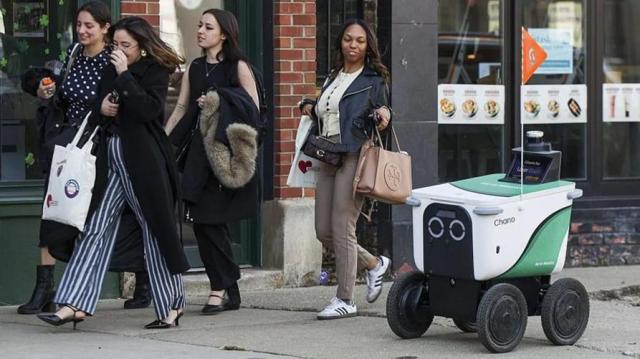
As autonomous delivery robots rapidly spread across cities worldwide, concerns about pedestrian safety and job loss are growing, according to a recent BBC report.
The BBC notes that in cities like Chicago, as well as in the UK, Japan, South Korea, and Germany, autonomous delivery robots are becoming a common sight for grocery and food deliveries. These robots, which navigate using cameras, sensors, and GPS, are seen as a futuristic logistics solution that could reduce traffic congestion and carbon emissions.
However, public reactions are mixed. Chicago resident John Roberts told the BBC, "At first, the futuristic appearance was impressive," but he changed his mind after having to step aside on the sidewalk to avoid a robot while walking with his family. He expressed concern, saying, "It felt a bit strange. The sidewalk is supposed to be for people, yet we were the ones who had to move aside. If dozens of robots equipped with cameras and lights start roaming the streets, family walks will be completely different."
In fact, regulatory movements are emerging in some areas of the U.S. and Canada. According to the BBC, San Francisco has limited robot operations to less congested areas, while Toronto has banned robot use on sidewalks since 2021.
Chicago has also prohibited robot operations in certain areas. Roberts has initiated an online petition calling for a halt to delivery robot operations citywide until safety validations and clear operational regulations are established, with over 4,400 supporters joining him. He stated, "People are having to step onto the road to avoid robots, and there have been reports of collisions and injuries, as well as incidents where robots unpredictably disrupt traffic flow or hinder emergency vehicles."
Similar concerns are being raised in Glendale, California. City Council member Ardy Kassakhian told the BBC, "One day, robots appeared out of nowhere, and initially, we didn't even know which company was operating them. Various concerns have been raised regarding pedestrian rights, accessibility, and the impact on the labor market." He emphasized the need for a clear regulatory framework that includes operational rules, insurance requirements, accessibility standards, and permitting processes.
On the other hand, the industry argues that these concerns may be overstated. Danny Pass, head of European operations for Starship Technologies, which operates delivery robots in the UK, told the BBC, "People are just not used to sharing the sidewalk with robots. These robots are designed to be friendly, polite, and safe."
Concerns about job losses for delivery workers are also being raised. Alex Marshall, representative of the Independent Workers' Union of Great Britain (IWGB), warned that widespread adoption of this technology could threaten the livelihoods of many precarious workers, stating, "We will have no choice but to pressure the government and local authorities to impose bans."
Despite these concerns, market outlook remains positive. The BBC cites a report from market research firm Transforma Insights, predicting that approximately 2.1 million autonomous delivery robots will be in operation worldwide by 2034.
Currently, regulatory levels vary by country, but South Korea and Japan are classified as relatively proactive in easing regulations.
* This article has been translated by AI.
Copyright ⓒ Aju Press All rights reserved.