

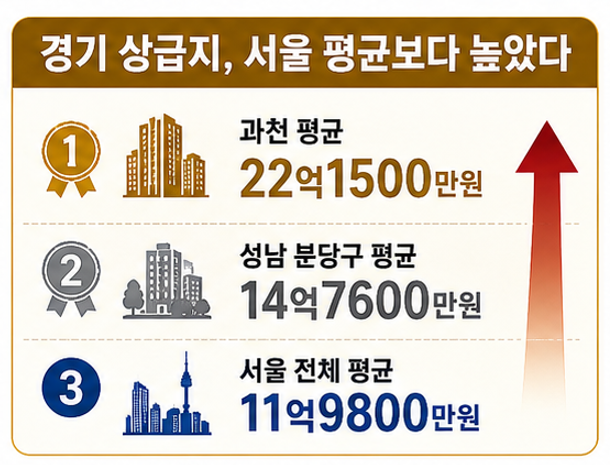
The apartment market in the Seoul metropolitan area is seeing a significant rise in the prominence of key areas in Gyeonggi Province. Traditional high-end regions like Gwacheon and Bundang have established price levels that exceed the average in Seoul, while areas such as Dongtan, Anyang Dong-an, Yongin Suji, and Gwangmyeong are now experiencing faster price increases than Seoul. The hierarchy of housing prices in the metropolitan area is shifting away from a simple "Seoul versus Gyeonggi" dynamic to a focus on key living zones and major complexes.
An analysis of real transaction data from the Ministry of Land, Infrastructure and Transport on June 18 revealed that, over the past year (from June 19, 2025, to June 18, 2026), Gwacheon recorded the highest average sale price in Gyeonggi Province at 2.215 billion won, significantly surpassing Seoul's average of 1.198 billion won during the same period. Bundang in Seongnam, including the Pangyo area, also had an average price of 1.476 billion won, higher than Seoul's average.
Some regions in Gyeonggi Province have outpaced Seoul in terms of price growth this year. According to the Korea Real Estate Agency, the cumulative increase in the apartment sales price index in Seoul is 4.50% for the year, while Gyeonggi Province as a whole saw a 2.48% increase. However, Dongtan in Hwaseong recorded a remarkable 9.57% increase, the highest in the nation. Other areas such as Anyang Dong-an (9.30%), Yongin Suji (9.03%), and Gwangmyeong (8.69%) also significantly exceeded Seoul's average. Bundang in Seongnam saw a 7.40% increase.
Individual complexes are also showing competitive transactions compared to major complexes in Seoul. A recent sale of an 84-square-meter unit at the Dongtan Lotte Castle near the station reached the 2.2 billion won mark, setting a new record. In contrast, a similar unit at the Cheongnyangni Lotte Castle SKY-L65 in Dongdaemun, Seoul, sold for just over 2 billion won. This illustrates how factors such as regional transportation, business districts, the scarcity of new constructions, and living infrastructure are influencing prices more than the administrative boundaries of Seoul.
The reasons for price increases vary by region. Dongtan's rapid price rise is attributed to demand from the semiconductor industry and the impact of the opening of the GTX-A line. In Anyang Dong-an and Bundang, expectations for the redevelopment of first-generation new towns are driving prices up, while Yongin Suji benefits from accessibility to Gangnam and the Shinbundang Line. Gwangmyeong's location near Seoul and expectations for redevelopment projects are also supporting its price growth.
However, not all of Gyeonggi Province has caught up to Seoul. Over the past year, the average sale price of apartments in Seoul was 1.198 billion won, which is 620 million won higher than Gyeonggi Province's average of 596 million won. The median price also reflects a significant gap, with Seoul at 960 million won compared to Gyeonggi's 527 million won, a difference of 433 million won. The disparity remains substantial in the popular 84-square-meter category, where the average sale price in Seoul is 1.308 billion won, while Gyeonggi's average is 644 million won. The median prices also show a gap of over 500 million won, indicating that the entry barrier to the Seoul market remains high.
Ultimately, the real estate market in the metropolitan area is increasingly defined by key living zones rather than administrative boundaries. While Gyeonggi Province leads in transaction volume, overall average prices and those for popular apartment sizes remain higher in Seoul. In contrast, regions like Gwacheon, Bundang, Pangyo, and Dongtan have established price levels that exceed the average in Seoul or surpass mid-tier complexes in the city.
A real estate agent in Gyeonggi Province noted, "While the overall average in Gyeonggi shows a significant gap with Seoul, areas like Gwacheon, Bundang, and Pangyo have already formed price levels that exceed Seoul's average. Recently, regions like Dongtan, which combine job opportunities, extensive transportation, and the scarcity of new constructions, are moving faster than mid-tier complexes in Seoul."
* This article has been translated by AI.
Copyright ⓒ Aju Press All rights reserved.