

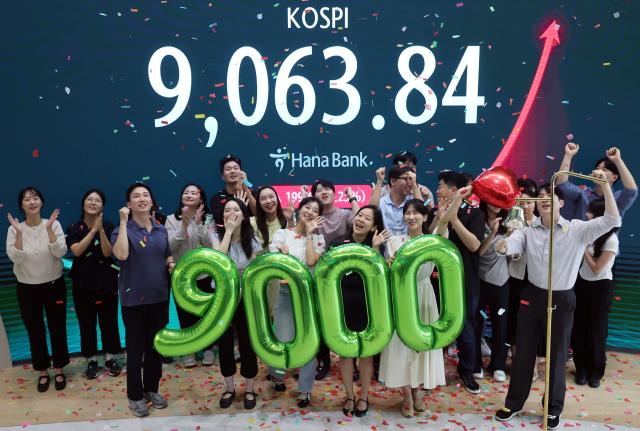
On June 18, the stock market displayed contrasting trends. While the KOSPI celebrated the dawn of the "9,000 era," the KOSDAQ fell below 1,000 at one point, highlighting a stark divergence. Market observers are keenly watching how upcoming measures to enhance KOSDAQ competitiveness will impact the market.
The KOSPI rose by 2.25%, closing at 9,063.84, while the KOSDAQ index dropped by 31.03 points (3.01%) to finish at 1,000.93. The KOSDAQ started the day down 2.15 points (0.21%) at 1,029.81 but widened its losses, dipping to as low as 996.93 during trading. Foreign and institutional investors sold a net 199 billion won and 265.7 billion won worth of shares, respectively, contributing to the index's decline.
Most of the top stocks in the KOSDAQ market ended lower. Notable declines included EcoProBM (-4.33%), EcoPro (-4.32%), Samchundang Pharm (-4.34%), ABL Bio (-6.74%), Kolon TissueGene (-5.58%), JUSUNG Engineering (-3.41%), and Rino Technology (-2.64%).
The KOSDAQ index has struggled in recent weeks. After surpassing the 1,200 mark for the first time in about 26 years on April 24, reaching a peak of 1,226.18 on April 27, it has since turned downward, remaining in the 900s for four trading days this month, indicating increased volatility.
However, there remains optimism in the securities industry regarding policies aimed at revitalizing the KOSDAQ. One key initiative is the KOSDAQ uplift system, which aims to categorize the unified market into premium, standard, and management tiers, encouraging companies to enhance their value to move up the ranks and improve overall market competitiveness. The Korea Exchange established a "KOSDAQ Segment Advisory Group" on June 16 to kick off discussions on implementing this system.
Expectations are also rising for benefits from the National Growth Fund's direct investments in the KOSDAQ market and a strengthened focus on eliminating underperforming companies. Kwon Myung-jun, a researcher at Yuanta Securities, noted, "With the first phase of the public participation National Growth Fund fully sold out, the second phase is set for September, suggesting that direct investments will commence in the second half of the year. If delistings of low-performing stocks are pursued after July, we can expect a significant improvement in the KOSDAQ's structure."
* This article has been translated by AI.
Copyright ⓒ Aju Press All rights reserved.