

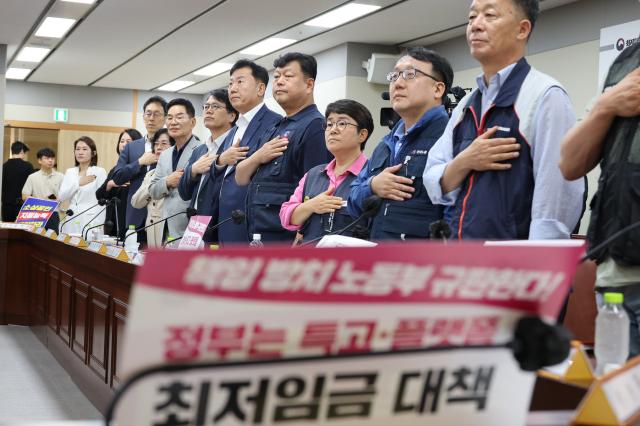
The Minimum Wage Commission held a heated debate on the application of differential minimum wage rates by industry during its meeting on June 18. Labor representatives argued that blaming the minimum wage for the struggles of self-employed individuals and small businesses is a justification for discrimination. In contrast, business representatives contended that considering the low wage rates and payment capabilities in vulnerable sectors, this issue can no longer be postponed.
During the meeting, Ryu Gi-seop, Secretary General of the Korean Confederation of Trade Unions, expressed his dismay, stating, "When discussions on differential application by industry begin, it turns into a recurring conflict between the disadvantaged parties. The fact that the difficulties faced by business owners in PC rooms, convenience stores, and the food and accommodation sectors are attributed to minimum wage issues reflects a tragic aspect of our society."
He further asserted, "The root causes of the crisis in self-employment are not the minimum wage, but structural issues such as high fees from platform companies, cost shifting from franchise headquarters, excessive rent, and declining commercial districts. It is a distorted structure that shifts the burden of costs onto the minimum wage to maintain their profit margins under the guise of differential application."
Similarly, Lee Mi-sun, Vice Chair of the Korean Trade Union Confederation, criticized the renewed discussions on differential application, saying, "The original intent of the Minimum Wage Act is being seriously undermined again. The essence of differential application is to freeze or reduce the minimum wage, deepening discrimination and inequality."
In response to claims that lower minimum wages should apply to sectors with a high proportion of foreign workers, she argued, "In an era with a million migrant workers contributing to our economy, it is discriminatory and dismissive to prioritize maximizing profits for large capital while ignoring these individuals. A survey of small businesses in 2024 indicated that the top desired policy is financial support, and the primary management challenge is intensified competition within the same industry. There is no evidence that the minimum wage is the main reason hindering management."
On the other hand, business representatives defended the differential application as a realistic measure to ensure the sustainability of the minimum wage system. Ryu Gi-jeong, Executive Director of the Korea Employers Federation, stated, "Employer representatives believe that the implementation of this system can no longer be delayed. It is time to apply it gradually in line with reality. In 21 OECD countries, minimum wages are differentiated based on various criteria such as industry, age, and region."
He added, "Differential application is not an exceptional case but a globally utilized method to enhance the acceptability of the system according to labor market conditions. The rate of non-compliance with minimum wage in the accommodation and food service sector has risen from about 6% in the early 2000s to over 30%, indicating that the current situation has reached a critical point."
Yang Ok-seok, Head of the Workforce Policy Division at the Korea Federation of Small and Medium Businesses, noted, "Statistics show that non-compliance rates are significantly higher in vulnerable sectors like accommodation and food service. Small business owners in these sectors face a situation where they cannot comply with the law even if they want to."
He also stated, "Differential application is a necessary institutional adjustment to mitigate the adverse effects of rapidly rising minimum wages and to protect jobs in small businesses. We must restore the acceptability of the minimum wage system by applying it differentially, even in vulnerable sectors."
Public interest committee members indicated their intention to derive conclusions based on the arguments from both labor and management. Sung Jae-min, a public interest committee member, said, "Today marks the second discussion on differential application by industry. With presentations from the employer representatives scheduled, this will be an opportunity to systematically review the issues raised and the evidence provided thus far."
He added, "We hope that the committee members will listen with an open mind and that through focused discussions, we can reach a conclusion that incorporates the presented content and accumulated discussions."
* This article has been translated by AI.
Copyright ⓒ Aju Press All rights reserved.