

Artificial intelligence (AI) is transforming the drug development landscape. The time required to identify candidate substances, which previously took years, has been reduced to just a few months. The application of AI is expanding from preclinical to clinical stages, fundamentally changing research and development (R&D) methodologies.
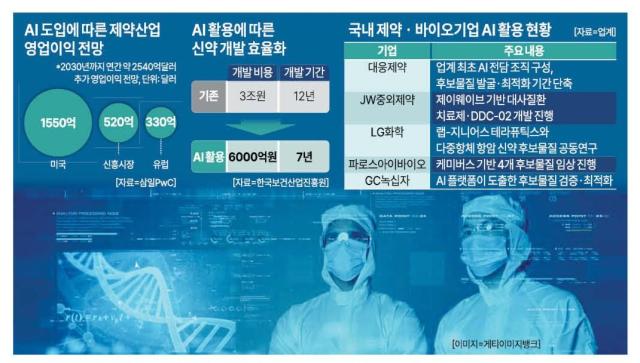
According to industry sources, drug development is known for being a high-risk, high-cost endeavor. It typically takes an average of 10 to 15 years and involves substantial financial investment, yet the clinical failure rate is as high as 90%. The Korea Health Industry Development Institute estimates that utilizing AI could reduce drug development costs from 3 trillion won to 600 billion won and shorten the development timeline from 12 years to 7 years.
The industry's interest in AI goes beyond merely accelerating research. A significant portion of drug development costs is incurred during late-stage clinical trials, making it crucial to identify candidate substances with a higher likelihood of success early in the process and to minimize trial and error. Jeong Yoon-taek, head of the Pharmaceutical Industry Strategy Research Institute, stated, "The era of 'ultra-fast digitalization' has arrived in the pharmaceutical industry, where the time for candidate substance discovery has been reduced from 2 to 3 years to less than 2 months using AI systems."
Domestic pharmaceutical companies are also actively integrating AI into their operations. Daewoong Pharmaceutical has established the industry's first dedicated AI team to conduct research in obesity, diabetes, and oncology. The company reports that its proprietary AI system has reduced the time from candidate substance discovery to optimization to about 2 months. In oncology, the process from active substance discovery to securing lead compounds for patent applications has taken just 6 months, a significant reduction from the previous 1 to 2 years.
JW Pharmaceutical is expanding its pipeline with its AI-based drug development platform, J-Wave. Research on candidate substances for metabolic disease treatments discovered through AI has been selected as a project for the 2025 National New Drug Development Program. The oral low-molecular-weight drug candidate, DDC-02, is also being developed with the goal of entering global multi-national clinical trials by 2028.
LG Chem is accelerating its antibody drug development using AI. On June 18, the company signed a joint research and licensing option agreement with the UK-based AI drug development firm Lab-Genius Therapeutics to discover multi-antibody cancer drug candidates. The goal is to cut the candidate substance discovery period from over 5 years to half that time and to expedite the entry into preclinical stages.
While AI drug development is rapidly gaining traction, experts note that it is still in the stage of proving its effectiveness. There have been limited instances of candidate substances discovered or designed through AI entering clinical trial phases.
Globally, efforts are underway to demonstrate the tangible results of AI in drug development. Insilico Medicine became the first in the industry to publish clinical proof-of-concept results for AI-based drug development in the prestigious journal Nature Medicine last year. The company reported safety and efficacy results from a Phase 2 clinical trial of candidate substances developed using its Pharma.AI platform, stating that the candidate selection process was shortened to an average of 13 months (with a minimum of 9 months) per project.
Domestic companies are expanding the use of AI from candidate substance exploration to preclinical and clinical stages. Pharos I-Bio is conducting clinical trials on four candidate substances using its AI drug development platform, Chemiverse. Among these, a candidate for treating acute myeloid leukemia is nearing entry into global Phase 2 trials.
GC Green Cross has recently been selected as a key research institution for the 'AI-Medicine New Drug Development Full-Cycle Multi-Agent AI Platform Construction and Demonstration' project, promoted by the Ministry of Science and ICT. This initiative aims to establish a system where large language model (LLM)-based AI agents collaborate to perform tasks from target discovery to preclinical candidate substance derivation. GC Green Cross will be responsible for validating and optimizing candidate substances derived from the AI platform through actual experiments.
The industry believes that AI is not only speeding up drug development but also fundamentally changing R&D methodologies. As global pharmaceutical companies establish systems for Phase 2 and 3 clinical trials, domestic firms are seizing opportunities to narrow the technological gap by securing their own platforms and pipelines.
An industry insider remarked, "AI is evolving from a mere tool for reducing research time to one that enhances the probability of success in drug development. In the future, how effectively companies integrate AI into their R&D processes will determine their competitive edge."
* This article has been translated by AI.
Copyright ⓒ Aju Press All rights reserved.