

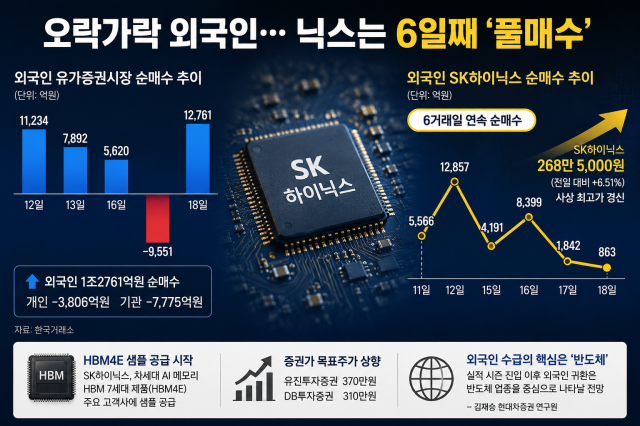
Despite fluctuations in foreign investment, SK Hynix has seen a steady influx of buying interest. Analysts suggest that the recent flow of foreign capital is centered around the semiconductor sector, indicating that SK Hynix could serve as a barometer for future foreign investment trends.
On June 18, the Korea Exchange reported that foreign investors purchased a net 1.2761 trillion won ($1.1 billion) in the stock market. Meanwhile, individual and institutional investors sold a net 380.6 billion won and 777.5 billion won, respectively, as they sought to realize profits. Foreign investors had previously engaged in net buying for three consecutive trading days from June 12 to June 16 but shifted to net selling on June 17, offloading 955.1 billion won.
Amid these short-term fluctuations, the buying momentum for SK Hynix remains noteworthy. On June 18, foreign investors bought a net 86.3 billion won worth of SK Hynix shares. This follows a series of net purchases starting from June 11, when they bought 556.6 billion won, followed by 1.2857 trillion won on June 12, 419.1 billion won on June 15, 839.9 billion won on June 16, and 184.2 billion won on June 17, marking six consecutive days of net buying.
The stock price has responded positively, with SK Hynix closing at 2,685,000 won, up 164,000 won (6.51%) from the previous trading day, setting another all-time high.
The strong performance is attributed to expectations surrounding next-generation AI memory capabilities. On June 18, SK Hynix announced it had begun supplying samples of its seventh-generation high-bandwidth memory (HBM4E) to major clients.
The previous day, the stock also reached a record high due to rising expectations for AI semiconductor demand and the anticipated listing of American Depositary Receipts (ADRs). Analysts have been raising their target prices, with Eugene Investment & Securities adjusting its target to 3.7 million won, citing positive assessments of the ADR listing and dividend expansion. DB Investment & Securities also raised its target price to 3.1 million won.
Analysts believe that the recent changes in foreign investment are primarily focused on the semiconductor sector. As foreign trading has been concentrated on major semiconductor stocks like Samsung Electronics and SK Hynix, the semiconductor industry is expected to be a key indicator for future foreign capital flows.
Kim Jae-seung, a researcher at Hyundai Motor Securities, stated, "As major macro events in June conclude and we enter the earnings season in July, if positive results continue, foreign investment will likely return, particularly in the semiconductor sector."
* This article has been translated by AI.
Copyright ⓒ Aju Press All rights reserved.