

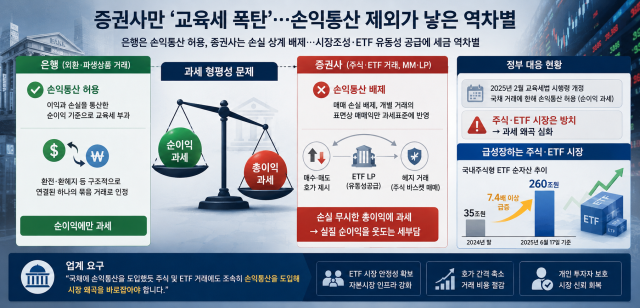
This year, the securities industry has been hit particularly hard by a surge in education taxes, raising concerns about the fairness of tax standards across financial sectors. While banks are classified under the same financial and insurance category, securities firms are not allowed to offset losses against profits from stock and exchange-traded fund (ETF) liquidity provision transactions, unlike banks' foreign exchange and derivatives trades.
Under current education tax laws, banks are taxed on net profits that account for both gains and losses from foreign exchange and derivatives trading. The government recognizes these transactions as interconnected, allowing for a comprehensive profit and loss calculation.
In contrast, securities firms' core activities involving stocks and collective investment securities (such as ETFs) are excluded from this profit and loss offsetting. Only the apparent gains from individual transactions are considered for tax purposes, while losses are entirely disregarded. Additionally, insurance companies, which also face the highest education tax rates, typically engage in long-term investments that do not fluctuate significantly, thus avoiding the tax burden that has disproportionately affected securities firms.
Industry complaints have intensified as the nature of market-making (MM) and ETF liquidity provider (LP) transactions conducted by securities firms differs fundamentally from typical trading aimed at capitalizing on price differences. These firms are required to submit both buy and sell quotes to enhance market liquidity. Particularly, ETF LPs must engage in hedging transactions that involve buying and selling baskets of underlying stocks alongside ETF trades to stabilize prices. As market volatility increases, the frequency of these hedging transactions rises exponentially, inflating the apparent trading volume (profits) without reflecting the actual net profits.
From an economic standpoint, these transactions are similar to banks' foreign exchange and derivatives trades, with the net profit being the true indicator of earnings, according to industry consensus. However, current tax laws treat these transactions the same as pure investments in securities, preventing loss offsetting. Consequently, while banks are taxed solely on net profits, securities firms face a tax burden based on total profits, ignoring losses, leading to a discriminatory tax structure.
The government has acknowledged these systemic limitations and proposed some measures. In February, the Ministry of Economy and Finance amended the education tax enforcement decree to allow profit offsetting for net profits from government bond transactions. This preemptive measure aimed to prevent a decline in securities firms' government bond trading ahead of their inclusion in the World Government Bond Index (WGBI).
However, critics argue that the government has focused solely on stabilizing the government bond market while neglecting the stock and ETF markets. Recently, the domestic stock market has experienced significant growth and volatility, coinciding with a rapid expansion in the ETF market. The liquidity provision transactions by MM and LP firms have surged dramatically, with the net assets of domestic equity ETFs skyrocketing from 35 trillion won at the end of 2024 to 260 trillion won as of June 17, representing an increase of over 7.4 times. This growing role in liquidity provision has exacerbated the gap between the tax standards based on apparent trading profits and actual net profits. Furthermore, the introduction of a new 1% maximum education tax rate this year has resulted in securities firms facing tax burdens that exceed their actual net profits.
An industry representative stated, "If the excessive education tax burden on LP transactions supporting ETF market stability continues, it could weaken the entire capital market infrastructure. This will ultimately lead to wider bid-ask spreads, increasing transaction costs and negatively impacting individual investors. Just as profit offsetting was introduced for government bonds, it is crucial to implement it for stock and ETF transactions promptly to correct market distortions."
* This article has been translated by AI.
Copyright ⓒ Aju Press All rights reserved.