

As the Bank of Korea prepares for a rate hike in July, market attention is shifting from the "first hike" to the broader "hike cycle." With inflationary pressures from rising oil prices in the Middle East expected to persist longer than anticipated and a clearer economic recovery, speculation is growing that the Bank of Korea is entering a tightening phase.
According to the Bank of Korea on June 18, minutes from the May Monetary Policy Committee meeting revealed that not only the two members who voted for a rate hike but also those who favored keeping rates steady expressed common concerns about upward inflation risks. This has led to market assessments that internal discussions within the committee have shifted from "whether to hike" to "when to hike."
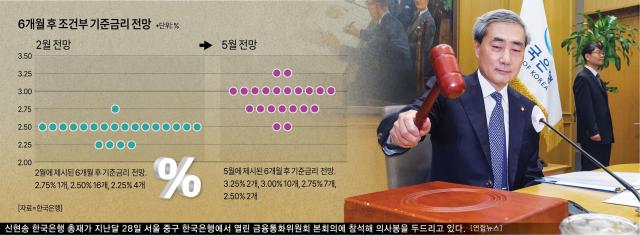
The changing sentiment within the committee is also reflected in the dot plot. In the projections released in May, 19 out of 21 members indicated expectations for a rate above the current 2.50%. Ten members projected a rate of 3.00%, while seven anticipated 2.75%, suggesting that a majority foresee further rate hikes beyond July.
The Bank of Korea is increasingly vigilant regarding inflation. Governor Rhee Chang-yong stated at a recent briefing on inflation target management that "inflation pressures are expected to exceed target levels for a considerable period." While government measures to stabilize prices may alleviate some upward pressure, the Bank of Korea believes that the impact of supply shocks is broadening and demand-side inflation pressures are also increasing.
Committee members advocating for a rate hike expressed concerns that both growth and inflation pressures are expanding simultaneously, raising the possibility of secondary effects through expected inflation and wage increases. They argued for a 0.25 percentage point increase in the benchmark rate to proactively address inflation concerns.
Members who favored keeping rates steady did not significantly differ in their inflation concerns. They assessed that the impacts of high oil prices and exchange rates could spread to core inflation and service prices, potentially leading to inflation rates significantly above target levels until the first quarter of next year.
The market views this rate hike as the beginning of a new tightening phase rather than a one-off measure. In the past, economic slowdown was the primary constraint on monetary policy, but recent upward revisions in growth forecasts, strong semiconductor exports, and a bullish stock market have shifted the focus from growth to inflation as the key variable in policy decisions.
The simultaneous tightening moves by global central banks also alleviate some pressure for additional hikes by the Bank of Korea. Following the European Central Bank and the Bank of Japan, the U.S. Federal Reserve has also indicated the possibility of rate hikes, signaling a shift toward tightening across major economies.
On the same day, Deputy Prime Minister and Minister of Economy and Finance Koo Yun-cheol chaired a joint macroeconomic and financial meeting at the government complex in Seoul, stating, "U.S. monetary policy may proceed in a more tightening direction in the future," and announced the activation of an integrated risk monitoring system covering stock, bond, foreign exchange, and real estate markets.
The market is paying close attention to the possibility of both the U.S. and South Korea entering a tightening phase simultaneously. Park Jun-woo, a researcher at Hana Securities, noted, "With inflation consistently exceeding target levels and unemployment forecasts being revised downward, employment risks have significantly eased," adding that hawkish sentiment within the Federal Open Market Committee suggests a high likelihood of a rate hike in December.
He further stated, "Even if oil prices stabilize, concerns about secondary effects through wages and service prices may increase in the second half of the year," warning that if inflation pressures persist longer than expected, both the Fed and the Bank of Korea will have no choice but to maintain a hawkish stance.
* This article has been translated by AI.
Copyright ⓒ Aju Press All rights reserved.