

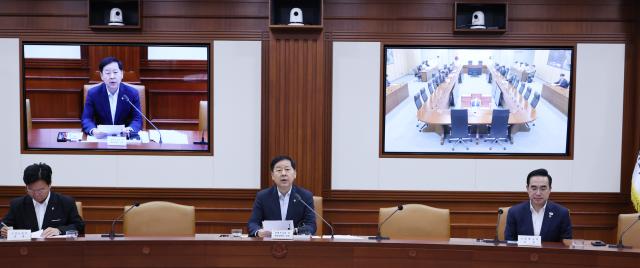
During the 270th Foreign Economic Ministers' meeting held at the Government Complex in Seoul on June 19, Gu remarked, "The recent agreement between the U.S. and Iran marks both a challenge and an opportunity for our economy. We aim to create long-term opportunities that enhance our economic security and supply chain resilience."
To capitalize on the cooperation demands arising from the reconstruction and economic restructuring in Middle Eastern countries, the government plans to establish a comprehensive response system. A task force for Middle East infrastructure cooperation, led by the Deputy Minister of Finance, will be launched to identify key projects and strengthen government-to-government collaboration through high-level local dispatches.
The government also aims to bolster its economic security framework. In the second half of the year, it will pilot an early warning system for supply chains and reform the management system for economic security items. Additionally, tailored economic cooperation strategies for each country will be developed to secure growth momentum linked to diplomatic achievements.
Gu stressed the importance of combining regional strengths with South Korea's manufacturing and technological capabilities to secure new growth drivers amid a changing international order.
Efforts to expand trade networks for market diversification will also accelerate. The government plans to resume negotiations for a Comprehensive Economic Partnership Agreement (CEPA) with Mongolia and advance follow-up negotiations on the Korea-China Free Trade Agreement (FTA) regarding services and investments. Trade cooperation with emerging markets, including Morocco, will also be expanded.
Gu stated, "We will establish a complementary economic cooperation platform that connects Mongolia's resources with our technology and industrial capabilities, while promoting mutually beneficial market openings with China, including K-content cooperation."
In response to the recent findings of the U.S. Trade Act Section 301 investigation concerning forced labor, the government will activate a comprehensive response system. It aims to maintain the balance of interests agreed upon between South Korea and the U.S. while ensuring that South Korean companies do not face unfavorable outcomes compared to major competitors.
Gu affirmed, "We will work closely with relevant ministries to ensure that our companies do not receive less favorable treatment than competitors in relation to the U.S. Section 301 measures."
Furthermore, the government plans to transform the K-knowledge sharing project (KSP), which has provided policy advice to 761 cases in 102 countries over the past 20 years, into a platform for South Korean companies' overseas expansion. New strategic planning projects will be established in four key areas: supply chains, artificial intelligence (AI), green initiatives, and culture, with the aim of ensuring that policy advice leads to actual investments and projects.
Gu concluded, "We will actively support our companies' overseas expansion and the creation of future growth drivers by leveraging the post-Middle East era as a new growth opportunity."
* This article has been translated by AI.
Copyright ⓒ Aju Press All rights reserved.